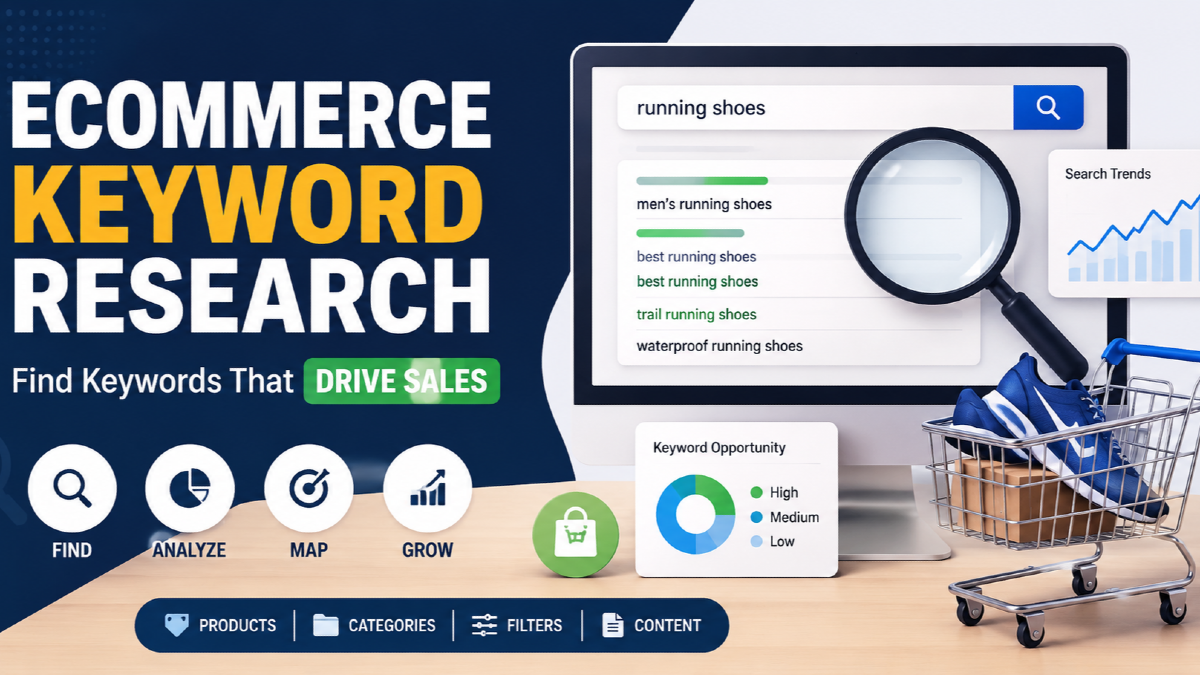
eCommerce Keyword Research: How to Find Keywords That Drive Sales
Updated Aug 22, 2026
27 min read
Vijay Bhabhor
Google Ads & SEO Specialist · Surat, India
17+ Years80+ Countries₹50Cr+ Managed100+ Projects
eCommerce keyword research is not about building the biggest spreadsheet of keywords you can find. It is about understanding how customers search when they discover products, compare alternatives and move closer to buying, then deciding which page on your store should satisfy each type of search.
That distinction matters because an online store has far more possible search landing pages than a normal content website. A query might belong to a category, subcategory, collection, product page, brand page, filter page, comparison guide or educational article. Choosing the right keyword is only half the job. You also need to give that keyword the right page owner.
A useful ecommerce keyword strategy should help answer practical questions such as:
Which products and categories are customers actively searching for?
Which searches show meaningful buying intent?
Which keyword clusters deserve category or collection pages?
Which searches belong on product pages?
Which product attributes could justify dedicated indexable collections?
Which queries require buying guides or comparison content instead of another commercial page?
Which opportunities are commercially valuable enough to prioritize?
Which existing URL should own each keyword cluster?
The strongest ecommerce keyword strategies connect search demand, customer intent, store architecture, inventory and product economics.
That is what turns keyword research into qualified organic traffic and revenue rather than a collection of unrelated blog visits.
If keyword research is part of a wider organic growth project, it should sit inside your overall eCommerce SEO strategy rather than operate as an isolated content exercise.
What Is eCommerce Keyword Research?
eCommerce keyword research is the process of identifying the searches potential customers use throughout the buying journey and deciding which website page should satisfy each search intent.
The important part of that definition is not simply “finding keywords.” It is understanding what the person behind the search expects to see.
Consider three searches:
running shoes
best running shoes for flat feet
Nike Pegasus 42 men's size 10
All three relate to running shoes, but the searcher is not asking for the same thing.
The first query is broad and commercial. A strong running-shoes category may be the appropriate destination.
The second query shows commercial investigation. The user may need recommendations, comparisons and buying guidance before choosing a product.
The third query is much closer to a specific product and variation.
This is why ecommerce SEO cannot be reduced to inserting keywords into product descriptions. The actual job is to match search intent with the correct page type.
Why eCommerce Keyword Research Is Different From Blog Keyword Research
On a content-led website, keyword research often leads to one simple decision: should we create an article for this topic?
An ecommerce website has many more possibilities.
A keyword can potentially belong to:
the homepage;
a main category;
a subcategory;
a collection;
a product page;
a brand page;
a filter or faceted page;
a comparison page;
a buying guide;
an educational article;
an FAQ section.
That makes ecommerce keyword research closely connected to information architecture.
Suppose you operate an online footwear store and discover these searches:
running shoes;
men's running shoes;
trail running shoes;
waterproof trail running shoes;
black trail running shoes;
best trail running shoes;
trail running shoes for beginners;
Nike trail running shoes.
These queries are semantically related, but that does not mean they should all target the same URL.
Some may justify commercial category pages. Others may belong to an attribute-based collection, a brand-category page or a buying guide.
The real objective is therefore:
Find demand, understand intent, group related searches and assign each opportunity to the page that can satisfy it best.
A Practical eCommerce Keyword Research Process
A structured research process prevents you from jumping from keyword discovery straight into content creation.
Step
Question
Output
1
What does the store sell?
Product and category entities
2
How do customers describe those products?
Seed keywords
3
What related searches exist?
Keyword universe
4
What does the searcher actually want?
Search intent
5
What does Google currently rank?
SERP validation
6
Is the keyword commercially useful?
Business priority
7
Which searches belong together?
Keyword clusters
8
Which page should own each cluster?
URL mapping
9
Can the store support the page properly?
Inventory and content validation
10
What should be created or improved first?
SEO roadmap
The final output should be a keyword map, not merely a list of phrases and search volumes.
Step 1: Understand Your Store Before Opening a Keyword Tool
One of the easiest ways to produce weak keyword research is to open a tool before understanding the business.
Start with the catalogue.
Your products already contain most of the entity relationships that will shape your research.
Main Product Categories
For a footwear store, the primary categories might include:
running shoes;
walking shoes;
hiking shoes;
casual shoes;
sandals.
Subcategories
Running shoes could break into:
road running shoes;
trail running shoes;
stability running shoes;
racing shoes.
Product Attributes
Customers may search using attributes such as:
colour;
gender;
size;
material;
fit;
waterproofing;
weight;
cushioning.
Brands
Brand relationships might include Nike, Adidas, ASICS, New Balance and any other brands actually stocked by the store.
Problems the Products Solve
Customers often search from the problem rather than the product category.
For footwear, that could include:
flat feet;
overpronation;
heel pain;
wet trails;
wide feet;
long-distance running.
Use Cases
Search demand may also form around situations such as:
marathons;
gym workouts;
daily running;
walking;
hiking;
office wear;
travel.
Buying Considerations
Customers may refine their search based on:
price;
reviews;
durability;
material;
comfort;
warranty;
shipping;
availability.
By the time you have mapped these relationships, you already have a strong initial entity and keyword universe without touching an SEO tool.
Step 2: Build Seed Keywords From Products and Categories
Seed keywords are broad phrases that describe the products, categories, audiences and problems your store serves.
For a running-shoe retailer, useful seeds could include:
running shoes;
trail running shoes;
walking shoes;
stability shoes;
running shoes for men;
running shoes for women.
Do not worry about exact search volume yet. At this stage, you are trying to make sure the research covers the important ways customers could describe your catalogue.
For each category, expand seeds using several dimensions.
Product
running shoes
Audience
running shoes for women
Problem
running shoes for flat feet
Feature
waterproof running shoes
Use Case
running shoes for marathon
Price
running shoes under ₹5000
Brand
Nike running shoes
Comparison
Nike vs ASICS running shoes
These seeds give you better starting points for deeper research than relying on one broad category phrase.
Step 3: Expand Your Keyword Universe
Do not depend on one keyword tool. Different sources reveal different parts of customer demand.
Google Search
Start with your category or product names and study the suggestions Google surfaces.
Look at autocomplete, related searches, People Also Ask, shopping results, competing pages, product refinements, brands and other modifiers that repeatedly appear.
A broad search such as running shoes may reveal demand around:
gender;
brand;
use case;
price;
foot condition;
style;
comparison.
Record useful patterns rather than collecting every possible variation.
Google Search Console
If the website already receives organic impressions, Search Console should be one of your first research sources.
Look for:
queries already generating clicks;
high-impression keywords sitting below the strongest ranking positions;
queries where the wrong page is ranking;
long-tail searches associated with category pages;
new product modifiers;
queries appearing around positions 10 to 30;
pages receiving impressions for topics they barely cover.
This data is valuable because it reflects how Google is already associating your own site with real searches.
An established store can easily have hundreds of opportunities hiding inside existing visibility. A broader website SEO audit can help determine whether existing pages should be improved before more URLs are created.
Google Keyword Planner
Keyword Planner can help expand category, product and problem-based seeds.
Use it to discover related terms, compare relative demand, identify commercial modifiers, inspect seasonality and understand paid competition and CPC signals.
Do not let search-volume estimates make the final SEO decision for you.
A keyword can have strong demand and still be wrong for the page you intended to create. The live SERP must validate the format.
Competitor Websites
Competitors can reveal important category and content opportunities that your current architecture misses.
Study their:
navigation;
categories;
subcategories;
collections;
brand pages;
product naming;
buying guides;
comparison content;
filter pages visible in Google.
Do not copy another store's structure blindly.
A competitor can have different inventory, margins, authority, geography, merchandising priorities and product depth.
Use competitors to identify possibilities. Use your own business data and SERP analysis to decide which possibilities deserve investment.
Internal Site Search
Internal search data is often overlooked even though it comes directly from people already visiting your store.
Customers may search for:
products;
colours;
sizes;
brands;
problems;
model names;
products you do not yet stock.
This can expose the difference between how your catalogue is organized and how customers actually look for products.
That information can improve both SEO and merchandising.
Customers often describe needs differently from keyword tools.
A customer might ask:
Which running shoe is best if I have wide feet?
while your keyword research tool reports:
wide fit running shoes
Both are useful.
The keyword tool shows measurable search language. The customer's question reveals how the problem is understood in real life.
Step 4: Use Google Ads Search Terms as eCommerce SEO Evidence
If your store already runs Google Search campaigns for eCommerce, paid search-term data can become one of the strongest commercial inputs for SEO research.
Do not stop at clicks.
Look for search terms generating:
purchases;
revenue;
strong conversion rates;
new customers;
high average order values;
repeated product interest.
Suppose your campaign targets trail running shoes, but the search-term report repeatedly shows purchases from:
waterproof trail running shoes for men
That query deserves further SEO investigation.
You would then check:
Is there meaningful organic search demand?
What type of pages currently rank?
Does your website already have visibility?
Do you have enough relevant products?
Would a dedicated collection or category improve the shopping experience?
Paid search data does not prove that you can rank organically, and every converting term does not deserve its own URL.
What it does provide is first-party evidence that a query may carry commercial value. That is much stronger than choosing topics only because a keyword tool reports volume.
Step 5: Classify eCommerce Search Intent
Search intent determines page type.
The familiar intent categories are informational, commercial investigation, transactional and navigational. For ecommerce, the useful part is connecting those categories to an actual landing page.
Query
Likely Intent
Likely Page
what are trail running shoes
Informational
Guide
best trail running shoes
Commercial investigation
Buying guide
trail running shoes
Transactional/category
Category
men's waterproof trail running shoes
Transactional
Subcategory or collection
Nike Pegasus 42
Product/model
Product page
Nike Pegasus 42 vs ASICS Novablast
Comparison
Comparison guide
Nike running shoes
Brand + category
Brand/category page
This is why intent should be assessed before you become excited by search volume.
A keyword with huge demand can still be useless for a commercial page if Google consistently interprets the query as informational.
You cannot force a transactional category page into an informational SERP simply because you want the traffic.
Step 6: Decide Whether the Keyword Belongs to a Category, Product, Filter or Article
Category Keywords
Category keywords represent broad product groups.
Examples include:
running shoes;
protein powder;
office chairs;
women's dresses.
These generally belong to strong commercial category pages where the customer can browse suitable products.
Subcategory Keywords
Subcategories narrow the main product family.
Examples:
trail running shoes;
whey protein isolate;
ergonomic office chairs;
maxi dresses.
A subcategory becomes more defensible when meaningful demand exists, you stock enough products, its intent differs from the parent category and the page can offer a useful browsing experience.
Product Keywords
Queries such as Nike Pegasus 42, Samsung Galaxy S26 or Sony WH-1000XM6 usually represent product or model intent.
Product-level research should also investigate:
model variants;
colours;
sizes;
specifications;
compatible products;
alternative product names;
common misspellings.
Attribute and Filter Keywords
Examples include:
black running shoes;
wide fit running shoes;
waterproof trail running shoes;
running shoes size 12.
This is where keyword research begins to affect technical SEO.
The existence of a keyword does not mean every filter combination should become indexable.
A filtered page becomes more defensible when:
real demand exists;
the filtered product set is useful;
enough products are available;
the page offers differentiated value;
the URL can be crawled and internally linked responsibly.
Without that discipline, faceted navigation can generate thousands of low-value URLs. Understanding URL parameters becomes especially important before using filters as an organic growth strategy.
Comparison and Buying Keywords
Queries such as:
best running shoes for beginners;
trail shoes vs road shoes;
Nike vs ASICS running shoes;
best shoes for flat feet;
often need editorial content rather than another collection.
But the SERP remains the final validation point. A term such as running shoes for flat feet may produce category pages in one market and buying guides in another.
Step 7: Analyze the SERP Before Approving a Keyword
Keyword tools estimate demand. The SERP tells you what Google currently believes satisfies that demand.
For every high-priority keyword, inspect the results manually.
What Type of Pages Rank?
Are the strongest results:
category pages;
product pages;
buying guides;
comparison articles;
videos;
forums;
marketplaces?
Your intended page should normally align with the dominant search intent.
Who Dominates the Results?
If the first page is filled with Amazon, major marketplaces, dominant manufacturers and large retailers, the keyword may require significantly more authority and patience.
That does not automatically make the keyword a bad target. It changes the expected difficulty and investment.
Is the SERP Mixed?
A query such as best running shoes may show editorial guides, Reddit discussions, retail collections and videos.
That tells you the search need is mixed.
Study which format dominates the highest positions and whether your planned page can genuinely compete with that expectation.
What Is Missing From the Existing Results?
Look for gaps such as:
weak product filtering;
old recommendations;
poor explanations;
missing comparison tables;
thin category copy;
weak sizing guidance;
poor navigation;
limited product selection.
Information gain is not achieved by writing a longer page. It comes from giving the searcher something more useful.
Step 8: Evaluate Keyword Metrics Without Becoming Volume-Obsessed
Search Volume
Use search volume to estimate relative demand, not guaranteed traffic.
Keyword Difficulty
Difficulty scores can help compare competition, but they are third-party estimates.
A supposedly easy keyword can still be difficult when your store lacks authority, category depth, links, inventory or relevant content.
A difficult keyword can still be strategically important enough to build toward.
CPC
Higher CPC can suggest advertisers value the search commercially, which is useful context for ecommerce.
But CPC does not automatically make a query an organic priority.
Search Trends
Demand can be seasonal, emerging, declining or event-driven.
Check whether the keyword is stable throughout the year or concentrated around particular months.
SERP Competition
The actual pages ranking for the query usually tell you more about feasibility than a single difficulty score.
Step 9: Prioritize Keywords by eCommerce Business Value
The traditional formula of “high volume plus low difficulty equals opportunity” is too shallow for ecommerce.
A keyword should be assessed against the business behind the page.
Search Intent
How close is the searcher to a commercial action?
Product Relevance
Do you genuinely sell enough products that satisfy the search?
Search Demand
Is there enough demand to justify the investment?
Margin
Are the products commercially attractive?
Inventory Depth
Can the page present a useful selection?
Availability
Will those products remain available long enough for SEO investment to make sense?
Conversion Potential
Does the search align with products that customers actually buy?
SEO Feasibility
Can your website realistically compete with the current results?
Paid Search Evidence
Has the query or category already generated commercial activity through paid search?
Internal Linking Value
Will the new page strengthen an important part of your site architecture?
A keyword with lower search volume can be a better SEO investment when it aligns with stronger product relevance, inventory and margins.
Example: Search Volume vs Business Value
Imagine a running-shoe store finds two opportunities.
Keyword A: cheap running shoes
8,000 monthly searches;
low-margin products;
high price sensitivity;
limited suitable inventory;
high return rate.
Keyword B: waterproof trail running shoes
1,200 monthly searches;
higher-margin products;
strong inventory;
high product relevance;
good historical conversion behaviour.
A volume-only strategy prioritizes Keyword A.
A business-first strategy may prioritize Keyword B.
That is the difference between researching keywords for traffic and researching keywords for profitable ecommerce growth.
Step 10: Find Long-Tail eCommerce Keywords
Long-tail keywords give you more context about what the customer wants.
Compare:
running shoes
running shoes for men
men's waterproof trail running shoes
men's waterproof trail running shoes for wide feet
As specificity increases, search volume often decreases, but intent becomes clearer.
Useful modifiers include:
Audience
for men;
for women;
for kids;
for beginners;
for professionals.
Attributes
black;
waterproof;
lightweight;
cotton;
organic;
wide fit.
Use Cases
for marathon;
for hiking;
for office;
for travel;
for wedding.
Problems
for flat feet;
for dry skin;
for back pain;
for sensitive skin.
Price Modifiers
under ₹1000;
under ₹5000;
affordable;
premium.
Comparison Modifiers
best;
vs;
alternative;
review.
Purchase Modifiers
buy;
online;
price;
sale;
discount.
Do not create one page for every long-tail variation. Group queries that share the same intent and can be satisfied by the same page.
Step 11: Research Category and Collection Keywords
For ecommerce stores, category pages can be more commercially valuable than blog posts because they can rank for purchase-oriented searches while giving the visitor an immediate path to products.
Suppose your parent category is running shoes.
Research may reveal:
men's running shoes;
women's running shoes;
trail running shoes;
stability running shoes;
road running shoes;
running shoes for flat feet;
waterproof running shoes.
For each potential category, ask:
Does this keyword represent distinct search intent?
Do we have enough matching products?
Does Google rank category or collection pages?
Can we provide a useful selection?
Can the page be internally linked naturally?
If the answer is consistently yes, a dedicated category can make sense.
If not, forcing another SEO category into the site can create thin architecture and overlapping page ownership.
Step 12: Research Product Keywords
Product-page SEO is often neglected because stores assume the product name is the only keyword worth targeting.
For important products, investigate:
exact product name;
model;
brand + model;
model + colour;
model + gender;
model + use case;
model + specification;
common misspellings;
customer terminology.
The goal is not to insert every variation into the copy.
The research should help you use accurate terminology in:
product titles;
headings;
descriptions;
specifications;
structured data;
internal anchor text.
The product page still needs to work as a shopping page first.
Step 13: Handle Variants, Filters and Faceted Keywords Carefully
Large stores can generate enormous numbers of URLs through colour filters, sizes, brands, price ranges, sorting and other product attributes.
Some of those combinations may have search demand.
That does not mean all of them deserve indexation.
For example:
black running shoes
may have enough demand and inventory to justify a permanent collection.
But:
black men's running shoes size 9 under ₹4,300
probably does not need a dedicated organic landing page just because the combination can technically be generated.
When multiple URLs represent nearly identical product sets or content relationships, canonical tags may become part of the technical implementation.
Keyword research tells you where demand exists.
Technical SEO determines how that demand should safely exist within your URL architecture.
Step 14: Use Competitor Keyword Gap Analysis
Competitor research should answer one useful question:
Which valuable search intents exist in our market that our website does not currently satisfy?
Begin with direct product competitors, then identify organic SERP competitors.
They are not always the same.
A retailer can compete commercially with you without ranking well organically. A publisher can dominate informational and commercial-investigation searches without selling any products.
Review competitor:
categories;
subcategories;
brands;
buying guides;
comparison pages;
FAQ topics;
indexable filters.
Then classify the gap.
Gap
Example
Potential Action
Missing category
Competitors rank for trail running shoes
Evaluate a new category
Weak category
Your page exists but performs poorly
Improve the existing page
Missing buying guide
Competitors rank for best shoes for flat feet
Evaluate editorial content
Wrong intent
A blog post targets a category query
Remap ownership
Thin filter architecture
Valuable attribute demand exists
Evaluate collection/filter strategy
Cannibalization
Several URLs target the same intent
Consolidate
Never publish a page only because a competitor has one.
Every new URL should earn its place in the architecture.
Step 15: Cluster Keywords by Search Intent
Keyword clustering means grouping queries that can reasonably be satisfied by the same page.
For example:
trail running shoes;
trail shoes;
running shoes for trails.
may all belong to one commercial category.
But:
best trail running shoes;
trail running shoes reviews;
which trail running shoes are best.
may belong to commercial-investigation content.
Similarity in wording is not enough.
The better question is:
Would someone searching these terms reasonably be satisfied by the same page?
SERP overlap helps validate that decision. If Google regularly ranks the same pages for multiple queries, those searches may belong together. If the SERPs are substantially different, separate intent becomes more likely.
Step 16: Map Keyword Clusters to URLs
Keyword mapping gives each important intent one primary URL owner.
Keyword Cluster
Intent
Page Type
URL Role
running shoes
Transactional
Main category
Category owner
trail running shoes
Transactional
Subcategory
Child category
waterproof trail running shoes
Transactional
Collection/filter
Evaluate indexability
Nike Pegasus 42
Product
Product page
Product owner
best trail running shoes
Commercial investigation
Buying guide
Supporting content
trail vs road running shoes
Comparison
Comparison guide
Supporting content
This process prevents the site from creating multiple URLs such as:
/trail-running-shoes
/best-trail-running-shoes
/trail-shoes
/running-shoes-for-trails
and unintentionally making several pages compete for essentially the same intent.
Once ownership is defined, strong on-page SEO optimization can align titles, headings, supporting content and internal links with the query cluster the page owns.
Step 17: Build a Keyword Map for the Entire Store
A useful ecommerce keyword spreadsheet should contain far more than:
Keyword | Volume | Difficulty
Field
Purpose
Keyword
Search query
Cluster
Related query group
Parent entity
Main product or category
Intent
Searcher's goal
Page type
Category, product, filter or article
Search demand
Relative opportunity
Difficulty
Competitive estimate
CPC
Paid commercial signal
Business value
Commercial importance
Product margin
Optional profitability input
Inventory depth
Products available
Existing URL
Current owner, if any
Target URL
Planned owner
Current impressions
Search Console visibility
Current position
Existing ranking position
Action
Create, update, expand, merge or leave
Internal parent
Page that should link to it
This turns keyword research from a database into an SEO operating plan.
Worked Example: eCommerce Keyword Research for a Running-Shoe Store
Suppose an online footwear retailer wants to increase organic visibility for running shoes.
1. Start With the Catalogue
Main categories:
running shoes;
walking shoes;
hiking shoes.
The retailer decides to focus first on running shoes.
2. Build Seed Keywords
running shoes;
men's running shoes;
women's running shoes;
trail running shoes;
stability running shoes.
3. Expand Modifiers
Research reveals searches around:
waterproof;
wide fit;
flat feet;
marathon;
beginners;
lightweight;
road;
trail;
Nike;
ASICS.
4. Classify Intent
trail running shoes is likely category intent.
best trail running shoes is more likely commercial investigation.
trail running shoes for flat feet may require SERP validation because either a commercial collection or buying guide could satisfy the need depending on Google's interpretation.
Nike Pegasus 42 has product/model intent.
trail running shoes vs road running shoes is comparison intent.
5. Evaluate Business Relevance
Suppose the store has 40 trail-running products, strong inventory depth, attractive margins and multiple waterproof options.
That provides a strong business case for investing in the trail-running cluster.
If the same store stocks only two stability shoes, publishing six stability-shoe categories would be hard to justify even if keyword tools show demand.
6. Create the Architecture
A possible hierarchy could be:
Running Shoes
↓
Trail Running Shoes
↓
Waterproof Trail Running Shoes
Supporting editorial content could include:
Best Trail Running Shoes;
Trail Running Shoes vs Road Running Shoes.
Individual models sit at the product layer beneath the relevant categories.
The resulting structure now reflects both search demand and inventory rather than a random publishing calendar.
Step 18: Use AI for eCommerce Keyword Research Without Inventing Demand
AI can speed up research, especially when you already have real data to organize.
It can help:
generate product modifiers;
classify intent;
identify entity relationships;
cluster large keyword lists;
organize Search Console queries;
group Google Ads search terms;
surface possible customer questions;
draft keyword-map structures.
For example, you can give an AI system your product categories, customer personas, Search Console queries and paid-search terms and ask it to group them by product, problem, feature, audience and intent.
That is useful.
What AI cannot prove is that a generated keyword has real search demand or commercial value.
Important opportunities should still be validated using:
live Google results;
Search Console;
Keyword Planner;
SEO tools;
actual store data.
AI is useful for organization and pattern recognition. It should not replace search evidence.
Step 19: Connect Keyword Research With Internal Linking
Keyword research should reveal relationships between pages, not just target phrases.
Suppose you create a Trail Running Shoes category.
Related pages might include:
waterproof trail shoes;
best trail running shoes;
trail vs road running shoes;
trail shoe sizing guide.
These pages should not exist as isolated URLs.
A useful structure is:
Parent Category → Subcategory → Product
while supporting content creates contextual paths back toward relevant commercial categories.
Good internal linking improves user navigation and helps reinforce how products, categories and supporting information relate to one another.
Step 20: Prioritize Existing Pages Before Creating New Ones
Not every keyword opportunity needs another URL.
Before creating a page, ask:
Does an existing category already target this intent?
Does a product page already rank for the query?
Could the keyword be incorporated naturally into an existing page?
Would the new URL compete with an existing page?
Is there enough inventory to support a meaningful new category?
Does the SERP actually support the page type you intend to create?
Create
Create a new URL when genuinely new intent exists and the site does not currently satisfy it properly.
Update
Improve the existing URL when the correct owner already exists but the page is weak.
Expand
Add missing subtopics, product entities or supporting information when the page already owns the intent but lacks depth.
Merge
Consolidate pages when multiple URLs substantially compete for the same search intent.
Leave Alone
Do not change a page simply because a keyword tool surfaced another related variation. If the current ownership is already appropriate, leave it alone.
This discipline prevents keyword research from becoming a page-generation exercise.
Common eCommerce Keyword Research Mistakes
Choosing Keywords Only by Search Volume
A large audience does not automatically mean a valuable audience. Combine demand with search intent, product relevance and business economics.
Sending Every Keyword to the Blog
Commercial product searches should normally lead toward commercial shopping pages. Use editorial content where the searcher genuinely needs guidance, explanation or comparison.
Creating a Category for Every Modifier
Every colour, material, size and use-case variation does not deserve a permanent category. Require distinct demand, adequate inventory and a useful shopping experience.
Ignoring the Live SERP
A keyword tool cannot tell you everything about the format Google currently rewards. Manually inspect important SERPs before approving new pages.
Ignoring Product Profitability
An SEO team can spend months increasing visibility for products the business barely wants to sell. Include margin, inventory and strategic priority when those inputs are available.
Creating One Page Per Keyword Variation
This creates overlapping intent and cannibalization. Cluster by what the customer actually wants rather than by minor wording differences.
Ignoring Existing Search Console Queries
Your site may already be receiving impressions for valuable terms. Review existing visibility before expanding the architecture.
Ignoring Google Ads Search-Term Data
Paid acquisition may already reveal the language used by customers who purchase. Use that evidence to identify SEO opportunities, then validate those opportunities independently.
Indexing Every Filter
Faceted navigation can create thousands of low-value pages very quickly. Approve indexable filters selectively.
Finishing Research Without a URL Map
A spreadsheet does not define ownership. Every approved keyword cluster should have a page type, primary owner URL and clear relationship with the rest of the site.
eCommerce Keyword Research Checklist
Before approving a keyword or cluster, check:
Is it relevant to a real product, category or customer problem?
What is the search intent?
What type of page dominates Google?
Does an existing page already own the intent?
Is there enough demand to justify investment?
Is the competition realistic?
Does the keyword have commercial or strategic value?
Do you have enough relevant inventory?
Does it align with profitable products?
Is paid-search evidence available?
Can related keywords be consolidated into one page?
Could a new page create cannibalization?
Does the proposed URL fit the store architecture?
Which page will link to it?
Where should the page send the visitor next?
If you cannot answer those questions, the keyword is probably not ready for content or page production.
How Often Should eCommerce Keyword Research Be Updated?
Keyword research should not be treated as a one-time project.
Review the keyword map when:
new product categories launch;
inventory changes significantly;
seasonal demand shifts;
customer terminology changes;
Search Console surfaces new queries;
paid campaigns reveal new converting searches;
competitors introduce meaningful new categories;
important rankings decline;
SERP intent changes;
several pages begin competing for the same topic.
Fast-moving catalogues may need frequent review of some clusters. Core categories can remain stable for much longer.
How to Measure Whether Your Keyword Strategy Is Working
Do not judge the strategy from individual rankings alone.
Impressions
Are the right commercial and supporting pages appearing for more relevant queries?
Clicks
Is organic search bringing potential buyers into the store?
Keyword Coverage
Is each page gaining visibility across the wider keyword cluster it was designed to own?
Category Visibility
Are your commercial categories gaining organic visibility, or is growth happening only through blog traffic?
Revenue
Are organic visitors actually purchasing?
New Customers
Is organic search acquiring customers the business values?
Conversion Rate
Does the landing page satisfy the search intent strongly enough to turn qualified organic traffic into action?
Cannibalization
Are multiple pages competing for the same keyword cluster?
Query Expansion
Is Google beginning to associate important pages with relevant long-tail variations and adjacent entities?
The objective is not simply to rank for more keywords.
The objective is to build an organic search structure that helps the right customers find the right products and pages.
Frequently Asked Questions About eCommerce Keyword Research
What is eCommerce keyword research?
eCommerce keyword research is the process of finding the searches customers use when discovering, comparing and buying products, then mapping those searches to the most appropriate category, product, collection, filter or informational page.
How do I find keywords for my eCommerce website?
Start with your products and categories, then expand using Google Search, Search Console, Keyword Planner, competitor sites, internal site search, customer questions and paid-search data. Validate important opportunities against the live SERP before creating pages.
Should category pages or product pages target SEO keywords?
Both can rank for organic searches, but they usually satisfy different intent. Broad product-group searches normally belong to category pages, while specific product or model searches usually belong to product pages.
How do I find high-buying-intent eCommerce keywords?
Look for product, category, brand, price, comparison, compatibility and purchase-oriented searches. Then validate what Google currently ranks. A commercial-sounding modifier alone does not prove transactional intent.
Are long-tail keywords good for eCommerce?
Yes. Long-tail searches often reveal specific product attributes, customer problems, audiences and purchase requirements. Related long-tail phrases should normally be clustered together rather than turned into dozens of separate URLs.
Should every eCommerce filter page be indexed?
No. Index filter and faceted pages selectively when there is real demand, adequate inventory, distinct intent and a useful browsing experience. Indexing every possible combination can create large numbers of thin or duplicate URLs.
Can Google Ads data help with SEO keyword research?
Yes. Search-term and conversion data can reveal queries with proven commercial relevance. Paid-search performance does not guarantee organic ranking potential, so the opportunity still needs independent SERP and SEO validation.
Can AI perform eCommerce keyword research?
AI can help brainstorm modifiers, classify intent, identify entity relationships and cluster large keyword datasets. Important opportunities should still be validated using real search behaviour, Search Console, paid-search data, live SERPs or established keyword tools.
Final Takeaway
Good ecommerce keyword research connects what customers search for with what your store sells and which page can satisfy that search best.
Do not stop after collecting keywords and search volumes.
For each meaningful opportunity, work through this sequence:
Search Intent → SERP Type → Product Relevance → Business Value → Keyword Cluster → Page Type → Owner URL → Internal Links
That process turns keyword research into ecommerce SEO architecture rather than another spreadsheet.
When categories, products, filters and supporting content reflect how customers actually search, organic visibility becomes part of the buying journey instead of existing separately from it.
If your store already has a large catalogue, unclear category ownership, overlapping URLs or thousands of keyword opportunities with no prioritization model, professional eCommerce SEO services can help turn that research into a cleaner keyword map, URL ownership structure and commercial SEO roadmap.
With 17+ years of hands-on experience in paid search and organic growth, I've helped businesses across 80+ countries build scalable digital marketing systems. I've personally managed over ₹50 crore in ad spend, worked with 100+ clients, and hold certifications from Google, Meta, and HubSpot. Based in Surat — working with clients across India, USA, UK, Canada, and Australia.