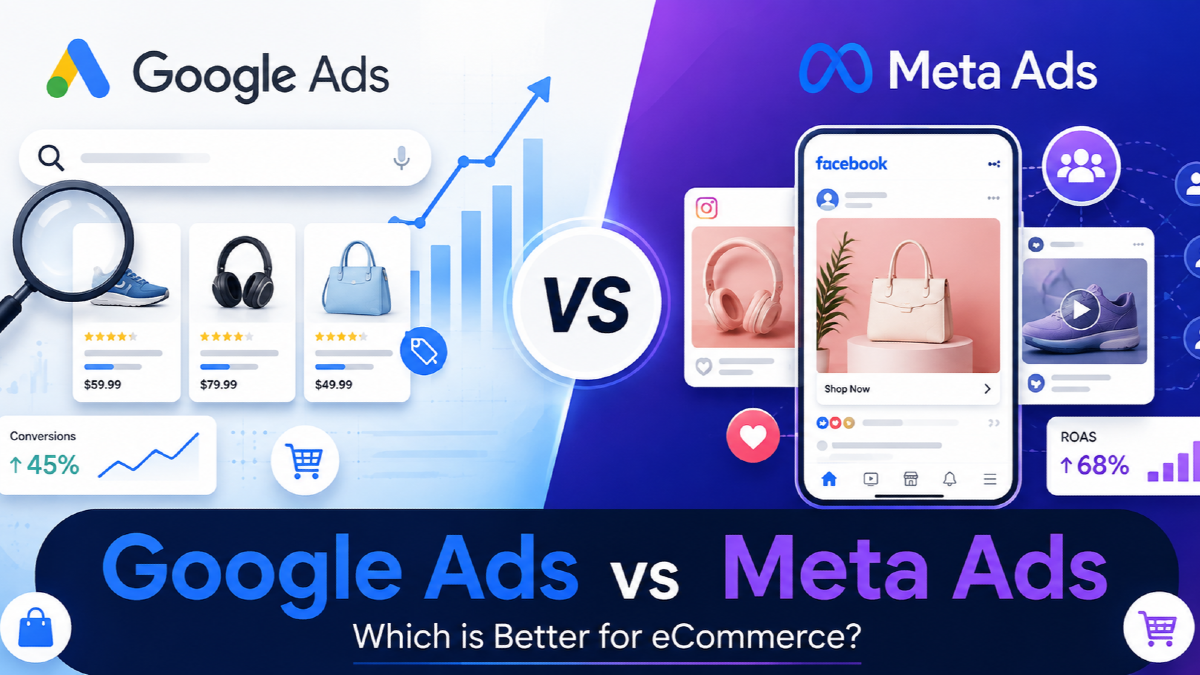
Google Ads and Meta Ads can both generate ecommerce sales, but they solve different acquisition problems. Google tends to have an advantage when shoppers are already searching for a product, category or solution. Meta tends to have an advantage when customers need to discover the product, see it in use or develop interest through creative.
The mistake is deciding between them using CPC, CPM or platform-reported ROAS alone.
For an ecommerce business, the better channel is the one that can acquire the next profitable customer under your current search demand, product economics, creative capacity, inventory and measurement conditions.
Quick answer: Start with Google when meaningful commercial search or shopping demand already exists and your products compete well when shoppers compare options. Give Meta stronger consideration when discovery and visual persuasion are central to the purchase. Mature ecommerce businesses may use both, but budget should follow incremental customer value and contribution rather than whichever dashboard reports the highest ROAS.
Google Ads vs Meta Ads for eCommerce: Quick Comparison
Factor
Google Ads
Meta Ads
Primary customer behaviour
Often reaches shoppers actively searching, researching or comparing
Often reaches customers while they browse Facebook and Instagram
Existing demand requirement
Stronger starting position when relevant search demand already exists
Can reach customers even when they are not actively searching for the product
Product discovery
Possible across several Google campaign types, but Search and Shopping are especially strong at capturing existing intent
Strong discovery potential through visual, video and social creative
Search intent
Major advantage where commercial queries reveal what shoppers want
Does not depend on the shopper entering a search query
Creative dependency
Varies by campaign type; Shopping can lean heavily on product data and merchandising
Usually requires a stronger and more continuous creative-testing system
Product-feed dependency
Very important for Shopping and many ecommerce Performance Max campaigns
Important for catalog-driven advertising, but creative can also operate independently of catalog formats
Strong ecommerce formats
Shopping, Search and Performance Max
Sales campaigns, catalog ads, image and video advertising
Common scaling constraint
Available profitable search demand, competition and product economics
Creative fatigue, audience expansion and economics as spend increases
Measurement challenge
Brand searches and returning demand can make reported efficiency look stronger than incremental acquisition
View-through and cross-device journeys can make platform reporting difficult to compare directly with Google
Best starting situation
Existing commercial demand with products people already search for and compare
Products that benefit from discovery, demonstration, visual persuasion or storytelling
This is a starting framework, not a rule that declares one platform the winner. Product behaviour matters more than the platform label.
The Real Difference: Demand Capture vs Demand Creation
The most useful way to begin comparing Google Ads and Meta Ads for ecommerce is through demand capture versus demand creation.
Google is particularly strong when a shopper expresses intent through a search. Someone searching for “men's brown leather loafers size 10,” “buy bridal lehenga online” or a specific replacement part is already telling Google something about what they want.
Search and Shopping campaigns can place a relevant product or offer in front of that existing demand.
Meta works differently. A shopper may open Instagram without any intention of buying a skincare product, dress or piece of jewellery. A strong image, Reel, customer demonstration or product story can introduce something the person was not actively searching for.
That makes Meta particularly useful for products where seeing the product creates interest.
But do not turn this distinction into an absolute rule.
Google does more than capture searches. Performance Max, YouTube and remarketing can reach people across different Google properties and stages of consideration. Meta also does more than create awareness. Meta sales and catalog campaigns can reach people with existing purchase intent, including previous website visitors and shoppers already familiar with the brand.
So the useful question is not:
“Does Google capture demand while Meta creates it?”
The better question is:
“How much existing demand can I capture profitably, and how effectively can I create or expand demand beyond it?”
When Google Ads Usually Makes More Sense for eCommerce
Google deserves a strong starting bias when shoppers already know what they want and actively search for it. That does not mean every ecommerce company with search volume should automatically choose Google. You still need competitive pricing, a credible store, useful product pages and acceptable acquisition economics.
Customers already search for your products
If meaningful commercial search demand already exists, Google gives you access to shoppers who are actively expressing what they need.
Consider an ecommerce store selling automotive replacement parts. A shopper searching for a specific compatible component is very different from someone casually scrolling through social media. The search itself reveals intent, product need and sometimes model or specification information.
That creates a natural starting advantage for Google.
The same principle can apply to established categories such as electronics, footwear, furniture, appliances, jewellery and fashion when shoppers actively search for those products.
The purchase is comparison-driven
Google becomes useful when customers compare price, specifications, brands, models, reviews, shipping or product variations before buying.
An electronics shopper researching a particular television model may compare several retailers before making a decision. Search and Shopping place the store inside that active comparison process.
Being present does not guarantee the sale. Your price, shipping proposition, reviews, availability and landing-page quality still affect whether the shopper chooses you.
Your catalog maps well to shopping intent
Google Shopping can be particularly valuable when products can be represented clearly through structured product data, imagery, price and availability.
A well-maintained product feed through Merchant Center helps Google understand what you sell. Product titles, categories, identifiers, images, prices and availability become part of how products can participate in shopping-driven advertising.
If Shopping is a major part of your acquisition plan, your product feed should be treated as advertising infrastructure rather than a one-time technical setup.
You can explore the broader role of Google Ads for ecommerce separately if Google is already the stronger channel candidate.
Customers research before purchasing
Higher-consideration products often generate research before the transaction. Customers may search by product type, specifications, brand, alternatives, reviews and price at different points in the journey.
This can make Google useful even when the purchase does not happen on the first visit.
Your creative-production capacity is limited
This factor is often ignored.
Meta can be an excellent acquisition platform, but a business that cannot consistently produce persuasive product images, videos, demonstrations, UGC-style concepts and new creative angles may struggle to sustain Meta performance.
Google is not creative-free, but certain search and shopping environments can rely more heavily on intent, product data and merchandising than a Meta strategy built around continuous creative testing.
When Meta Ads Usually Makes More Sense
Meta deserves stronger consideration when customers are unlikely to search for the product before discovering it, or when the product becomes substantially more persuasive after someone sees it.
Customers are not actively searching for the product
A new ecommerce category has a basic problem on Google: if people do not know the product exists, they may not search for it.
Imagine a brand introducing an unusual home accessory that solves a familiar problem in a new way. Search volume for the exact product may initially be tiny because customers do not yet know what to call it.
A video showing the problem and solution can create interest without waiting for search demand to develop.
The product is visually persuasive
Fashion, jewellery, beauty, home decor and similar categories can benefit when visual presentation changes how customers perceive the product.
A plain product title cannot always communicate how a dress moves, how jewellery looks when worn or how a home product changes a room.
Meta's Facebook and Instagram environments give brands more opportunities to build the purchase case visually.
The product needs demonstration or education
Some products become valuable only after the customer understands what they do.
A short demonstration can explain a beauty tool, kitchen product or unfamiliar consumer device faster than expecting a cold customer to search for its exact category.
In this situation, creative is doing part of the selling before the shopper reaches the product page.
The business can produce strong creative consistently
Meta should not be evaluated only by targeting capability. Creative production is part of the media strategy.
A business capable of regularly testing different hooks, product demonstrations, customer perspectives, formats and offers has more ways to discover which messages attract new customers.
If the company has one polished brand video and expects it to run indefinitely, the theoretical advantages of Meta may not translate into scalable acquisition.
The brand needs to reach beyond existing search demand
Google can become constrained when most commercially useful search demand is already being captured at acceptable economics.
Increasing the budget does not create unlimited additional high-intent searches.
Meta can provide another route to audience expansion when the business has products and creative capable of generating interest among customers who were not actively searching.
Should a New eCommerce Brand Start With Google Ads or Meta Ads?
A new ecommerce brand should start with the channel that provides the clearest meaningful customer-acquisition test. Do not choose Google because search traffic sounds more qualified, and do not choose Meta because a competitor appears to be scaling there.
Work through these questions in order.
1. Does meaningful commercial search demand exist?
Research whether customers already search for your product, category, problem or close alternatives.
If commercial demand is visible and your products are competitive in that market, Google may provide the cleaner first test.
If customers are unlikely to search for the product until they discover it, Meta becomes more interesting.
2. Can the offer convert cold discovery traffic?
Meta can introduce your product to new audiences, but the offer still needs to make sense to someone who was not planning to buy it five minutes earlier.
Product differentiation, price, trust, reviews, shipping, returns and landing-page quality all affect whether discovery can become a purchase.
3. Can you produce enough persuasive creative?
Do not choose a creative-dependent acquisition strategy without the resources to supply it.
If you can consistently produce demonstrations, UGC-style concepts, lifestyle content, product comparisons and fresh visual angles, Meta becomes easier to test properly.
4. Do the unit economics support paid acquisition?
Before choosing either platform, understand what you can afford to pay for a new customer.
A product selling for $100 does not give you $100 to acquire the buyer. Product cost, fulfillment, payment fees, shipping subsidies, returns and other variable costs reduce what remains.
Your contribution margin is the amount remaining after the variable costs associated with the sale. That amount, along with repeat-purchase behaviour and customer lifetime value, affects your acceptable acquisition cost.
5. Which platform gives you the clearest first test?
If strong purchase-intent searches exist but you have limited creative resources, Google may give you a clearer first answer.
If search demand is weak but the product is visually compelling and you have strong creative, Meta may provide the better test.
If both look promising and your budget can support meaningful testing, you can test both. But a new brand should not feel obligated to launch everywhere simultaneously.
What If You Have a Small Advertising Budget?
With a constrained ecommerce budget, splitting spend across Google and Meta automatically can make the test worse.
Two underfunded campaigns do not necessarily produce twice the learning. They can produce two sets of inconclusive data.
The amount required for a useful test depends on expected customer acquisition cost, conversion rate, product price, click costs and the amount of purchase data needed to make a sensible decision. There is no universal minimum that applies to every ecommerce store.
Consider a purely illustrative example.
Suppose a store can initially spend $2,000 and estimates that acquiring a new customer may cost around $80. This figure is hypothetical, not a benchmark.
Splitting the budget equally gives each platform $1,000. At the assumed CAC, that would correspond to roughly 12 or 13 new customers per platform before normal performance variation.
That may or may not be enough evidence for the business to make a useful decision.
If one platform clearly fits existing customer behaviour better, concentrating the initial test there may teach you more than mechanically dividing the budget.
The goal is not to give one platform permanent ownership of the budget. It is to generate enough evidence to make the next allocation decision intelligently.
Google Ads vs Meta Ads by eCommerce Product Type
Product category can provide a starting bias, but it should never become a platform rule. Two brands selling the same category can have completely different demand, margins, creative strength, pricing and customer behaviour.
Product Type
Google Starting Fit
Meta Starting Fit
Reason
What to Test
Fashion
Strong when shoppers search by garment, occasion, style or brand
Strong when styling and visual discovery drive desire
Both search intent and visual influence can be important
Shopping demand vs short-form creative-led acquisition
Jewellery
Useful for known styles, occasions and product searches
Useful when design, styling and gifting create discovery
Highly visual but also searchable
Shopping/search intent vs lifestyle and UGC-style creative
Beauty
Strong for known products, ingredients and problem-aware searches
Strong for demonstrations, routines and transformations
Education and visual proof can strongly influence demand
Problem-led Google demand vs demonstration-led Meta creative
Supplements
Can fit established category and ingredient searches
Can reach relevant audiences through education and creative
Trust, compliance, economics and repeat purchase matter heavily
Qualified search demand vs compliant educational creative
Electronics
Often strong
Useful depending on product and creative proposition
Customers frequently compare model, specifications and price
Search/Shopping economics vs discovery and remarketing
Replacement parts
Often very strong
Usually a weaker discovery starting point
Purchase often begins with a specific need or compatibility search
SKU, model and problem-specific search coverage
Furniture
Strong for category and specification searches
Strong for visual inspiration and room-based discovery
Both planned research and visual influence matter
High-intent categories vs lifestyle creative
Home decor
Useful where category demand exists
Often strong for visual discovery
Customers can develop desire after seeing a product in context
Shopping demand vs inspiration-led creative
Specialty food
Useful when customers know the product or search by need
Useful for appetite, gifting and product discovery
Purchase behaviour varies significantly by product
Category demand vs visual offer-led acquisition
B2B ecommerce
Often useful when buyers search by product, specification or supplier
Potentially useful for awareness and remarketing
Search can reveal explicit procurement intent
Commercial search demand before broad social acquisition
The table should be used to decide what deserves testing first, not to exclude the other platform permanently.
Which Platform Has Better ROAS: Google Ads or Meta Ads?
Neither platform has universally better ROAS for ecommerce, and platform-reported ROAS is not always directly comparable.
ROAS is advertising revenue divided by advertising spend. The formula is simple. Determining which channel deserves credit for the revenue is not.
Google and Meta can observe different parts of the same customer's journey and apply their own attribution logic. Attribution is the process of assigning credit for a conversion across marketing interactions.
This creates a common management problem: both platforms can report performance that looks convincing while the store's total revenue does not support simply adding both reported numbers together.
Brand search can make Google look exceptionally efficient
Suppose someone discovers a retailer through another marketing channel, remembers the brand and later searches for the company by name on Google.
A Google ad may participate near the end of that journey and receive conversion credit according to the applicable attribution setup.
The Google campaign may genuinely contribute to the purchase, but its high reported ROAS does not automatically tell you how much new demand the campaign created.
This distinction becomes important when deciding whether another $10,000 should be moved into Google.
Meta reporting needs context too
Meta can also report conversions connected to interactions it observed. Depending on the journey and measurement setup, Meta may receive credit for a conversion even when other channels also influenced the customer.
That does not mean the conversion is fake. It means channel reporting should not be interpreted as a perfectly exclusive division of revenue.
Use business data alongside platform data
When comparing Google Ads vs Meta Ads ROAS, review more than the two advertising dashboards.
Look at:
Store or backend revenue
New versus returning customers
New-customer acquisition cost
Blended acquisition cost
Contribution margin
Overall marketing efficiency
Platform attribution
Changes in total business revenue as spend changes
Why Google Can Show Higher ROAS Without Creating More Incremental Growth
A higher Google Ads ROAS can be real while still overstating how attractive the next unit of Google budget is.
Consider a hypothetical customer journey.
A shopper sees a fashion product in an Instagram ad on Monday. She watches the video but does not buy. On Wednesday, she remembers the brand, searches its name on Google, clicks a Shopping or Search ad and completes the purchase.
Google participated in the final purchase journey. Meta also participated earlier.
This example does not prove that Meta caused the purchase. The shopper might have bought without the Meta impression. It also does not prove Google independently created the customer.
This is where incrementality becomes useful. Incrementality asks what additional conversions or business results occurred because of the advertising activity compared with what would have happened without it.
That question is harder than reading ROAS from a dashboard, but it is much closer to the decision a business owner actually needs to make.
Before moving budget from Meta to Google because Google's ROAS is higher, examine whether the additional Google spend can continue finding profitable non-brand demand and new customers, or whether much of the reported efficiency comes from demand that already exists.
Which Platform Has Lower Customer Acquisition Cost?
Google Ads can have the lower customer acquisition cost in one business while Meta wins in another. CPC and CPM cannot answer this question by themselves.
Customer acquisition cost (CAC) is the cost required to acquire a customer. For ecommerce channel decisions, it is often useful to distinguish new customer CAC from a blended metric that includes returning buyers.
Suppose Meta traffic costs less per click but converts at a lower rate because shoppers are discovering the product for the first time. Google clicks cost more but come from people actively searching for the product.
Google could still produce the lower CAC.
Now reverse the situation. Suppose Google search auctions are extremely competitive while a brand has outstanding Meta creative that converts new audiences efficiently. Meta could produce the lower CAC despite operating higher in the discovery process.
The economic question is not:
“Where can I buy the cheapest traffic?”
It is:
“Where can I acquire economically useful customers at a cost the business can sustain?”
That requires context from average order value (AOV), contribution margin and customer lifetime value (LTV).
A $70 CAC may be excellent for one store and disastrous for another.
If acquisition costs are already the main constraint, review how to reduce ecommerce CPA before assuming the solution is simply moving spend between platforms.
How Much Budget Should Go to Google Ads vs Meta Ads?
There is no responsible universal Google Ads vs Meta Ads budget split for ecommerce.
A fixed percentage ignores the variables that actually determine where the next dollar can work hardest.
I would evaluate seven things before reallocating incremental budget.
1. Remaining commercial search demand
If profitable Google Search and Shopping demand remains uncaptured, Google may deserve more budget.
But once the business is already covering most high-value demand, additional spend may push into less attractive queries, products or auctions. Historical average ROAS does not tell you how the next budget increase will perform.
2. Incremental customer acquisition
Look at whether each channel is adding new customers rather than primarily harvesting existing demand or repeat purchasers.
Returning customers are valuable, but a channel appearing efficient because existing customers repeatedly convert through it should not automatically receive the acquisition budget intended for growth.
3. Contribution margin
Revenue is not profit.
If one platform drives products with much stronger contribution margin, its lower headline ROAS can sometimes produce a better business result than a channel selling lower-margin products at a higher ROAS.
4. Inventory availability
Advertising a category aggressively when profitable products are running out of stock makes little sense.
Budget allocation should respond to inventory depth, seasonality and the products the business actually wants to sell.
5. Creative capacity
Meta cannot scale indefinitely on weak or exhausted creative.
If the business cannot currently produce enough strong concepts, increasing Meta spend may simply accelerate creative fatigue. Conversely, a strong creative pipeline can open acquisition opportunities that did not exist when previous budget decisions were made.
6. Channel saturation
Every acquisition channel faces diminishing opportunities at some point.
The fact that Google performed well at $20,000 in spend does not prove the next $20,000 will produce the same return. The same is true for Meta.
7. Measurement confidence
Do not make a major reallocation based on numbers you do not trust.
If tracking is broken, new and returning customers are mixed together, or platform attribution is being treated as exclusive revenue ownership, fix the measurement problem before making an aggressive budget decision.
Your wider ecommerce Google Ads strategy should therefore connect bidding and campaign structure with business economics rather than operating independently from the rest of paid acquisition.
A Better eCommerce Budget Allocation Framework
Instead of beginning with a fixed percentage, I prefer to think about the next profitable customer.
The purpose of the framework is simple: decide which channel currently has the strongest opportunity to acquire the next group of customers profitably.
Step 1: Validate conversion tracking
Make sure Google Ads, Meta and your ecommerce platform are collecting enough reliable data to support the decision.
Step 2: Separate new and returning customer performance where possible
If the objective is acquisition, understand how much spend is generating genuinely new customers.
Step 3: Estimate acceptable new-customer CAC
Use product economics, contribution margin, AOV and repeat-purchase behaviour to determine what the business can reasonably afford to pay.
Review whether Google still has commercially relevant Search or Shopping opportunities that can absorb more spend without pushing acquisition economics outside your acceptable range.
Step 5: Assess Meta's creative and audience expansion capacity
Ask whether you have enough winning creative, new concepts and audience opportunity to deploy additional spend productively.
Step 6: Evaluate marginal performance
Do not ask only what the channel averaged last month.
Ask what happened when spend increased and what you expect the next increment to produce.
Step 7: Allocate the next budget increment
Give additional budget to the strongest profitable opportunity rather than locking the account into a permanent platform percentage.
Step 8: Repeat with new evidence
Channel conditions change. Search demand, competition, creative performance, inventory and customer economics can all move.
The allocation should be revisited when enough new evidence exists to justify another decision.
If you are spending meaningfully across both channels but cannot determine which one deserves the next budget increase, that is usually a measurement and economics problem before it is a media-buying problem.
When Running Google Ads and Meta Ads Together Makes Sense
Using both platforms makes sense when each has a useful role and the business has enough budget, measurement quality and operational capacity to evaluate them properly.
The customer journey can move in either direction.
Meta discovery → website visit → Google search → purchase
A shopper may discover a product through an Instagram Reel, visit the store, leave and later search for the brand or product on Google before purchasing.
Meta may have introduced the product. Google may have helped the shopper return and convert.
Google discovery → website visit → later Meta exposure → purchase
The reverse also happens.
A shopper may first discover a retailer while searching Google, visit a product page without buying and later encounter the product or brand again on Instagram or Facebook before completing the purchase.
This is why the simplistic statement that “Meta creates demand and Google closes it” is unreliable.
Both platforms can introduce, influence, recapture and convert demand depending on the campaign, customer and product.
Running both becomes especially useful when:
Google is already capturing meaningful commercial demand.
Meta has demonstrated an ability to acquire customers beyond that demand.
The business can produce enough creative to support Meta.
Product feeds and merchandising support Google Shopping activity.
The budget is large enough to generate meaningful evidence on both platforms.
Measurement is strong enough to avoid simply adding platform-reported revenue together.
How to Measure Google Ads and Meta Ads Together
You need platform-level measurement and business-level measurement.
Google Ads conversion tracking helps Google measure and optimise activity inside its advertising environment. Meta Pixel and Conversions API provide Meta with website and server-side event signals. GA4 gives another view of customer journeys and traffic behaviour.
None of these should automatically be treated as the single unquestionable source for channel allocation.
Your store or backend revenue provides the commercial total the business actually generated.
When possible, connect this with:
New versus returning customer revenue
New customer count
Blended CAC
Channel-level spend
Contribution margin
Product and category profitability
Overall marketing efficiency
The objective is not to force Google Ads, Meta Ads and GA4 to report identical numbers. Their measurement methods and purposes differ.
The objective is to understand the business outcome well enough that attribution differences do not dictate your entire budget strategy.
Google Ads vs Meta Ads Decision Matrix
Business Situation
Starting Decision
Reason
Strong commercial search demand already exists
Google starting bias
Customers are already expressing product or category intent
New category with little meaningful search demand
Meta starting bias
Creative may need to introduce the product before customers search for it
Visually persuasive product with strong UGC and video capacity
Meta starting bias
Creative can demonstrate the product and create discovery
Specification-heavy or comparison-driven purchase
Google starting bias
Search behaviour reveals active research and buying intent
Both channels already generate profitable sales
Compare marginal contribution
The next budget decision matters more than historical average ROAS
Google reports much higher ROAS than Meta
Check attribution and customer mix first
Brand demand or returning customers may affect reported efficiency
Meta has cheap traffic but weak purchases
Do not scale based on CPC or CPM
Cheap visits are irrelevant if customer acquisition economics are poor
Tracking is unreliable
Fix measurement first
Budget allocation based on unreliable conversion data compounds the problem
Very limited testing budget
Choose one meaningful initial test
Two underfunded tests can produce less useful evidence than one focused test
Google Ads vs Meta Ads: Final Decision
There is no universal winner in Google Ads vs Meta Ads for ecommerce.
Google should receive stronger consideration when customers already demonstrate meaningful commercial search intent, your catalog fits Search or Shopping behaviour and additional profitable demand remains available.
Meta should receive stronger consideration when the product benefits from discovery, demonstration or visual persuasion and the business can consistently produce creative capable of turning cold attention into purchase intent.
When both channels work, do not lock the business into an arbitrary percentage split. Compare the next acquisition opportunity using new-customer CAC, contribution margin, remaining demand, creative capacity, inventory and measurement confidence.
A higher dashboard ROAS does not automatically make a platform the better place for the next budget increment.
The best platform is the one offering the stronger incremental profitable customer-acquisition opportunity under your current conditions.
If Google is the stronger fit, review your broader ecommerce Google Ads approach. If discovery and creative-led acquisition are the bigger opportunity, review Meta Ads for ecommerce.
If both channels are already running but increasing spend is not producing proportional business growth, diagnose the economics and measurement before reallocating budget simply to chase the higher reported number. This guide on how to improve ecommerce ROAS covers that problem separately.
Need help deciding where your next acquisition budget should go? I can evaluate Google Ads and Meta Ads against your search demand, customer-acquisition economics, attribution, product margins and current channel performance to identify where additional spend has the stronger business case.
Frequently Asked Questions
Is Google Ads or Meta Ads better for eCommerce?
Google Ads is generally stronger when customers already search for the product or category with commercial intent. Meta Ads can be stronger when customers need to discover or understand the product through creative. The actual winner depends on search demand, product behaviour, margins, creative capacity and customer acquisition economics.
Should a new eCommerce brand start with Google Ads or Meta Ads?
Start with the platform that provides the clearest meaningful acquisition test. If strong commercial search demand already exists, Google may be the better starting point. If search demand is limited but the product is visually persuasive and you can produce strong creative, Meta may deserve the first test.
Is Google Shopping better than Meta Ads?
Google Shopping can be stronger when shoppers already search for and compare products using factors such as image, price, brand and specifications. Meta can be stronger when customers are unlikely to search until creative introduces the product. Product behaviour and acquisition economics should determine which receives priority.
Which has better ROAS, Google Ads or Meta Ads?
Neither platform has universally better ROAS. Platform-reported ROAS should not be compared without considering attribution, brand searches, returning customers and differences in the customer journey. Store revenue, new-customer acquisition and contribution margin provide important context beyond the advertising dashboards.
Which is cheaper, Google Ads or Meta Ads?
Do not judge the platforms by CPC or CPM alone. Meta can generate cheaper clicks while producing a higher customer acquisition cost, and expensive Google clicks can still be profitable when purchase intent is strong. Compare the cost of acquiring economically valuable customers rather than the cost of buying traffic.
Can I run Google Ads and Meta Ads together?
Yes. Running both can make sense when each channel has a useful acquisition role and the business has enough budget and data to evaluate them. Customers may discover a product on Meta and later purchase through Google, or discover it through Google and later convert after Meta exposure.
How should I split my budget between Google Ads and Meta Ads?
Do not use a universal percentage split. Allocate incremental budget according to remaining profitable search demand, new-customer CAC, contribution margin, creative capacity, inventory, channel saturation and measurement confidence. The channel that performed best historically is not automatically where the next budget increase should go.
Are Meta Ads better for low-cost ecommerce products?
Not automatically. Lower-priced products may work well on Meta when they are visually persuasive, easy to understand and economically viable for cold acquisition. But product price alone does not determine channel fit. Margin, conversion rate, creative strength, repeat purchases and acceptable CAC matter more.
Are Google Ads better for high-ticket ecommerce products?
Google can be a strong fit for high-consideration products when customers actively research specifications, brands, alternatives and prices before buying. However, a high price does not automatically make Google better. Search demand, competition, margins, conversion behaviour and the role of visual discovery still need to be evaluated.
With 17+ years of hands-on experience in paid search and organic growth, I've helped businesses across 80+ countries build scalable digital marketing systems. I've personally managed over ₹50 crore in ad spend, worked with 100+ clients, and hold certifications from Google, Meta, and HubSpot. Based in Surat — working with clients across India, USA, UK, Canada, and Australia.