Ecommerce SEO is the process of improving product pages, category pages, collection pages, site architecture, structured data, internal links, crawl efficiency, and user experience so online stores can attract qualified buyers from organic search and generate more revenue.
Ecommerce SEO is different from traditional website SEO because online stores must manage hundreds or thousands of URLs, product variants, category hierarchies, inventory changes, filters, faceted navigation, merchant data, and shopping-related search intent.
Many ecommerce websites focus only on product uploads and advertisements. Search engines evaluate much more than product availability. Google needs to understand product entities, category relationships, product attributes, pricing, availability, shipping information, return policies, and merchant trust signals before products can appear in shopping-related search experiences. Google recommends using Product structured data, merchant listing markup, product variant markup, and Merchant Center product data to help Google understand ecommerce inventory.
This guide explains how ecommerce SEO works in 2026 and how to improve visibility for product pages, category pages, collection pages, buying guides, and revenue-generating search terms.
What Is Ecommerce SEO?
Ecommerce SEO is the practice of making online store pages discoverable, crawlable, indexable, understandable, and conversion-ready for search engines and shoppers.
The goal is not simply ranking pages. The goal is connecting products with buyers at the moment they are searching for products, brands, features, specifications, comparisons, reviews, pricing information, or purchase solutions.
Ecommerce SEO involves:
- Product page optimization
- Category page optimization
- Collection page optimization
- Product entity optimization
- Structured data implementation
- Merchant Center optimization
- Technical SEO
- Internal linking
- Content marketing
- Revenue measurement
Google's ecommerce documentation explains that product information can appear in product snippets, merchant listings, Google Images, Shopping experiences, and knowledge panels when sufficient product information is provided through structured data and merchant feeds.
| Ecommerce SEO Goal | Business Impact |
|---|---|
| More product visibility | More qualified traffic |
| Better category rankings | More product discovery |
| Improved product understanding | Higher click-through rate |
| Better crawl efficiency | Faster indexing |
| Improved user experience | Higher conversion rate |
| Revenue-focused optimization | More organic sales |
How Ecommerce SEO Differs From Normal SEO
Ecommerce SEO focuses on products, categories, inventory, merchant data, and purchase intent, while traditional SEO often focuses on information, services, or lead generation.
A service website may have 20 pages. An ecommerce store may have 20,000 URLs generated through products, categories, variants, collections, filters, sorting options, and search pages.
| SEO Area | Traditional Website | Ecommerce Website |
|---|---|---|
| Main assets | Pages and articles | Products, categories, collections |
| Search intent | Information and leads | Product discovery and purchases |
| Content scale | Dozens or hundreds of pages | Hundreds or thousands of URLs |
| Structured data | Articles and FAQs | Products, offers, variants, reviews |
| Inventory management | Not applicable | Critical ranking factor |
| Merchant data | Rarely needed | Required for shopping visibility |
Ecommerce websites also face additional challenges such as:
- Duplicate product URLs
- Faceted navigation
- Product variants
- Out-of-stock products
- Thin category pages
- Large-scale crawl management
- Merchant listing eligibility
- Product feed consistency
These issues rarely exist on standard business websites.
Ecommerce SEO Starts With Page Type Mapping
Page type mapping determines which page should rank for which search intent.
One of the biggest ecommerce SEO mistakes is assigning multiple search intents to the same page or creating several pages targeting the same intent.
Every ecommerce website should define ownership for:
- Category pages
- Subcategory pages
- Collection pages
- Brand pages
- Product pages
- Comparison pages
- Buying guides
| Search Query | Recommended Page Type |
|---|---|
| Running shoes | Category page |
| Men's running shoes | Subcategory page |
| Nike running shoes | Brand page |
| Nike Pegasus 41 | Product page |
| Best running shoes for beginners | Buying guide |
| Nike Pegasus vs Adidas Adizero | Comparison page |
Before writing content or optimizing metadata, determine which page should own the search intent.
Without page mapping, ecommerce websites often create:
- Keyword cannibalization
- Duplicate categories
- Thin collections
- Weak product discoverability
- Confusing internal linking structures
Keyword Research for Product, Category and Buying Intent
Ecommerce keyword research should focus on purchase intent, product attributes, category demand, and commercial search behavior.
Many ecommerce stores target only high-volume keywords. Revenue often comes from highly specific searches.
For example:
- Running shoes
- Men's running shoes
- Trail running shoes
- Waterproof trail running shoes
- Nike waterproof trail running shoes
- Nike Pegasus trail waterproof size 10
Each search becomes more specific and closer to a purchase decision.
| Keyword Type | Example | Intent |
|---|---|---|
| Category | Running shoes | Product discovery |
| Subcategory | Trail running shoes | Narrowed discovery |
| Brand | Nike running shoes | Brand preference |
| Attribute | Waterproof running shoes | Feature-based search |
| Comparison | Nike vs Adidas running shoes | Evaluation |
| Product | Nike Pegasus 41 | Purchase intent |
Keyword research should include:
- Product keywords
- Brand keywords
- Category keywords
- Collection keywords
- Attribute keywords
- Comparison keywords
- Problem-solving keywords
- Buying guide keywords
For a complete research process, see How to Do Keyword Research.
Category Page SEO
Category pages are usually the highest revenue-generating pages on an ecommerce website because they target broad commercial search intent.
Many ecommerce stores focus heavily on product pages while ignoring category pages.
Category pages often rank for:
- Broad product terms
- Commercial keywords
- High-volume searches
- Product discovery queries
A category page should help users understand:
- What products are available
- How products differ
- Which attributes matter
- How to choose the right product
| Category Page Element | Purpose |
|---|---|
| H1 | Define category topic |
| Intro content | Explain category |
| Filters | Improve product discovery |
| Sorting | Improve usability |
| Internal links | Pass relevance |
| Category content | Support rankings |
| FAQs | Address purchase questions |
Strong category pages combine:
- Search demand
- User intent
- Product discovery
- Internal linking
- Conversion optimization
Category pages should not become blog posts. The primary goal remains product discovery.
Product Page SEO
Product pages help search engines understand individual products and help buyers make purchase decisions.
Every product page should answer:
- What is the product?
- Who is it for?
- What are the specifications?
- What are the available variants?
- What does it cost?
- Is it available?
- What do buyers say?
| Product Page Component | SEO Purpose |
|---|---|
| Product title | Identify product entity |
| Product images | Visual understanding |
| Product description | Explain product value |
| Specifications | Attribute matching |
| Reviews | Trust signals |
| Availability | Shopping eligibility |
| Structured data | Machine understanding |
| Related products | Internal linking |
Google recommends providing rich product information such as price, availability, ratings, shipping details, return policies, product identifiers, and variants through structured data and merchant data.
Product pages should support both search engines and buyers. The best-performing product pages combine:
- Entity clarity
- Attribute coverage
- Product specifications
- User-generated content
- Merchant trust signals
- Clear purchase paths
Product Descriptions, Attributes and Specifications
Product descriptions should help search engines understand the product entity while helping shoppers make purchase decisions with confidence.
Many ecommerce websites use manufacturer descriptions or supplier content across hundreds of products. This creates duplicate content issues and reduces differentiation.
A strong product page explains the product through attributes, specifications, features, benefits, compatibility, dimensions, materials, usage scenarios, care instructions, and purchase considerations.
Instead of writing generic sales copy, focus on factual information.
After mentioning a product, explain its important attributes.
Examples include:
- Size
- Color
- Material
- Weight
- Dimensions
- Capacity
- Battery life
- Compatibility
- Fabric
- Finish
| Product Information Type | Purpose |
|---|---|
| Product summary | Explain what the product is |
| Specifications | Provide measurable facts |
| Features | Explain capabilities |
| Benefits | Explain practical value |
| Dimensions | Support purchase decisions |
| Compatibility | Reduce buyer uncertainty |
| Care instructions | Improve customer satisfaction |
Google's product documentation recommends providing accurate product information including identifiers, availability, pricing, reviews, shipping information, and return policies to improve product understanding. Product data should remain consistent across the website, structured data, and merchant feeds.
Every product page should answer common purchase questions before the user needs to ask them.
Technical SEO for Ecommerce
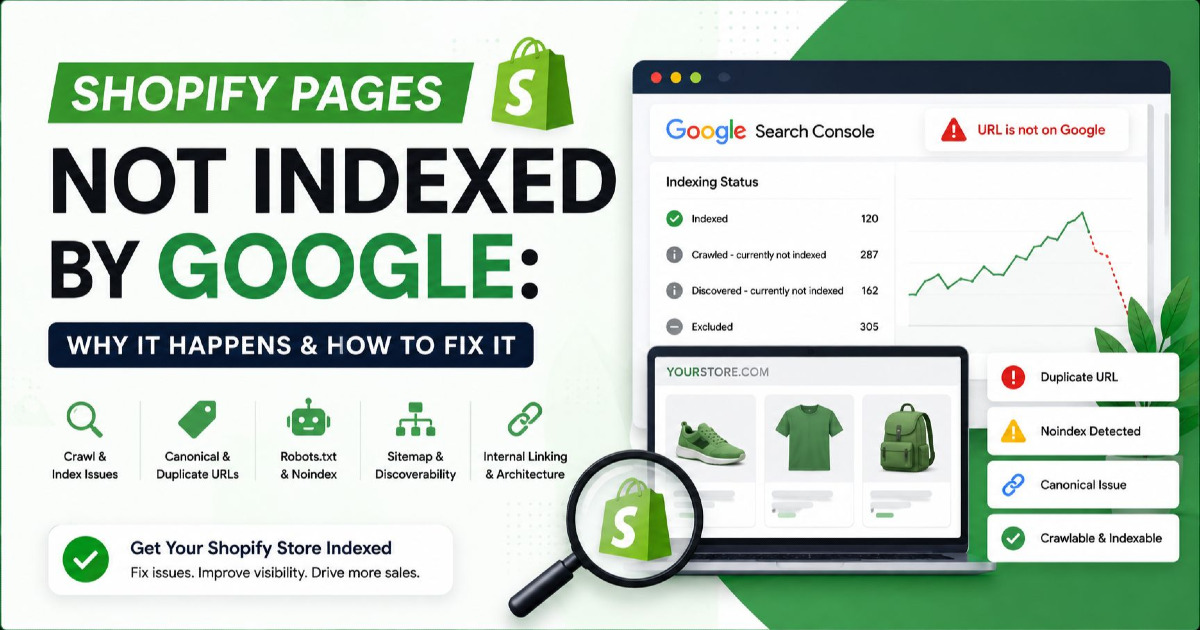
Technical SEO helps search engines efficiently crawl, understand, and index ecommerce websites at scale.
Ecommerce websites generate far more URLs than standard business websites.
A store with:
- 5,000 products
- 200 categories
- 20 filter options
- Product variants
- Sorting URLs
- Search pages
can easily create hundreds of thousands of crawlable URLs.
Without technical SEO controls, search engines may waste crawl resources on low-value URLs instead of important revenue-generating pages.
| Technical Area | SEO Impact |
|---|---|
| Indexability | Controls which pages can rank |
| Crawlability | Controls discovery efficiency |
| Site architecture | Supports content relationships |
| XML sitemaps | Supports URL discovery |
| Canonicalization | Reduces duplicate signals |
| Structured data | Improves machine understanding |
| Core Web Vitals | Improves user experience |
Technical SEO issues often have sitewide effects.
A single incorrect canonical tag template can impact thousands of products simultaneously.
For a deeper technical implementation framework, see Technical SEO Guide.
Faceted Navigation, Filters and URL Parameters
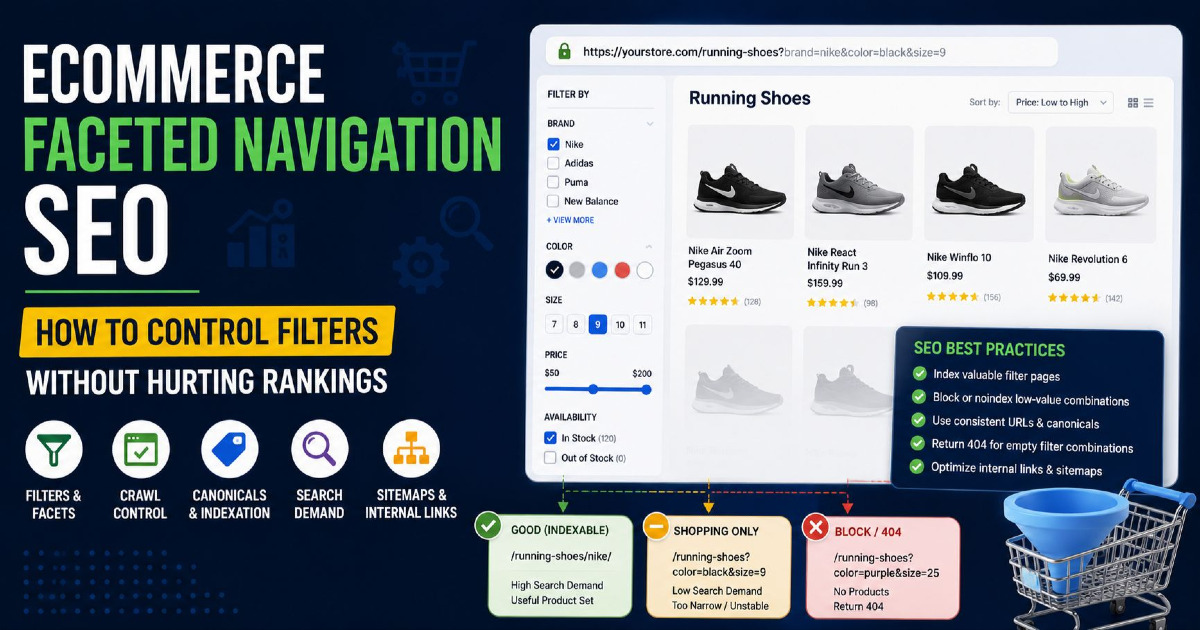
Faceted navigation helps users discover products, but uncontrolled filters often create major ecommerce SEO problems.
Filters are useful for shoppers.
Examples include:
- Size filters
- Color filters
- Price filters
- Brand filters
- Material filters
- Availability filters
Problems occur when every filter combination generates a crawlable and indexable URL.
Examples:
- /shoes?color=black
- /shoes?color=black&size=10
- /shoes?color=black&size=10&brand=nike
- /shoes?color=black&size=10&brand=nike&sort=price
These URLs often create duplicate, thin, or low-value pages.
| Filter Type | Recommended Treatment |
|---|---|
| High-demand filter pages | Consider indexation |
| Low-value combinations | Prevent indexing |
| Sorting parameters | Canonicalize |
| Tracking parameters | Canonicalize |
| Search parameters | Restrict indexing |
Google's ecommerce documentation recommends controlling duplicate URLs and ensuring important canonical URLs receive the strongest ranking signals.
For deeper parameter management strategies, see URL Parameters Guide.
Canonicals, Pagination and Product Variants
Canonical tags help search engines understand which URL should represent a product or category when multiple versions exist.
Ecommerce websites commonly generate duplicates through:
- Product variants
- Tracking URLs
- Sorting URLs
- Pagination
- Session IDs
- Filtered URLs
Canonical tags consolidate ranking signals toward preferred URLs.
| Scenario | Recommended Action |
|---|---|
| Tracking parameters | Canonicalize |
| Sorting URLs | Canonicalize |
| Session IDs | Canonicalize |
| Duplicate URLs | Canonicalize |
| True product variants | Evaluate separately |
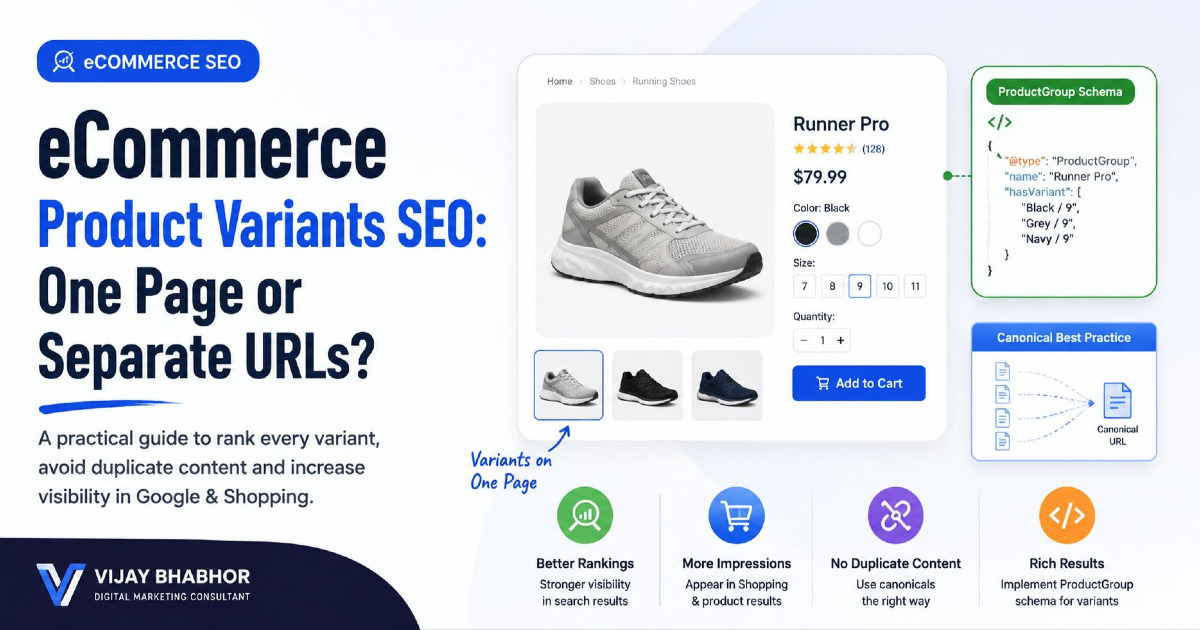
Product variants deserve special consideration.
Examples include:
- Color variants
- Size variants
- Material variants
- Pattern variants
Google now supports variant relationships through ProductGroup structured data and variant markup.
If a variant has unique demand, unique content, and unique search behavior, it may deserve its own indexable URL.
If the variant only changes a minor attribute, consolidating signals may be the better option.
For canonical implementation details, see Canonical Tags Guide.
Product Entity SEO for Ecommerce
Product Entity SEO helps search engines understand products as entities rather than collections of keywords.
Modern search systems increasingly evaluate:
- Products
- Brands
- Variants
- Attributes
- Categories
- Merchant relationships
Instead of targeting only keywords, ecommerce websites should help search engines understand the complete product entity.
Important product entity attributes include:
- Brand
- Model
- SKU
- GTIN
- MPN
- Color
- Size
- Material
- Availability
- Price
| Entity Layer | Examples |
|---|---|
| Brand entity | Nike, Apple, Samsung |
| Product entity | iPhone 16 Pro |
| Variant entity | 256GB Black Titanium |
| Category entity | Smartphones |
| Attribute entity | Color, Size, Material |
The more clearly a website defines product entities, the easier it becomes for search engines to understand relationships across products, categories, and brands.
Merchant Center Feed Optimization
Merchant Center feeds help Google understand ecommerce inventory beyond what appears on website pages.
Many ecommerce stores focus only on website SEO while ignoring feed quality.
Merchant Center feeds provide:
- Product titles
- Descriptions
- Pricing
- Availability
- Images
- GTINs
- Brand data
- Shipping information
- Return policies
Feed data should match website data.
Inconsistencies between feeds and landing pages create trust issues and eligibility issues.
| Feed Element | Importance |
|---|---|
| Title | Product understanding |
| Description | Product context |
| Availability | Shopping eligibility |
| Price | Trust and visibility |
| GTIN | Entity identification |
| Images | Visual understanding |
| Brand | Entity relationships |
Google's Merchant Center documentation recommends maintaining accurate, consistent product information across feeds and website pages.
Product Structured Data and Merchant Listings
Structured data helps search engines understand products, offers, reviews, variants, shipping details, and merchant information.
Product structured data acts as a machine-readable layer that explains ecommerce information.
Important structured data elements include:
- Product
- Offer
- AggregateRating
- Review
- Brand
- GTIN
- ShippingDetails
- MerchantReturnPolicy
- ProductGroup
| Structured Data Type | Purpose |
|---|---|
| Product | Product understanding |
| Offer | Pricing and availability |
| Review | User feedback |
| AggregateRating | Review summaries |
| ProductGroup | Variant relationships |
| ShippingDetails | Delivery information |
| MerchantReturnPolicy | Return information |
Google states that merchant listings can use structured data to show pricing, availability, shipping information, return policies, ratings, and product information across shopping experiences.
At this stage, the foundation of ecommerce SEO is established.
Google Shopping Graph and Product Discovery
Google Shopping Graph is Google's product understanding system that connects products, brands, merchants, prices, reviews, availability, shipping information, and user behavior signals to improve product discovery across Google surfaces.
Traditional ecommerce SEO focused primarily on rankings.
Modern ecommerce SEO focuses on visibility across multiple shopping experiences.
Products may appear through:
- Organic search results
- Merchant listings
- Product snippets
- Google Shopping
- Google Images
- Popular Products
- Shopping knowledge panels
- AI-powered shopping experiences
Google increasingly evaluates products using multiple data sources rather than relying solely on page content. Product structured data, Merchant Center feeds, product reviews, pricing consistency, shipping information, and inventory availability all contribute to product visibility.
This means ecommerce SEO is no longer limited to optimizing HTML pages. Product visibility now depends on how well product information is connected across an ecommerce ecosystem.
| Visibility Signal | Why It Matters |
|---|---|
| Product schema | Helps search engines understand products |
| Merchant Center feed | Provides inventory and pricing data |
| Product reviews | Supports trust and comparison |
| Availability | Supports shopping eligibility |
| Shipping information | Improves purchase confidence |
| Return policies | Reduces purchase uncertainty |
| Variant relationships | Improves product understanding |
Many ecommerce websites still optimize only titles and descriptions. The strongest ecommerce websites provide complete product ecosystems that search engines can understand and trust.
Out of Stock Product SEO
Out-of-stock products should not automatically be removed from search results.
This is one of the most common ecommerce SEO mistakes.
Many stores delete products immediately after inventory becomes unavailable.
Removing URLs often destroys:
- Existing rankings
- External backlinks
- Internal link equity
- Historical engagement signals
- Product authority
The correct treatment depends on the inventory situation.
| Inventory Situation | Recommended Action |
|---|---|
| Temporarily out of stock | Keep page live |
| Seasonal product | Keep page indexed |
| Expected to return | Keep URL active |
| Permanently discontinued | Redirect to closest replacement |
| No replacement exists | Keep page with alternatives or return 410 when appropriate |
Good out-of-stock pages should include:
- Stock notifications
- Expected availability information
- Alternative products
- Related categories
- Replacement recommendations
Google's product documentation supports availability markup, allowing search engines to understand inventory status instead of guessing from page content.
Deleting URLs should be the final option, not the first response.
Ecommerce Crawl Budget Management
Crawl budget management ensures search engines spend time crawling important revenue-generating URLs rather than low-value pages.
As ecommerce websites grow, crawl efficiency becomes increasingly important.
Search engines must decide:
- Which pages to crawl
- How often to crawl them
- Which pages deserve indexing
- Which URLs should receive ranking signals
Ecommerce websites frequently create unnecessary crawl waste through:
- Filter URLs
- Sorting URLs
- Session IDs
- Internal search pages
- Duplicate products
- Tracking parameters
| URL Type | Crawl Priority |
|---|---|
| Category pages | High |
| Subcategory pages | High |
| Revenue-driving products | High |
| Buying guides | Medium to High |
| Brand pages | Medium to High |
| Filter combinations | Low |
| Search result pages | Low |
| Tracking URLs | Low |
A crawl budget audit should identify:
- Indexable pages
- Non-indexable pages
- Duplicate URLs
- Orphan pages
- Redirect chains
- Thin content URLs
The goal is simple.
Make it easy for search engines to discover and revisit pages that generate revenue.
AI Overview Optimization for Ecommerce Stores
Ecommerce websites must now optimize for AI-generated shopping experiences in addition to traditional rankings.
Search behavior is changing.
Many users now search with:
- Comparison questions
- Product recommendation queries
- Buying advice requests
- Feature-based searches
- Problem-solving searches
Examples include:
- Best running shoes for beginners
- Best office chair for lower back pain
- Which laptop is best for video editing
- Best saree fabric for summer
- Best gaming monitor under 300 dollars
To improve visibility within modern shopping experiences, ecommerce websites should provide:
- Clear product attributes
- Complete specifications
- Comparison content
- Buying guides
- Review content
- Expert recommendations
- Product relationships
| Content Type | SEO Value |
|---|---|
| Buying guides | Supports commercial research queries |
| Comparison pages | Supports evaluation intent |
| Product FAQs | Improves topical coverage |
| Specification tables | Improves attribute understanding |
| Reviews | Adds trust and context |
| Category guides | Supports product discovery |
Google's ecommerce documentation increasingly emphasizes complete product information, variant relationships, merchant data, and structured product information. Product pages, feeds, and structured data now function as a connected system rather than independent SEO components.
Core Web Vitals and Mobile Shopping Experience
Mobile shopping experience directly affects user satisfaction, conversion rates, and search performance.
Most ecommerce traffic now comes from mobile devices.
Slow-loading product pages create:
- Higher bounce rates
- Lower conversion rates
- Poor user experience
- Reduced engagement
Core Web Vitals help evaluate page experience.
| Metric | Measures |
|---|---|
| LCP | Loading performance |
| INP | User interaction responsiveness |
| CLS | Visual stability |
Common ecommerce performance problems include:
- Large product images
- Third-party scripts
- Heavy tracking tags
- Large JavaScript files
- Slow hosting infrastructure
- Unoptimized theme code
Product pages should prioritize:
- Fast image delivery
- Stable layouts
- Fast interaction speed
- Mobile usability
- Simple checkout journeys
A technically fast website helps every ecommerce SEO initiative perform better.
Internal Linking and Site Architecture
Internal linking helps search engines understand product relationships, category hierarchies, and site importance.
Many ecommerce stores rely entirely on navigation menus.
Strong ecommerce architecture creates multiple pathways between related content.
A logical hierarchy may look like:
- Homepage
- Main Category
- Subcategory
- Product Page
Additional contextual links should connect:
- Related products
- Related categories
- Brand pages
- Buying guides
- Comparison pages
- Popular collections
| Internal Link Type | Purpose |
|---|---|
| Navigation links | Primary discovery |
| Breadcrumbs | Hierarchy understanding |
| Related products | Product discovery |
| Category links | Topical relevance |
| Buying guide links | Commercial education |
| Brand links | Entity association |
Internal links should help users move naturally through the buying journey.
Search engines use these relationships to understand which pages deserve more importance and how products relate to categories, brands, and informational content.
Content Marketing for Ecommerce
Content marketing helps ecommerce websites rank beyond product and category searches by capturing buyers during research, comparison, evaluation, and purchase planning stages.
Many ecommerce stores focus only on product pages.
This limits visibility because customers often search for information before making a purchase.
Examples include:
- Best running shoes for beginners
- How to choose a gaming laptop
- Best saree fabric for summer
- Difference between memory foam and latex mattresses
- Best office chair for long working hours
These searches occur before the customer reaches a product page.
A strong ecommerce content strategy creates supporting assets that help users move toward a purchase decision.
| Content Type | Primary Purpose |
|---|---|
| Buying guides | Support product selection |
| Comparison pages | Support evaluation intent |
| Brand guides | Support brand discovery |
| How-to content | Support informational searches |
| Product use cases | Support commercial intent |
| Industry resources | Build topical authority |
Every informational page should support ecommerce goals.
The purpose is not traffic alone.
The purpose is moving users toward category pages, product pages, collections, and purchase decisions.
For content optimization fundamentals, review On Page SEO Optimization.
Reviews, UGC and Trust Signals
Reviews and user-generated content help shoppers evaluate products while providing additional product information for search engines.
Product pages without reviews often struggle to compete against established ecommerce websites.
Reviews add:
- Product experience data
- Attribute coverage
- Customer feedback
- Trust signals
- Long-tail content
- Fresh page updates
User-generated content can include:
- Customer reviews
- Ratings
- Customer photos
- Customer videos
- Questions and answers
- Product discussions
| Trust Signal | Benefit |
|---|---|
| Verified reviews | Supports credibility |
| Customer photos | Shows real-world usage |
| Ratings | Supports product comparison |
| Return policy | Reduces purchase risk |
| Shipping details | Improves transparency |
| Product FAQs | Addresses objections |
Google supports review-related structured data where appropriate and recommends providing accurate review information that reflects real customer experiences.
Trust signals influence both search visibility and conversion performance.
Local SEO for Ecommerce Stores
Local SEO becomes important when an ecommerce business also operates physical stores, warehouses, showrooms, pickup locations, or regional service areas.
Many ecommerce businesses overlook local visibility opportunities.
Examples include:
- Furniture stores
- Jewelry stores
- Fashion retailers
- Electronics stores
- Home decor stores
- Automotive retailers
Customers often search using location modifiers.
Examples include:
- Furniture store in Surat
- Jewelry shop near me
- Electronics showroom in Ahmedabad
- Bridal saree shop in Mumbai
| Local SEO Asset | Purpose |
|---|---|
| Google Business Profile | Local visibility |
| Store pages | Location relevance |
| Store reviews | Trust signals |
| Location schema | Entity clarity |
| Local citations | Business validation |
| Store inventory pages | Local shopping relevance |
Businesses operating both ecommerce and physical retail locations should combine ecommerce SEO with local SEO strategies.
International Ecommerce SEO
International ecommerce SEO helps websites target multiple countries, languages, currencies, and regional markets.
International expansion introduces additional SEO complexity.
Examples include:
- Language targeting
- Country targeting
- Currency management
- Regional inventory
- Localized content
- Localized pricing
International ecommerce websites should create clear regional targeting structures.
| International Element | Purpose |
|---|---|
| hreflang | Language targeting |
| Country-specific URLs | Regional relevance |
| Localized content | Market alignment |
| Regional pricing | User experience |
| Localized shipping | Purchase confidence |
| Country-specific categories | Search demand alignment |
International SEO requires more than translation.
Search behavior, terminology, product demand, regulations, and buying preferences often differ across markets.
Ecommerce SEO Measurement
Ecommerce SEO should be measured using revenue, transactions, and business outcomes rather than rankings alone.
Traffic is useful.
Revenue is more important.
Many ecommerce businesses celebrate ranking improvements while ignoring commercial performance.
| Metric | Business Value |
|---|---|
| Organic revenue | Measures business impact |
| Transactions | Measures sales |
| Revenue per landing page | Identifies high-performing pages |
| Revenue per category | Supports prioritization |
| Revenue per product | Supports product optimization |
| Organic conversion rate | Measures traffic quality |
| Average order value | Measures customer value |
Useful reporting should answer:
- Which categories generate the most revenue?
- Which products generate the most organic sales?
- Which landing pages convert best?
- Which markets produce the highest value customers?
- Which content assets assist purchases?
SEO becomes significantly more valuable when measured against revenue instead of rankings alone.
Ecommerce SEO Priority Matrix
Ecommerce SEO improvements should be prioritized based on revenue impact and implementation effort.
Many stores spend months optimizing low-impact pages while ignoring high-value opportunities.
| Priority Level | Examples |
|---|---|
| Highest Priority | Category pages, high-revenue products, indexing issues |
| High Priority | Internal links, structured data, Core Web Vitals |
| Medium Priority | Buying guides, brand pages, comparison pages |
| Lower Priority | Low-traffic products, minor metadata changes |
A practical ecommerce SEO roadmap often follows this order:
- Fix crawl and indexation issues
- Improve category pages
- Improve product pages
- Implement structured data
- Optimize Merchant Center data
- Improve site architecture
- Expand content marketing
- Scale international visibility
Common Ecommerce SEO Mistakes
Many ecommerce SEO problems are caused by technical inefficiencies, duplicate content, weak product information, and poor site architecture.
| Mistake | SEO Impact |
|---|---|
| Thin category pages | Weak rankings |
| Manufacturer descriptions | Duplicate content |
| Uncontrolled filters | Crawl waste |
| Incorrect canonicals | Signal confusion |
| Missing structured data | Reduced product understanding |
| Poor internal linking | Weak authority flow |
| Deleting out-of-stock products | Lost rankings |
| Ignoring Merchant Center | Lost shopping visibility |
| Slow mobile pages | Poor user experience |
| Tracking only rankings | Missed revenue insights |
Most ecommerce SEO issues are not caused by algorithms.
They are caused by architecture, content quality, crawl inefficiencies, and incomplete product information.
Frequently Asked Questions About Ecommerce SEO
What is ecommerce SEO?
Ecommerce SEO is the process of optimizing product pages, category pages, site architecture, structured data, and technical elements to improve organic visibility and revenue for online stores.
Why is ecommerce SEO different from traditional SEO?
Ecommerce SEO focuses on products, categories, inventory, merchant data, variants, and purchase intent, while traditional SEO often focuses on informational content or lead generation.
Are category pages more important than product pages?
Both are important. Category pages often rank for broader commercial keywords, while product pages capture highly specific purchase intent.
Should out-of-stock products be removed?
No. Temporarily unavailable products should usually remain live with availability information and alternative product recommendations.
Does structured data help ecommerce SEO?
Yes. Product structured data helps search engines understand products, pricing, reviews, variants, shipping information, and availability.
How important is Merchant Center for ecommerce SEO?
Merchant Center helps Google understand inventory, pricing, availability, shipping details, and product data across shopping experiences.
What are the most important ecommerce SEO metrics?
Organic revenue, transactions, conversion rate, revenue per landing page, category performance, and product performance are among the most valuable metrics.
Can ecommerce SEO improve product visibility in Google Shopping?
Proper product data, structured data, Merchant Center optimization, and accurate inventory information can improve eligibility and visibility across shopping experiences.
Final Takeaway
Ecommerce SEO is no longer limited to optimizing titles, descriptions, and keywords.
Modern ecommerce SEO requires a complete system that helps search engines understand products, categories, brands, variants, merchant information, and customer intent.
The strongest ecommerce websites combine:
- Clear site architecture
- Well-optimized category pages
- Comprehensive product information
- Product entity optimization
- Structured data
- Merchant Center integration
- Efficient crawl management
- Strong internal linking
- Helpful content marketing
- Revenue-focused measurement
When these elements work together, ecommerce SEO becomes a revenue growth channel rather than a traffic acquisition tactic. The goal is not simply more rankings. The goal is helping the right products reach the right buyers at the right stage of the purchase journey.