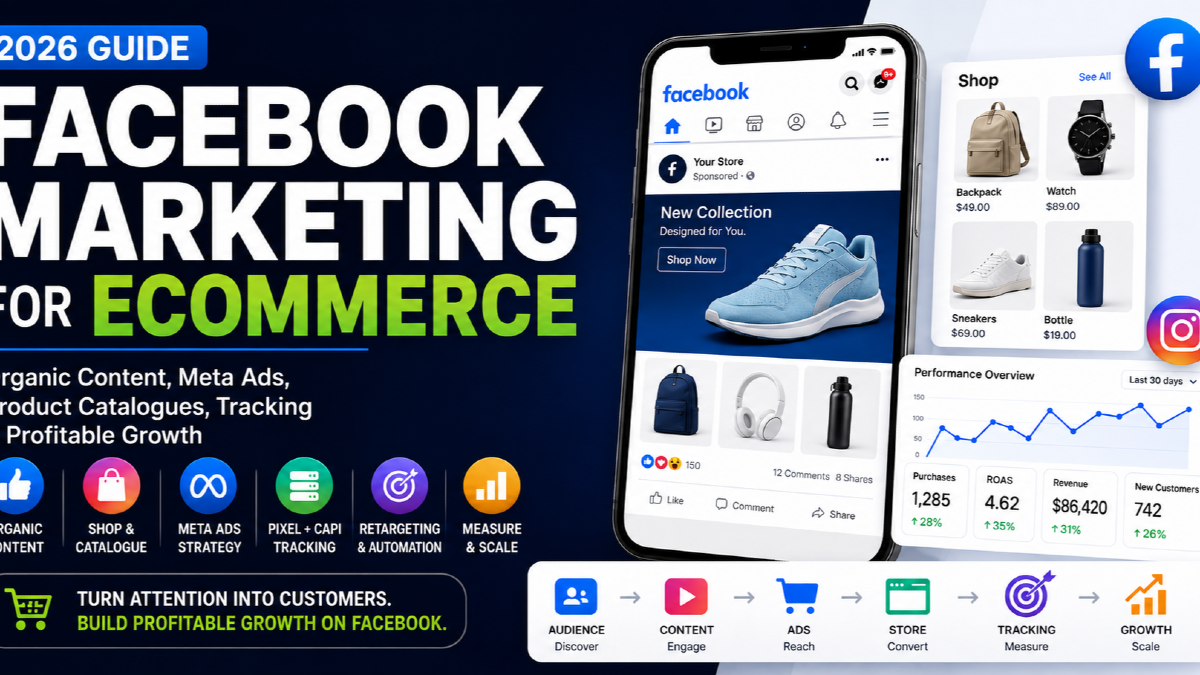
Facebook marketing for eCommerce in 2026 is not a choice between organic posting and Facebook Ads. The strongest strategy connects product merchandising, organic content, paid Meta advertising, conversion tracking and customer economics into one system.
An online store can publish excellent Reels and still fail because the product page does not convert.
It can run technically strong Meta campaigns and still lose money because customer acquisition cost is higher than contribution margin.
It can install the Meta Pixel and Conversions API correctly and still make poor decisions because platform-reported revenue is never reconciled against actual store orders.
That is why I do not think about Facebook eCommerce marketing as a simple funnel anymore.
I think about it as a commerce loop:
Shelf → Story → Signal → Spend → Store → Score → Repeat
- Shelf: What products, collections and catalogue data are available?
- Story: How do you make those products interesting enough to stop attention?
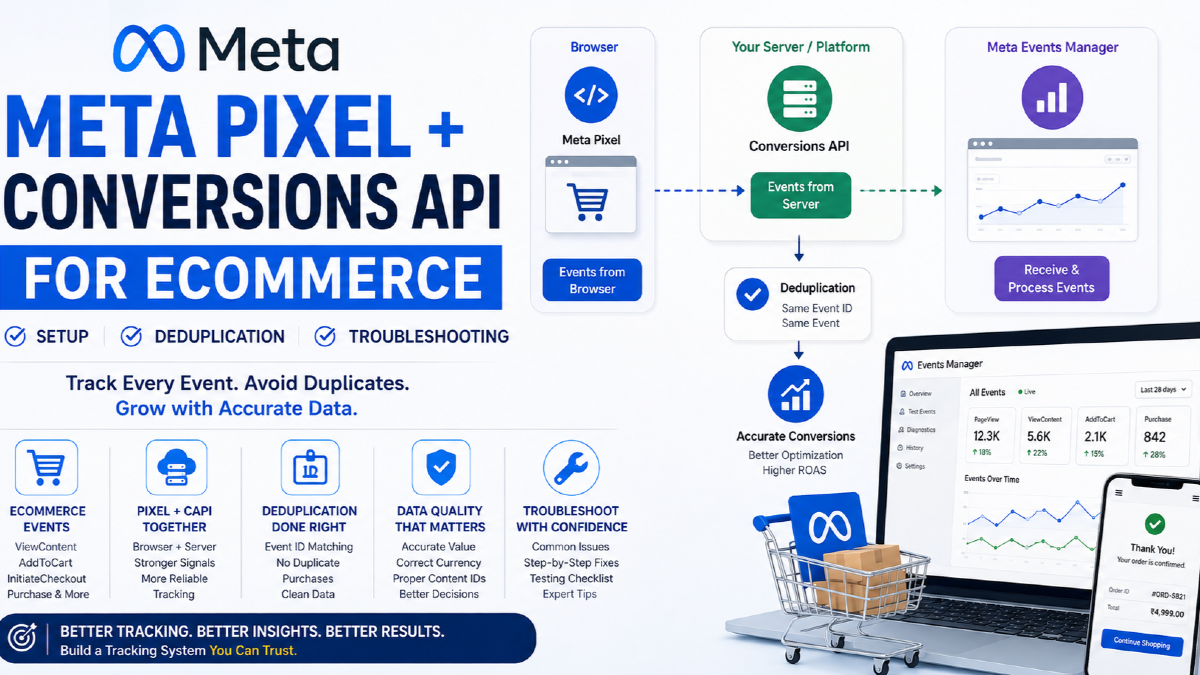
- Signal: Can Meta correctly understand product views, carts, checkouts and purchases?
- Spend: Where should paid distribution be used?
- Store: What happens after someone clicks?
- Score: Did you acquire profitable customers or just generate platform metrics?
Each part affects the next.
That is the framework this tutorial will use.
Why Facebook Marketing for eCommerce Is Different
Most Facebook marketing tutorials begin with:
- create a Facebook Page;
- post consistently;
- choose an audience;
- boost posts;
- run ads.
That is not enough for an eCommerce business.
An online store has additional layers:
- hundreds or thousands of products;
- catalogues and product feeds;
- variants;
- inventory;
- product margins;
- average order value;
- shipping;
- returns;
- repeat purchases;
- website checkout;
- purchase tracking.
Facebook marketing therefore has to work with the commerce system rather than sit beside it.
A good campaign cannot compensate forever for a bad catalogue, poor product economics or a weak store experience.
The Facebook eCommerce Commerce Loop
| Layer | Main question | What can go wrong |
|---|---|---|
| Shelf | Are the right products ready to be discovered? | Weak catalogue, poor product data, low inventory |
| Story | Can we make customers care? | Generic creative, no proof, no differentiation |
| Signal | Can Meta understand meaningful customer actions? | Missing or duplicated events |
| Spend | Where should paid distribution go? | Wrong objective, fragmented campaigns, premature scaling |
| Store | Does the website convert the attention? | Weak PDP, shipping friction, poor checkout |
| Score | Was the customer economically valuable? | ROAS looks good while contribution is weak |
The rest of the article follows these six layers.
1. Shelf: Start With Products, Not Ads
Before deciding what to post or advertise, decide which products deserve attention.
This sounds obvious, but many stores advertise whatever happens to be in the catalogue.
A better starting point is to classify products by:
- revenue;
- margin;
- inventory depth;
- conversion rate;
- repeat purchase potential;
- seasonality;
- visual appeal;
- customer demand.
The product that receives the most clicks is not automatically the product you should scale.
A product with:
- low margin;
- high return rate;
- poor stock depth;
- heavy discount dependency;
can create attractive advertising metrics while contributing very little profit.
Build product groups around commercial logic
Instead of treating a catalogue as one giant pool, think in groups such as:
- bestsellers;
- high-margin products;
- new launches;
- seasonal collections;
- high-AOV products;
- repeat-purchase products;
- clearance stock.
These groups can influence:
- organic content;
- Facebook Shop merchandising;
- catalogue product sets;
- campaign prioritisation;
- creative production.
Facebook Shop Is a Merchandising Layer, Not Your Entire Store
Facebook Shops can give customers another place to discover and browse products.
For supported merchants and markets, platforms such as Shopify can synchronise product data into Facebook and Instagram commerce experiences. Shopify's current 2026 setup supports syncing inventory and product information from the ecommerce backend into the connected Shop.
That can help maintain consistency across:
- product title;
- price;
- images;
- availability;
- collections.
But do not think of Facebook Shop as a replacement for your website.
Your own ecommerce store remains where you control:
- merchandising depth;
- SEO;
- checkout experience;
- first-party customer data;
- upsells;
- bundling;
- site search;
- customer accounts.
Think of Facebook commerce surfaces as additional discovery and merchandising layers around the primary store.
Catalogue Quality Affects More Than Advertising
Once a product catalogue feeds Facebook and Instagram, poor product data becomes a marketing problem.
Pay attention to:
- product IDs;
- titles;
- images;
- price;
- availability;
- variant relationships;
- product groupings.
Your product IDs deserve particular care because website tracking events and catalogue products may need to correspond correctly.
If your website sends one product identifier while the catalogue expects another, product-level tracking and catalogue advertising can become harder to interpret.
2. Story: Organic Facebook Should Be a Creative Laboratory
I would not build an eCommerce organic strategy around:
“We need five Facebook posts every week.”
Posting volume is not the objective.
The more useful question is:
What do we need to learn about customers and creative?
Organic Facebook content can be useful because it gives you a low-media-cost environment for testing:
- product angles;
- hooks;
- objections;
- demonstrations;
- customer language;
- stories.
Some organic posts may generate substantial reach.
Others may generate very little.
That does not make organic content useless.
The learning itself can feed your paid media.
The Six eCommerce Content Jobs
Instead of content pillars such as “educational, inspirational and promotional,” I prefer assigning each piece of content a job.
Job 1: Create product awareness
The customer may not know the product exists.
Useful content:
- new product reveals;
- product-in-use videos;
- before-and-after;
- problem/solution demonstrations.
Job 2: Explain the product
The customer sees it but does not understand why it matters.
Useful content:
- feature demonstrations;
- material explanations;
- sizing;
- how-to videos;
- use cases.
Job 3: Reduce risk
The customer likes the product but does not trust the purchase yet.
Useful content:
- reviews;
- customer videos;
- unboxings;
- return-policy explanations;
- warranty information.
Job 4: Differentiate
The customer is comparing you with alternatives.
Useful content:
- comparison videos;
- why this material;
- how your design differs;
- product-versus-product demonstrations.
Job 5: Merchandise
The customer is ready to browse.
Useful content:
- collections;
- seasonal edits;
- bundles;
- best sellers;
- gift ideas.
Job 6: Trigger action
The customer needs a reason to buy now.
Useful content:
- launches;
- limited stock;
- seasonal offers;
- bundles;
- free shipping;
- promotions.
Now your content calendar becomes a commercial learning system rather than a posting obligation.
Reels: Use Product Motion, Not Just Video
Facebook Reels create another discovery surface for products, and Meta currently includes Reels within its broader Advantage placement environment. Meta also recommends creative that is native to the vertical, mobile-first Reels format.
But “make more Reels” is weak advice.
Instead, ask:
What does motion help the customer understand that a static image cannot?
Examples:
- how fabric moves;
- how a product opens;
- how quickly something works;
- the size of the item in real life;
- before and after use;
- texture;
- assembly;
- how a product fits.
That gives Reels a specific commercial purpose.
Strong organic Reels can become paid creative
If an organic Reel reveals a strong hook or product angle, you can use that insight when producing paid ads.
Do not assume an organic winner will automatically become a paid winner.
But organic behaviour can help identify:
- which product earns attention;
- which opening line works;
- which objection generates discussion;
- which demonstration people replay or share.
Use Comments as Market Research
One of the most valuable parts of organic social is not the engagement count.
It is the language customers use.
Look at comments and messages for:
- questions;
- objections;
- comparison requests;
- shipping concerns;
- feature questions;
- unexpected use cases.
Those comments can become:
- new ads;
- FAQ copy;
- product-page improvements;
- new product bundles;
- email content.
This is how organic Facebook creates value even when organic reach itself is unpredictable.
3. Signal: Your Advertising System Needs Trustworthy Events
Before buying large amounts of traffic, make sure Meta can correctly understand what happens after the click.
For an online store, the most useful customer journey normally includes events such as:
- ViewContent;
- AddToCart;
- InitiateCheckout;
- Purchase.
You may also track Search, AddPaymentInfo and other relevant events.
But adding more events is not automatically better.
The important question is whether each event represents the real customer action accurately.
Purchase Is the Event I Would Audit First
A technically firing Purchase event can still be wrong.
Check:
- Does it fire only after a real completed order?
- Does it fire once?
- Is the value correct?
- Is the currency correct?
- Are the product IDs correct?
- Does it duplicate when the confirmation page is refreshed?
If your setup uses both browser and server events, you also need correct deduplication.
I have covered that implementation separately in the detailed guide to Meta Pixel and Conversions API for eCommerce.
Do Not Confuse More Tracking With Better Tracking
It is possible to send:
- more browser events;
- more server events;
- more matching parameters;
while actually making your measurement worse.
For example:
One store order
could incorrectly become:
Two Meta Purchase events
if the browser and server versions are not deduplicated.
Or the order may send the wrong revenue value.
That gives the platform more data but gives the business worse information.
4. Spend: Paid Facebook Should Amplify What the Business Can Support
Once your product, creative and measurement foundations are usable, paid advertising becomes a distribution system.
This is where modern Facebook marketing differs sharply from the older model.
Historically, advertisers often treated campaign success as an audience-targeting puzzle.
They built:
- many interest ad sets;
- narrow audience stacks;
- multiple lookalike percentages;
- manual placement combinations.
Meta now automates much more of the delivery process.
That shifts advertiser leverage toward:
- creative;
- conversion signal;
- product economics;
- offer;
- campaign simplicity.
The broader paid media system is covered on my Meta Ads page.
For eCommerce, Start With the Sales Outcome
If the business objective is online purchases, your advertising system should ultimately be evaluated against sales.
That does not mean every campaign has to look identical.
But it does mean you should be careful about celebrating easier metrics simply because they are cheaper.
For example:
- cheap video views;
- cheap traffic;
- cheap engagement;
may have a useful role.
But they do not automatically mean customers are being acquired profitably.
Prospecting and Retargeting Should Not Become Two Separate Businesses
Retargeting is useful because ecommerce customers frequently do not purchase during their first visit.
Potential retargeting groups can include:
- product viewers;
- cart users;
- checkout users;
- previous customers.
But there is a trap.
Retargeting often looks efficient because it contains people who already know the business.
If you allocate too much budget there, you can improve reported ROAS while doing little to create new demand.
So separate these two questions:
How efficiently are we converting existing demand?
and:
How efficiently are we creating new customers?
Creative Should Do Some of the Targeting
Imagine you sell running shoes for people with wide feet.
Old targeting logic might begin with:
Which Facebook interest identifies wide-foot runners?
Creative-first logic begins with:
Can the ad make someone with this exact problem immediately recognise themselves?
Example:
“Running shoes feel tight before your run even starts?”
The message itself begins filtering the audience.
This does not mean audience settings have no value.
It means the ad should carry meaningful customer information instead of expecting targeting controls to do all the work.
Build a Creative Portfolio, Not a Single Winning Ad
A product rarely has only one useful story.
For one product, you might test:
| Creative angle | Example |
|---|---|
| Problem | Show the frustration before the product |
| Demonstration | Show exactly how the product works |
| Proof | Use customer review or UGC |
| Comparison | Explain why it differs from alternatives |
| Value | Show bundle, durability or cost-per-use logic |
| Identity | Connect product with how the customer sees themselves |
This is different from changing the button colour or replacing one headline word.
Meaningful creative testing changes the reason a customer may care.
Do Not Refresh Creative on a Fixed Calendar
I would avoid rules such as:
“Replace creatives every five days.”
Creative fatigue depends on:
- spend;
- audience size;
- frequency;
- season;
- product lifecycle;
- creative depth.
A strong ad can continue working for a long period.
A weak ad can fail on the first day.
Use evidence rather than calendar rules.
How Much Should an eCommerce Brand Spend on Facebook Ads?
There is no useful universal daily budget.
The answer depends on the economics.
Suppose:
- your acceptable new-customer CAC is ₹1,500;
- your test budget is ₹300 per day.
You may need several days before even generating enough spend for one expected customer.
Another store with a ₹200 acceptable CAC would operate very differently.
So budget should be connected to:
- expected CAC;
- conversion rate;
- margin;
- testing requirements;
- cash flow.
Do not choose budget because an article says small businesses should spend ₹500 per day.
5. Store: The Ad Click Is Only the Handoff
One of the biggest mistakes in Facebook ecommerce marketing is treating the campaign as responsible for everything after the click.
The ad controls:
- attention;
- expectation;
- message;
- promise.
The store must fulfil that promise.
Product Page Continuity Matters
If the ad says:
“Waterproof trail shoes built for monsoon running.”
but the landing page opens with:
“Premium footwear since 2012.”
you have broken the message continuity.
The shopper should quickly find:
- the same product;
- the same key benefit;
- the same offer;
- the same visual context.
Facebook Traffic Often Needs More Reassurance Than Search Traffic
A customer who searched Google for:
buy waterproof running shoes
already expressed strong intent.
A customer who discovered the product while scrolling Facebook may need more persuasion.
That means your product page may need to work harder on:
- problem explanation;
- proof;
- reviews;
- delivery;
- returns;
- sizing;
- trust.
This is one reason Meta and Google traffic should not always be judged as though they arrive with identical intent.
Diagnose the Funnel by Behaviour
If ads generate clicks but not purchases, identify where the behaviour breaks.
| Behaviour | Likely area to investigate |
|---|---|
| Impressions but no clicks | Creative, offer, audience/message fit |
| Clicks but poor landing-page engagement | Page speed, message mismatch, weak page |
| Product views but few carts | Product, price, proof, offer |
| Carts but few checkouts | Shipping, cart friction, price shock |
| Checkouts but few purchases | Payment, trust, checkout friction |
| Purchases but poor profit | CAC, margin, discounting, returns |
When the problem goes beyond tracking and customers still do not convert, use the deeper diagnostic on why Meta Ads are not converting.
Cart Abandonment Is Not Automatically a Retargeting Problem
When customers add to cart but fail to purchase, many marketers immediately launch more retargeting ads.
But abandonment may be caused by:
- unexpected shipping;
- delivery times;
- lack of payment method;
- coupon-code hunting;
- weak trust;
- comparison shopping.
Advertising can remind the customer.
It cannot remove every source of friction.
6. Score: Stop Using ROAS as the Only Verdict
This is where the commerce loop becomes a business system rather than an advertising tutorial.
Meta reports advertising performance.
Your store reports transactions.
Your finance data tells you whether those transactions created economic value.
You need all three.
Platform ROAS and Business Profit Are Different Questions
ROAS is useful.
But it does not directly account for:
- cost of goods;
- shipping subsidy;
- payment fees;
- returns;
- discounts;
- agency or operational costs.
Imagine:
Meta revenue: ₹10 lakh
Ad spend: ₹2 lakh
Reported ROAS:
5×
That may look excellent.
But whether it is commercially excellent depends on the margin behind the ₹10 lakh.
Add New-Customer CAC
If existing customers buy frequently, reported performance can look stronger because the campaign is capturing people who already know the brand.
So where possible, separate:
- new customers;
- returning customers.
Then calculate:
New-customer CAC = acquisition spend / new customers acquired
This creates a much more useful question:
How much does Meta cost us to acquire a customer we did not previously have?
Use MER to Understand the Whole Business
MER — marketing efficiency ratio — provides a blended view.
A simple version is:
Total business revenue / total marketing spend
This does not replace channel reporting.
It helps stop a common mistake:
every platform claiming credit while the business itself is not growing proportionally.
Use GA4 as a Different Lens, Not a Referee
GA4 can help you understand broader customer journeys and landing-page behaviour.
But Meta Ads Manager and GA4 use different attribution logic.
They should not be expected to show identical results.
For behavioural analysis beyond Meta reporting, use the GA4 eCommerce funnel analysis framework.
The Commerce Loop Should Produce Better Questions
Once you connect Shelf, Story, Signal, Spend, Store and Score, your reporting changes.
Instead of asking:
“Why did Facebook ROAS fall?”
you can ask:
- Did the product mix change?
- Did a bestselling product go out of stock?
- Did creative fatigue increase?
- Did Purchase tracking change?
- Did landing-page conversion decline?
- Did shipping cost increase?
- Did new-customer share fall?
Those are better business questions.
Organic and Paid Should Share a Creative Memory
One of the most powerful operational changes you can make is to stop running organic social and paid social as isolated teams.
Build a shared creative record.
For every piece of content, record:
- product;
- hook;
- customer problem;
- format;
- offer;
- organic response;
- paid response;
- sales outcome.
Over time, you begin learning patterns such as:
- UGC works best for Product A;
- demonstrations work best for Product B;
- comparison angles work best for Product C;
- discount creative gets clicks but lower-quality customers.
That knowledge is much more valuable than finding one temporary winning ad.
How Facebook and Google Ads Should Work Together
For many ecommerce brands, Facebook and Google are not substitutes.
They often interact with different forms of demand.
A simplified journey might be:
Facebook Reel → product discovery → website visit → later Google search → Shopping click → purchase
Another journey could be:
Google search → product view → no purchase → later Meta ad → purchase
Both are possible.
This is why comparing dashboard ROAS without understanding the customer journey can be misleading.
I cover the channel decision in more depth in Google Ads vs Meta Ads for eCommerce.
When Facebook Should Not Be Your First eCommerce Growth Channel
Facebook is not automatically the right answer for every store.
Be cautious when:
- the product is extremely difficult to demonstrate;
- margins cannot support paid acquisition;
- the website barely converts existing high-intent traffic;
- the store cannot produce creative consistently;
- tracking is unreliable;
- stock changes too quickly;
- the product relies almost entirely on active search demand.
In those cases, another constraint may deserve investment first.
When Facebook Can Be Especially Strong
The platform can be particularly useful when:
- the product is visual;
- the product benefits from demonstration;
- people are not already searching heavily for it;
- customer stories influence buying;
- the product has several creative angles;
- repeat purchasing supports acquisition economics.
For a deeper paid-media framework around these conditions, see Meta Ads for eCommerce.
A Better Weekly Facebook Marketing Review
Instead of spending your weekly meeting scrolling through Ads Manager, review one question from each commerce-loop layer.
| Layer | Weekly question |
|---|---|
| Shelf | Which products deserve more or less attention? |
| Story | What creative angle did we learn this week? |
| Signal | Can we still trust our Purchase data? |
| Spend | Where is the next useful budget opportunity? |
| Store | Where is conversion friction increasing? |
| Score | Are we acquiring economically valuable customers? |
That meeting is far more useful than:
CTR increased by 0.2%.
What Changes Beyond 2026?
Facebook's interface will continue changing.
Campaign options will change.
Meta will automate more creative and delivery decisions.
AI-generated advertising assets will become easier to produce.
But those changes do not invalidate the commerce loop.
Automation makes inputs more important
As Meta automates more:
- bidding;
- placements;
- audience expansion;
- creative variation;
the advertiser's advantage increasingly comes from the inputs automation cannot invent reliably on its own:
- a good product;
- customer insight;
- a differentiated offer;
- real creative ideas;
- accurate business data.
AI will increase creative quantity
Generating ad variations will become easier.
That means quantity itself will become less impressive.
The scarce asset will be:
a useful idea worth generating variations around.
First-party business data becomes more valuable
The businesses with the strongest advantage will understand:
- which customers are new;
- which products create profit;
- which customers repeat;
- which acquisition channels create incremental value.
That knowledge helps guide the platform instead of relying on platform dashboards to define business success.
Facebook eCommerce Marketing Mistakes I Would Stop Making
Publishing organic content with no commercial learning objective
Ask what the content is meant to teach you about the product or customer.
Advertising every product equally
Products have different margins, inventory and conversion potential.
Using narrow targeting as the entire strategy
The creative and offer should identify the customer problem.
Calling retargeting your growth engine
Retargeting converts existing interest. It does not create unlimited new demand.
Optimising toward cheap clicks
Cheap traffic is not automatically commercially useful traffic.
Changing creative because seven days passed
Use actual performance evidence.
Installing more tracking when the existing tracking is wrong
Correct data beats more data.
Making Meta ROAS the final business KPI
Use store revenue, CAC and profitability alongside platform reporting.
Blaming ads for every conversion problem
Sometimes the product page or checkout is the constraint.
Scaling before the business economics work
Increasing spend magnifies the underlying economics.
Frequently Asked Questions
Is Facebook still good for eCommerce in 2026?
Yes, for the right products and economics. Facebook is particularly useful for product discovery, visual demonstration, customer proof and paid acquisition. Success still depends on creative, tracking, website conversion and customer acquisition economics.
Should an eCommerce store focus on organic Facebook or paid Facebook Ads?
They serve different roles. Organic content can build trust and reveal useful creative insights, while paid advertising provides scalable distribution. Strong ecommerce teams often use organic learning to improve paid creative.
Does an eCommerce brand need a Facebook Shop?
Not every store needs one, and availability depends on Meta's commerce eligibility and supported markets. A Shop can provide another product discovery surface, but your main ecommerce website should remain central to the broader customer and data strategy.
What Facebook content works best for eCommerce?
There is no universal winner. Useful formats include product demonstrations, UGC, comparisons, customer proof, product education, Reels and collection merchandising. The strongest format depends on what the customer needs to understand before buying.
Should I use broad targeting or interests for Facebook eCommerce ads?
Do not treat it as a fixed rule. Broad targeting can work well when creative and conversion data are strong, while more defined audiences can still be useful in specific situations. Test based on your account rather than following a universal audience formula.
How much should I spend on Facebook Ads for an eCommerce store?
Base the budget on expected customer acquisition cost and the amount of data required to evaluate the campaign. A useful test budget should be capable of generating enough meaningful conversion opportunities to learn something.
What is the most important Facebook Ads metric for eCommerce?
There is no single metric. Purchase CPA and ROAS are useful, but new-customer CAC, contribution margin, MER, AOV and repeat customer value provide important business context.
Can Meta Pixel and Conversions API improve Facebook marketing?
Reliable Pixel and CAPI tracking can provide a better representation of customer actions when implemented correctly. They do not guarantee better advertising performance on their own.
Why do Meta Ads show more sales than my store attributes to Facebook?
Meta and your ecommerce or analytics systems answer different attribution questions. First verify that Purchase tracking is accurate and deduplicated, then evaluate the difference as an attribution issue rather than assuming one platform must be wrong.
Final Takeaway: Build the Commerce Loop, Not a Facebook Tactic
Facebook eCommerce marketing works best when organic content, paid advertising, tracking and store economics stop operating as separate projects.
The system is:
Shelf → Story → Signal → Spend → Store → Score
Your products determine what is worth promoting.
Your stories determine whether customers care.
Your tracking determines whether Meta and your team can understand what happened.
Your paid media scales useful distribution.
Your website turns that attention into orders.
Your economics determine whether those orders were worth acquiring.
Then the results feed back into the next product decision and the next creative idea.
That is the Facebook marketing system I would build for an ecommerce brand in 2026 and beyond.
The platform will keep changing. The loop does not depend on one campaign type, one audience feature or one creative trend surviving forever.
It depends on understanding customers and turning attention into economically useful purchases.
That is also the wider performance-marketing approach behind Vijay Bhabhor: use platforms as parts of the acquisition system rather than allowing platform metrics to become the business strategy.