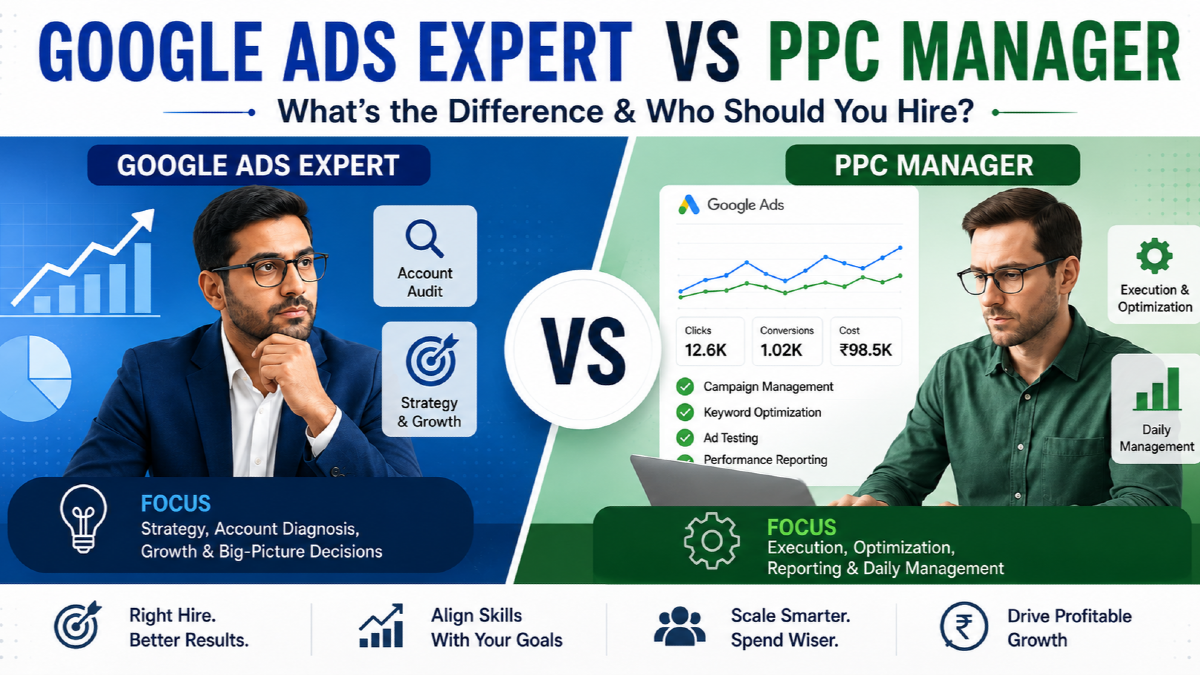
If you are hiring someone to manage Google Ads, the difference between a Google Ads expert and a PPC manager is not as clear as the job titles suggest.
Both may build campaigns, manage budgets, review search terms, adjust bidding, test ads, monitor conversions and report performance.
The real difference usually appears in what you expect the person to decide.
If your advertising strategy is already clear and you need someone to operate, monitor and improve campaigns consistently, an experienced PPC manager may be exactly what you need.
If you do not know why performance has declined, whether your tracking can be trusted, how the account should be restructured, what CPA or ROAS the business can actually afford, or where the next increase in budget should go, you need someone capable of deeper diagnosis and strategic decision-making.
That person may call themselves a Google Ads expert, PPC manager, paid search specialist or performance marketer.
Do not hire the title. Hire the level of responsibility and judgement your account requires.
Google Ads Expert vs PPC Manager: Quick Comparison
| Area | PPC Manager | Google Ads Expert |
|---|---|---|
| Campaign setup | Yes | Yes |
| Ongoing optimization | Core responsibility | Can manage directly |
| Search-term management | Yes | Yes |
| Budget pacing | Yes | Yes |
| Bidding strategy | Usually | Expected |
| Ad and asset testing | Yes | Yes |
| Conversion tracking review | Should understand it | Should be able to diagnose it |
| Account diagnosis | Depends on seniority | Core expectation |
| Major restructuring | May implement it | Should be able to design and justify it |
| Scaling strategy | May execute the plan | Should help determine where growth can come from |
| Business economics | Useful | Should influence decisions |
| Best fit | Continuous campaign ownership | Diagnosis, complex decisions and strategic direction |
These are practical distinctions, not official industry definitions.
A senior PPC manager can be far more capable than someone marketing themselves as a Google Ads expert. An experienced independent specialist may handle both strategy and daily campaign management.
The title tells you very little until you understand what the person actually owns.
Why These Job Titles Cause So Much Confusion
There is no universal definition of a Google Ads expert or PPC manager.
Companies and agencies use titles such as:
- Google Ads Specialist
- PPC Specialist
- PPC Manager
- Paid Search Manager
- Performance Marketing Manager
- Google Ads Consultant
- Google Ads Expert
for roles that can overlap heavily.
The agency model can make the distinction even less obvious.
At one agency, an account manager may mainly handle communication while a separate specialist makes campaign decisions. At another, the same person may control strategy, bidding, budgets, testing and reporting.
An independent specialist may handle the entire account personally.
Instead of relying on titles, clarify three things before hiring:
- Who decides what should be done?
- Who actually makes the changes inside the account?
- Who is accountable for explaining why business performance improved or declined?
Those answers are much more useful than the person's job title.
What Does a PPC Manager Actually Do?
A PPC manager usually provides continuous ownership of paid advertising campaigns.
The job is not simply to log into Google Ads and make changes. A capable manager keeps campaigns aligned with budget, conversion goals and changing search behaviour.
Campaign Management
Depending on the business, a PPC manager may operate:
- Search campaigns;
- Shopping campaigns;
- Performance Max;
- Demand Gen;
- YouTube campaigns;
- Display campaigns;
- remarketing campaigns.
The campaign mix should reflect how the business acquires customers rather than an obligation to use every Google Ads campaign type.
Search-Term and Keyword Management
For Search campaigns, ongoing management includes understanding which searches are consuming budget and which are producing useful business outcomes.
This can involve:
- reviewing search terms;
- adding negative keywords;
- finding new commercial queries;
- monitoring match-type exposure;
- identifying irrelevant traffic;
- reducing wasted spend.
Budget Management
A PPC manager should know whether campaigns are spending too quickly, failing to use available budget or consuming money in areas with weaker returns.
Good budget management goes beyond staying within a monthly limit.
The manager should be able to explain why one campaign deserves more budget than another.
Bidding and Optimization
Modern Google Ads accounts rely heavily on automated bidding strategies such as Maximize Conversions, Maximize Conversion Value, Target CPA and Target ROAS.
The manager therefore needs to understand more than how to select a bidding strategy.
They need to understand what conversion signals are being supplied to Google's bidding system and whether those signals represent the outcome the business actually wants.
Ad and Asset Testing
Ongoing management can also include testing:
- headlines;
- descriptions;
- offers;
- images;
- video assets;
- landing-page alignment;
- campaign assets.
The purpose of testing should be to answer a commercial question, not simply to keep generating new variations.
Conversion Monitoring
A PPC manager does not necessarily need to personally implement every advanced analytics configuration, but they should recognize when the data they are optimizing against looks unreliable.
If Google Ads reports 100 conversions but the CRM shows only 20 useful leads, that discrepancy cannot be ignored simply because campaign metrics look good.
Performance Reporting
A useful PPC report should answer three questions:
- What changed?
- Why did it change?
- What should happen next?
A dashboard showing impressions, clicks, conversions and ROAS without interpretation is reporting activity, not management insight.
If your campaigns already have a clear direction and primarily need consistent operational ownership, ongoing Google Ads management services are usually the more appropriate requirement.
What Should a Google Ads Expert Bring Beyond Campaign Management?
The word expert is useful only when it represents a higher quality of diagnosis and decision-making.
Years of platform experience alone do not create that difference.
The value becomes clearer when the obvious campaign optimizations are no longer solving the problem.
Diagnosing Why a Profitable Account Has Stopped Scaling
Suppose your account produces acceptable returns at $20,000 per month, but performance deteriorates whenever you try to spend $30,000.
Changing bids may not solve that problem.
The more useful questions are:
- Has the existing demand pool reached saturation?
- Which campaigns still have profitable incremental demand?
- Are additional conversions coming from weaker audiences?
- Should expansion happen through another product, market or campaign type?
- How much efficiency can the business afford to sacrifice for additional volume?
This is a scaling decision, not merely a campaign-maintenance task.
Deciding Whether the Account Structure Still Makes Sense
Google Ads accounts accumulate history.
After several years, agencies or internal teams may leave behind:
- overlapping campaigns;
- duplicate targeting;
- outdated structures;
- conflicting conversion goals;
- unnecessary segmentation;
- fragmented bidding data.
A manager can keep optimizing that structure indefinitely.
An experienced specialist should also be willing to ask whether the structure itself has become the problem.
Questioning Whether Google Is Optimizing Toward the Right Outcome
Automated bidding becomes dangerous when the conversion data feeding it is misleading.
Before trying to make the campaigns more efficient, an expert should understand:
- which actions are counted as primary conversions;
- whether conversions are duplicated;
- whether purchase values are accurate;
- whether reported leads become qualified opportunities or customers;
- whether new and existing customers should be measured differently;
- whether offline sales need to be connected back to advertising.
If the optimization signal is wrong, Google Ads can become very efficient at generating the wrong outcome.
Putting ROAS and CPA Into Business Context
A reported 500% ROAS does not automatically mean an account should receive more budget.
The result may be influenced by branded searches, existing customers, different product margins or attribution rules.
Similarly, a $100 CPA cannot be called expensive or cheap until you know what a customer is worth to the business.
Advertising metrics become useful only when they are connected to economics such as:
- gross margin;
- contribution margin;
- average order value;
- repeat purchase behaviour;
- lead-to-sale rate;
- customer lifetime value;
- new customer acquisition cost.
Knowing When Google Ads Is Not the Main Problem
More campaign optimization cannot fix every acquisition problem.
Sometimes the next improvement needs to happen elsewhere.
The constraint may be:
- poor conversion tracking;
- weak landing pages;
- uncompetitive pricing;
- poor product availability;
- low-margin products;
- weak Shopping feed data;
- poor lead qualification;
- slow sales follow-up.
A senior Google Ads expert should be able to identify when changing campaigns is unlikely to solve the actual business problem.
The Most Useful Difference: Execution, Analysis, Diagnosis and Direction
Instead of trying to separate “manager” from “expert,” evaluate the person across four levels of responsibility.
Level 1: Execution
Can the person correctly:
- build campaigns;
- manage search terms;
- configure campaign settings;
- create ads;
- control budgets;
- implement tracking requirements?
Level 2: Analysis
Can they explain:
- why CPA increased;
- why ROAS changed;
- where spend shifted;
- which search terms influenced performance;
- why a campaign stopped spending;
- why conversion volume changed?
Level 3: Diagnosis
Can they determine whether the real problem sits outside the obvious Google Ads settings?
This might include broken tracking, poor lead quality, weak margins, landing-page problems, feed issues or inventory constraints.
Level 4: Direction
Can they decide:
- what should be prioritized;
- what should be stopped;
- where additional budget should go;
- which markets or products deserve investment;
- which trade-offs are acceptable;
- how success should actually be measured?
A business spending a small, stable budget may primarily need Levels 1 and 2.
As spend, markets, products and measurement complexity increase, Levels 3 and 4 become much more valuable.
Google Ads Expert vs PPC Manager: Which One Does Your Business Need?
| Your Situation | Likely Requirement |
|---|---|
| Campaigns are performing and need continuous optimization | PPC management |
| New campaigns need to be created and maintained | PPC management |
| No one consistently reviews search terms, budgets and tests | PPC management |
| Performance suddenly declined and the cause is unclear | Expert diagnosis |
| Conversion tracking cannot be trusted | Measurement expertise |
| Several agencies or managers have repeatedly changed the account | Audit or expert review |
| Spend is increasing but profitable growth is not | Senior strategic expertise |
| Your internal team can execute but needs direction | Consulting |
| The account works but nobody has time to manage it properly | PPC management |
| A major account restructure is being considered | Expert review |
| You do not know what an acceptable CPA or ROAS should be | Senior strategic support |
You may also need both roles at different stages.
An experienced specialist might diagnose, restructure and establish the strategy first. Once the account becomes stable, a PPC manager can take responsibility for continuous operation and optimization.
When a PPC Manager Is Enough
Hiring the most senior specialist available is not automatically the best decision.
A capable PPC manager may be enough when:
- business objectives are already clear;
- conversion tracking is reliable;
- campaign structure makes sense;
- the account is generating acceptable results;
- budgets are relatively stable;
- the primary need is monitoring, testing and optimization.
In that situation, paying for continuous strategic intervention may add little value.
Good campaign management matters. The mistake is expecting routine management to solve a problem that actually requires diagnosis.
When You Need Deeper Google Ads Expertise
Senior specialist involvement becomes more useful when the business has unanswered questions rather than simply unfinished campaign tasks.
Your Spend Is Increasing but Revenue Is Not
This may point to demand saturation, weaker incremental traffic, budget misallocation or changes elsewhere in the conversion journey.
Lead Volume Is Increasing but Sales Are Not
If campaigns optimize toward form submissions, automated bidding may learn to generate more people willing to complete forms rather than more customers.
Lead quality must become part of the measurement system.
Google Ads and Your Backend Numbers Disagree
When advertising-platform conversions, analytics data, CRM records and actual revenue tell different stories, scaling based on platform ROAS becomes risky.
The discrepancy should be understood before major budget decisions are made.
The Account Has Been Rebuilt Several Times
Repeated restructuring can create more complexity instead of solving the original problem.
If several managers or agencies have already changed the account, a structured Google Ads audit may be a better starting point than another immediate rebuild.
Every Attempt to Scale Damages Efficiency
Some decline in efficiency is normal when advertising expands beyond the easiest demand.
But if nobody can explain where incremental customers should come from, the account needs a growth strategy rather than another round of routine optimization.
When Consulting Makes More Sense Than Hiring Another Manager
Sometimes you already have enough people managing the account.
You may have an in-house marketer, an agency, an analytics team or a competent PPC manager capable of implementing recommendations.
The missing piece may be senior strategic review.
In that situation, replacing the existing team can create unnecessary disruption.
Consulting can be a better model when you need someone to review strategy, challenge assumptions, diagnose performance problems or guide major decisions while your existing team continues implementation.
How to Evaluate a Google Ads Expert or PPC Manager Before Hiring
Years of experience are useful context, but they tell you very little about how someone will handle your account.
Ask questions that reveal their decision process.
1. What Would You Review Before Changing My Campaigns?
A strong answer should begin with understanding the business, existing measurement, historical performance, search terms, campaign structure and customer economics.
Be cautious if someone recommends changing bidding strategies or rebuilding campaigns before understanding why the current account performs as it does.
2. How Would You Check Whether My Conversion Tracking Is Reliable?
The answer should go beyond confirming that a conversion tag fires.
They should want to understand whether the conversion represents a useful business outcome and whether the values sent into Google Ads are accurate.
3. How Would You Decide Whether We Should Increase Budget?
“ROAS is good” is not enough.
A stronger answer considers:
- remaining demand;
- marginal acquisition efficiency;
- profitability;
- inventory;
- lead quality;
- new customer acquisition;
- the business's acceptable efficiency range.
4. When Would You Recommend Spending Less?
This question exposes whether the person sees themselves as a media buyer or a business advisor.
There are situations where reducing spend temporarily is the correct decision, particularly when measurement, inventory, conversion rate or economics do not support additional acquisition.
5. How Do You Separate a Google Ads Problem From a Business Problem?
Sometimes the advertising is functioning correctly while another part of the system is failing.
For example:
- the landing page does not convert;
- pricing is uncompetitive;
- the sales team does not follow up;
- inventory is weak;
- the offer is poor;
- attribution is unreliable.
The person responsible for paid acquisition should be able to recognize when campaign changes are not the answer.
6. Who Will Actually Work Inside My Account?
This question is particularly important when hiring an agency.
The senior person conducting the sales call may not be the person reviewing your search terms, budgets and performance every week.
Ask who makes strategic decisions, who implements them and how often senior oversight occurs.
If you are considering an offshore specialist, this guide to hiring a Google Ads expert from India covers additional questions worth checking.
Does Google Ads Certification Prove Someone Is an Expert?
No.
Google Ads certification can demonstrate familiarity with Google's products, campaign concepts and platform terminology.
It does not prove that someone can diagnose why a business is losing money, identify unreliable measurement, decide how much the company can afford to pay for a customer or determine where another $20,000 of advertising budget should go.
Use certification as one signal among several.
Also evaluate:
- actual account responsibilities;
- problem-solving ability;
- measurement knowledge;
- business understanding;
- communication;
- strategic judgement;
- hands-on account ownership.
How Much Should You Pay a Google Ads Expert or PPC Manager?
There is no meaningful universal rate because two accounts spending the same amount can require completely different levels of work.
Pricing can change based on:
- monthly advertising spend;
- number of campaigns;
- number of markets;
- product or service complexity;
- Shopping feed requirements;
- conversion tracking complexity;
- reporting requirements;
- strategic involvement;
- implementation responsibility.
The useful question is not:
Who charges the lowest management fee?
Ask:
What decisions, implementation and accountability am I paying this person to own?
You can compare common pricing structures in this guide to Google Ads management fees in India.
A Simple Framework for Deciding Who to Hire
Do You Already Know What Needs to Be Done?
Yes: You probably need reliable execution and ongoing account ownership. A competent PPC manager may be enough.
No: Diagnose the problem before paying someone simply to manage the existing structure.
Can You Trust Your Conversion Data?
Yes: Campaign and budget decisions can be made with greater confidence.
No: Fix or validate measurement before making aggressive scaling decisions.
Is the Account Stable but Time-Consuming?
Yes: Ongoing PPC management is probably the main requirement.
No: If the account is unstable, declining or repeatedly fails when scaled, deeper specialist involvement may be necessary.
Do You Already Have Someone Who Can Implement Recommendations?
Yes: Strategic consulting or periodic expert review may be enough.
No: Hire someone capable of both deciding what should happen and implementing those decisions.
Do You Need a Better PPC Manager or a Different Google Ads Strategy?
This is often the more useful question.
If search terms are rarely reviewed, budgets are poorly controlled, campaigns are neglected, testing is inconsistent and agreed changes are not implemented, you have a management problem.
If the campaigns are actively managed, reporting is consistent and optimization is happening, but nobody can explain why growth has plateaued or why additional budget stops producing profitable customers, you may have a strategy, measurement or business-economics problem.
Replacing one competent manager with another will not automatically solve the second problem.
If you are not yet sure where the constraint sits, start by diagnosing why Google Ads is not working before deciding which type of specialist you need.
Google Ads Expert vs PPC Manager: Final Answer
A Google Ads expert and a PPC manager are not mutually exclusive roles. The same person can be both.
If your business mainly needs someone to:
- operate campaigns continuously;
- manage keywords and search terms;
- monitor budgets;
- manage bidding;
- test ads and assets;
- report and improve performance;
you need strong PPC management.
If you also need someone to:
- diagnose why performance has changed;
- challenge the existing account structure;
- validate conversion measurement;
- identify why scaling is failing;
- connect CPA and ROAS with business economics;
- decide where additional budget should go;
- recognize when Google Ads is not the real constraint;
you need deeper strategic expertise.
Define the decisions you need someone to own first. Then hire the person who has demonstrated that level of capability, regardless of the title on their website or LinkedIn profile.
Frequently Asked Questions
Is a Google Ads expert the same as a PPC manager?
They can be. Neither title has a standardized industry definition. A senior PPC manager may handle strategy, execution, measurement and scaling, while someone using the Google Ads expert title may perform similar work. Compare actual responsibilities and decision ownership rather than titles.
What does a PPC manager do?
A PPC manager typically manages campaigns, budgets, search terms, bidding, testing, conversion performance and reporting. More experienced managers may also handle strategy, forecasting, restructuring and scaling decisions.
What makes someone a Google Ads expert?
Expertise should show in the quality of diagnosis and decisions. A strong specialist should understand campaign mechanics, measurement and automated bidding while also being able to connect advertising performance with customer acquisition, profitability and business objectives.
Should I hire a PPC manager or a Google Ads expert?
Hire according to the problem you need solved. If your account has a clear strategy and needs continuous execution, a PPC manager may be enough. If you have unresolved tracking, performance, restructuring or scaling problems, deeper specialist involvement is more appropriate.
Can one person handle both Google Ads strategy and management?
Yes. Senior in-house marketers and independent Google Ads specialists commonly handle both. Larger agencies are more likely to divide strategy, implementation, analytics and client communication among several people.
Is Google Ads certification enough to prove expertise?
No. Certification demonstrates knowledge of Google's advertising products and concepts. It does not prove that someone has successfully diagnosed difficult accounts, handled complex measurement or made commercially sound scaling decisions.
When should I replace my current Google Ads manager?
Replace the manager when the problem is genuinely poor management, such as neglected search terms, weak budget control, lack of monitoring, poor implementation or an inability to explain account activity. If management is competent but growth has stalled, investigate strategy, tracking, website performance, product economics or market demand before assuming a new manager will solve the problem.