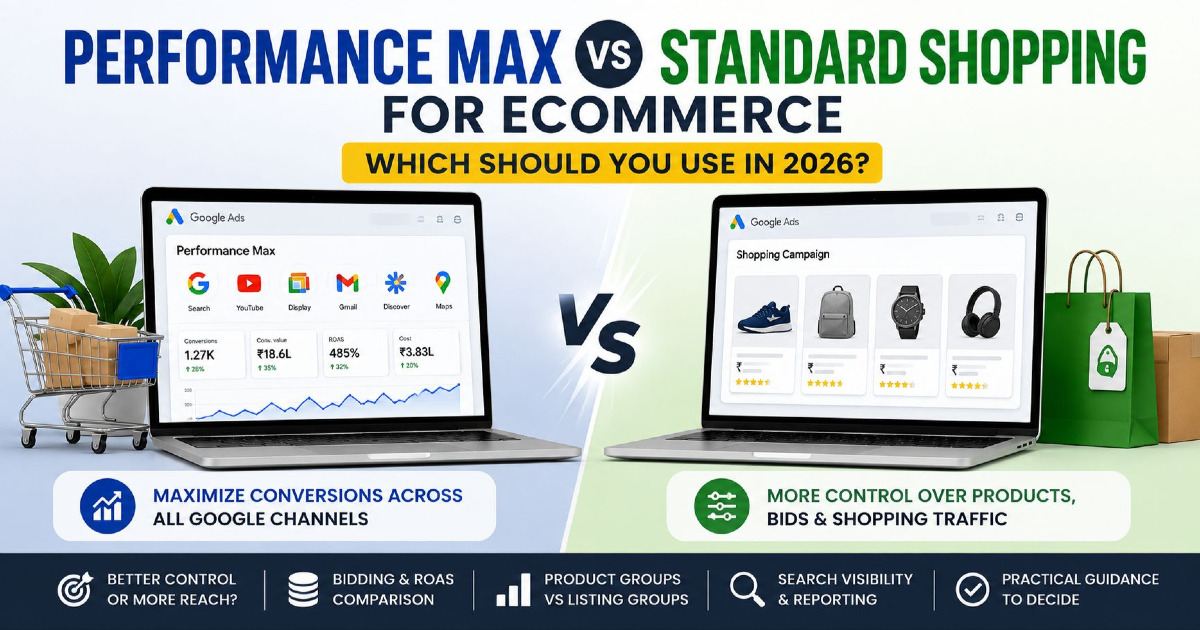
Your Performance Max campaign shows 5x ROAS.
Conversions flow consistently. Cost metrics stay controlled. Dashboard signals green across all KPIs.
Most advertisers stop here.
But here's what that ROAS number actually hides: 40–60% of those conversions likely come from people who were already buying from you.
They already knew your brand. They already searched for you by name. They were already at the transaction stage.
Performance Max simply stepped in, showed an ad, and took credit.
So your attribution dashboard reports strong performance. But your actual business growth? Barely expanding.
This gap between reported efficiency and real market expansion only becomes visible when you try to scale — and watch performance collapse.
The problem isn't your creative. It isn't your bidding strategy. It isn't even Google's algorithm.
It's your measurement architecture.
Most accounts blend demand capture (converting people already ready to buy) with demand creation (reaching new audiences) inside one campaign. Then use combined metrics to make budget decisions.
That structure guarantees misallocation.
This article breaks down exactly how Performance Max attribution creates this distortion, how to diagnose it in your account, and the specific structural fix that separates real performance from inflated metrics.
No theory. Just the mechanical reality of how attribution works — and what to change.
Why Most Advertisers Misread PMax Performance
Your Performance Max dashboard reports strong numbers.
ROAS holds at 4x or higher. Conversions flow consistently. Cost metrics appear controlled.
On the surface, everything signals success.
But here's the structural problem most advertisers never identify.
ROAS measurement doesn't distinguish between demand you created and demand you captured.
It aggregates all conversion events into one efficiency metric. That aggregation hides the composition of your results.
In most ecommerce accounts, a substantial portion of conversions originates from users already progressing toward purchase. They recognized your brand. They initiated branded searches. They required minimal persuasion.
Performance Max intercepted that existing intent and processed the conversion.
So your attribution reports reflect strong performance.
But the underlying question remains unanswered:
Did your campaign generate that demand, or simply harvest it?
That distinction determines whether you're building sustainable growth or extracting value from a limited pool.
When this separation doesn't exist in your measurement framework:
- Budget increases feel justified by strong ROAS
- Efficiency metrics remain stable initially
- But customer acquisition rate stagnates
This creates the illusion of progress while actual market expansion slows.
Your dashboard communicates efficiency.
Your business experiences plateau.
Until you separate perception from mechanics, scaling decisions operate on incomplete information.
The next section reveals exactly how attribution architecture creates this distortion — and why automation doesn't correct it.
The Attribution Architecture Problem Inside Performance Max
Performance Max doesn't just execute campaigns.
It controls attribution logic.
That's where measurement accuracy begins to diverge from reality.
Every conversion your dashboard displays operates through attribution models. Google's algorithms determine which campaign receives credit for each conversion event.
The system follows documented rules.
But here's the structural constraint.
Performance Max optimizes toward conversion probability, not demand origination.
The campaign type uses cross-channel inventory to identify users exhibiting purchase intent signals. This typically targets individuals already advancing through consideration stages.
Users actively searching for solutions.
Comparing specific products.
Demonstrating clear buying signals.
Performance Max identifies these high-probability converters and delivers relevant creative.
Then captures attribution credit.
This creates systematic attribution bias.
The algorithm naturally gravitates toward users who convert easily — not users who require demand generation to reach purchase consideration.
So when you analyze performance reports, Performance Max appears to drive significant results.
But mechanically, it often enters the conversion path at advanced funnel stages.
That's why efficiency metrics look strong.
That's why performance appears consistent.
And that's why many advertisers accept the data without investigating conversion composition.
Automation optimizes within its objective function.
It doesn't validate whether that function aligns with business growth needs.
If the system prioritizes conversion likelihood over demand expansion, your attribution data will reflect that optimization path.
Not the complete customer acquisition picture.
Once you understand this mechanical reality, Performance Max performance data requires different interpretation.
Not as a growth measurement system.
But as an efficiency optimization system that needs external validation.
How Branded Search Traffic Inflates Performance Max ROAS (What Standard Reports Conceal)
Let's examine the composition layer.
In most ecommerce Performance Max accounts, conversion volume doesn't primarily originate from new audience discovery.
It concentrates in branded search behavior.
Between 40–60% of Performance Max conversions typically stem from branded query traffic.
This means users already input your brand name into search interfaces.
They possess existing brand awareness.
They demonstrate established trust signals.
They operate near transaction decision points.
Performance Max serves ads to these high-intent users and receives attribution for the conversion event.
This is where ROAS calculations begin reflecting efficiency that doesn't represent acquisition performance.
Branded traffic converts at substantially higher rates than non-branded audience segments.
- Lower cost-per-click from reduced competition
- Elevated conversion rates from existing familiarity
- Superior ROAS from minimal acquisition friction
When these branded conversions blend into aggregated Performance Max metrics, overall performance indicators inflate.
Efficiency metrics improve.
Dashboard ROAS rises.
But growth mechanics remain unchanged.
Now, branded search traffic delivers legitimate business value.
It represents high-intent demand worth capturing.
But it cannot serve as the foundation for evaluating acquisition effectiveness.
Because it doesn't answer the critical strategic question:
Are your campaigns expanding your addressable customer base... or monetizing demand that already exists through other channels?
Until you implement measurement separation between branded and non-branded performance, ROAS continues presenting an incomplete efficiency picture.
These Conversions Don't Represent New Customer Acquisition (And Why That Distinction Matters)
At this layer, the challenge extends beyond attribution mechanics.
It becomes a customer composition problem.
These users already existed within your conversion funnel.
So the strategic question shifts.
Not "Did we generate conversion events?"
But "What customer acquisition actually occurred?"
Because sustainable growth doesn't originate from processing existing demand alone.
It requires continuous audience expansion.
- New customer acquisition increases total addressable market penetration
- Returning or brand-familiar users maintain baseline revenue
- Combining both categories obscures actual acquisition performance
When both segments process through unified campaign structures, measurement clarity degrades.
You lose visibility into:
- True cost of acquiring genuinely new customers
- Whether campaigns reach audiences outside existing awareness
- What specifically drives long-term customer base expansion
That's where most scaling constraints originate.
Budget allocation increases.
Revenue demonstrates marginal growth.
But customer base expansion doesn't maintain proportional velocity.
This explains why numerous accounts experience plateau despite strong efficiency metrics.
They optimize conversion processing effectively.
But lack structural capacity for audience acquisition.
Without clear measurement separation, this constraint remains invisible until scaling attempts fail.
Performance Max Captures Demand — It Doesn't Systematically Create It
Digital advertising serves two functionally distinct objectives.
One addresses demand capture. The other handles demand creation.
Demand capture and demand creation require different campaign architectures.
Performance Max demonstrates exceptional capability in the first category. It leverages intent signals, cross-channel automation, and machine learning to identify users exhibiting purchase readiness. It matches relevant messaging to conversion-stage behavior and processes transactions efficiently.
That's why performance metrics appear strong.
But demand creation operates through different mechanics. It requires reaching audiences without existing purchase intent, establishing category awareness, and influencing users who don't demonstrate immediate conversion probability. This process demands multiple touchpoints, extended consideration periods, and campaign structures optimized for awareness rather than conversion.
Performance Max doesn't architecturally prioritize this layer.
It naturally optimizes toward faster, more predictable conversion paths.
This creates strategic imbalance:
- Demand capture delivers short-term efficiency optimization
- Demand creation enables long-term growth capacity
If both aren't structurally separated in your campaign framework, optimization algorithms focus exclusively on immediate return generation. Over time, this contracts expansion potential because you're not feeding new demand into the conversion system.
This is where most scaling initiatives begin plateauing.
The system maintains performance within existing boundaries, but those boundaries don't expand.
When that dynamic establishes itself, depending on aggregated performance metrics becomes strategically risky.
Because numbers may signal stability... while growth capacity quietly contracts.
That's precisely why the next examination focuses not on understanding performance, but questioning how those metrics influence budget allocation logic.
Why Strong ROAS Creates Flawed Scaling Decisions
Strong ROAS generates confidence.
Increase budget allocation. Expand spend. Scale successful campaigns.
That represents standard optimization logic.
But this is where many accounts encounter structural failure.
Inflated ROAS metrics produce misguided scaling decisions.
Because scaling isn't purely about efficiency metrics. It depends on understanding conversion source composition and whether that composition remains stable at elevated spend levels.
When budget increases, the system must identify additional conversion opportunities. Not the readily available ones. Not existing demand pools. New conversion sources.
And that's where performance characteristics begin shifting.
- Cost per acquisition (CPA) begins increasing
- Conversion rate demonstrates decline
- ROAS gradually deteriorates
Performance that appeared stable at constrained budgets doesn't replicate at scale.
This generates operational confusion.
The campaign demonstrated effectiveness previously. Now performance becomes inconsistent. Teams begin adjusting bid strategies, rotating creative assets, or testing audience expansions without understanding the root constraint.
But the problem isn't tactical execution.
It's the foundational assumption behind scaling logic.
Strong efficiency metrics at limited spend don't guarantee scalable performance capacity. Especially when those metrics depend on constrained or high-intent demand pools.
Scaling requires depth in available demand.
If the system hasn't been consistently feeding new demand into the conversion funnel, that depth doesn't exist.
So rather than unlocking growth, budget increases begin exposing structural limitations.
This explains why many advertisers experience plateau after initial success.
Metrics suggested scalability.
But infrastructure wasn't architected for expansion.
Before increasing spend further, focus should shift from "how much to allocate" to "what exactly are we scaling."
How to Diagnose This Problem in Your Account (Step-by-Step Analysis Framework)
At this stage, assumptions provide no value.
You require diagnostic visibility.
You must examine performance composition beyond aggregated ROAS.
Most advertisers review campaign-level metrics and stop there. That view conceals actual conversion drivers. The objective here remains clear: break through surface metrics and identify true conversion sources.
Execute this analysis sequence inside your Google Ads interface:
- Step 1: Navigate to Performance Max campaign → Access Insights tab
This interface surfaces search category data and intent signal classifications. The data isn't comprehensive, but it provides directional intelligence about query patterns driving activity. - Step 2: Analyze "Search Categories" data distribution
Examine query types triggering ad delivery. Identify patterns — particularly queries containing your brand name or close brand variations. - Step 3: Isolate conversion-concentrated segments
Focus on which categories contribute highest conversion volume and revenue. Don't prioritize clicks or impression metrics. - Step 4: Cross-reference with GA4 data (when available)
Compare new versus returning user behavior, branded versus non-branded traffic patterns, and assisted conversion paths. This validates whether conversions originate from existing demand pools. - Step 5: Map conversion path length
Examine user interaction sequences before conversion. Short conversion paths typically indicate high existing intent, not discovery-driven demand generation. - Step 6: Evaluate performance stability against budget increases
If performance deteriorates when spend increases, this typically signals the campaign was extracting value from limited demand pools.
This entire diagnostic process addresses one critical question: understanding conversion origination.
Not just conversion quantity, but conversion source composition.
Most accounts never execute this depth of analysis. That's why performance appears acceptable... until scaling exposes structural constraints.
If you want structured analysis of this pattern across your complete campaign architecture, a comprehensive audit maps these relationships clearly → Google Ads Audit
The Correction: How to Extract Accurate Performance Max Performance Data
Once you identify the pattern, the next step isn't optimization.
It's structural separation.
Separating branded traffic represents the first architectural correction.
This isn't about improving ROAS calculations.
It's about making your attribution data usable for strategic decision-making.
Here's the exact implementation framework that works:
- Create dedicated branded Search campaign
Use exact match keywords for your brand name and close brand variations. This ensures branded demand processes through controlled campaign structures where performance becomes clearly measurable. - Implement brand exclusions in Performance Max campaign settings
This prevents Performance Max from capturing high-intent branded traffic. Once excluded, Performance Max must pursue broader, non-branded conversion opportunities. - Recalculate ROAS after implementing separation
Your reported ROAS will likely decrease. That's expected behavior. You're now examining cleaner data reflecting actual acquisition performance. - Analyze branded versus non-branded performance independently
This provides clarity about where efficiency exists naturally and where growth requires investment. - Adjust budget allocation based on accurate performance composition
Scale campaigns driving new demand generation. Maintain campaigns capturing existing demand. Treat both categories with different optimization logic.
This structure provides control.
Instead of depending on blended performance metrics, you now understand what actually drives results.
And yes, performance may appear worse initially.
But it becomes accurate.
If you want deeper control over branded campaign architecture, this approach aligns with how structured search campaigns should be built → Search Ads Strategy
Because once attribution data achieves accuracy, every subsequent decision becomes strategically sharper.
What Happens After Implementing the Correction (And Why Performance Initially Appears Worse)
This is the moment most advertisers hesitate.
You implement the correction. You separate traffic sources. You clean attribution data.
And then... performance metrics decline.
30–50% ROAS reduction represents normal post-correction behavior.
On paper, it appears performance degraded.
Before implementation, campaigns demonstrated strong efficiency. High returns, stable metrics, predictable performance.
After correction, those numbers change substantially.
- ROAS decreases measurably
- CPA may increase
- Conversion volume may fluctuate
This is where most people experience concern.
But nothing actually broke.
You removed the measurement distortion.
What you're observing now approaches reality. The campaign no longer benefits from blended attribution signals. It operates on clearer input data, which means output reflects actual acquisition performance characteristics.
This shift feels uncomfortable because the efficiency illusion disappears.
Previously, decisions operated on inflated efficiency metrics. Now they operate on accurate performance data.
And accurate data doesn't always present attractive metrics initially.
But it provides something substantially more valuable.
Control.
Now you understand what genuinely drives results and what requires optimization investment. Instead of operating on assumptions, you can adjust budget allocation, targeting parameters, and campaign strategy based on real conversion signals.
This represents the strategic turning point.
From performance that appears strong... to performance that can actually scale.
What You Should Measure Instead of Isolated ROAS
Once attribution data achieves accuracy, the next step involves shifting measurement frameworks.
ROAS without compositional context remains incomplete.
It shows efficiency, but not quality. It shows return, but not growth mechanics.
To make strategically sound decisions, you need broader metric frameworks that reflect both performance and expansion capacity.
Here's what matters:
- Customer Acquisition Cost (CAC)
The actual cost to acquire a genuinely new customer. This represents one of the clearest indicators of sustainable growth capacity. - New versus Returning Customer Distribution
Helps identify whether campaigns expand your customer base or depend on existing demand recycling. - Incremental Revenue
Revenue that wouldn't have occurred without advertising investment. This separates true impact from assisted conversions that would have happened organically. - Conversion Rate by Traffic Source Type
Compare performance across different audience segments. This highlights where efficiency originates naturally and where scaling potential exists. - Cost Per Acquisition (CPA) Stability
Track how it changes as spend increases. Stable CPA indicates scalable demand depth, rising CPA signals structural limitations.
These metrics provide analytical depth.
Instead of single performance indicators, you now see how campaigns behave across different funnel layers.
That clarity transforms how you allocate budgets, how you evaluate channel effectiveness, and how you architect growth strategies.
What Sustainable Growth Looks Like After Correcting Performance Max Structure
Once you move beyond surface metrics, growth characteristics change fundamentally.
Sustainable growth originates from consistent new customer acquisition.
Not just increased conversion volume. Not just stable ROAS maintenance.
But systematic expansion of your total customer base.
This is what changes after implementing structural corrections:
- Campaigns begin reaching genuinely new audiences, not just converting existing awareness
- Customer acquisition becomes measurable and controllable through clean attribution
- Budget increases produce proportional growth rather than performance instability
- Decisions operate on clear data rather than blended assumptions
Growth becomes predictable.
You can identify which campaigns drive new user acquisition, which ones convert existing demand, and how each channel contributes to the complete system.
This creates stronger infrastructure for scaling.
Instead of allocating budget toward what "appears" efficient, you invest in what demonstrably expands the business.
And that shift separates short-term performance optimization from long-term growth architecture.
Because once you can clearly measure acquisition, every subsequent decision becomes more intentional.
And more profitable.
For comprehensive Performance Max strategy frameworks that balance demand capture with demand creation → Performance Max Strategy
When You Should Implement This Correction (Critical Decision Triggers)
Not every account requires this structural correction immediately.
But when specific patterns emerge, ignoring them becomes expensive.
Strong ROAS doesn't guarantee profitable growth.
Here are clear signals indicating it's time to implement structural corrections:
- Strong ROAS but stagnant revenue expansion
Performance metrics appear strong, but business growth doesn't maintain proportional velocity. - Budget scaling produces rapid efficiency deterioration
Small budget increases lead to noticeable performance metric declines. - Customer base expansion isn't occurring consistently
Repeat purchases remain stable, but new customer acquisition demonstrates limitations. - Heavy dependence on brand-driven conversion volume
Substantial revenue portion depends on existing brand awareness rather than new audience reach. - Unclear performance attribution across campaign structures
Difficult to identify what specifically drives growth versus what maintains existing revenue.
If you observe even two or three of these patterns, the constraint is already affecting scalability.
This is where most accounts remain stuck.
Not because campaigns fail operationally.
But because measurement architecture doesn't support growth requirements.
Final Consideration: Stop Depending on Surface Metrics
Clean dashboards can mislead.
Attractive numbers don't always represent clear performance understanding.
Clarity drives superior decisions.
When metrics blend different traffic sources, decisions become reactive. You scale what appears efficient. You pause what appears weak. But without compositional context, both actions operate on incomplete information.
The objective isn't just better performance optimization.
It's better understanding of what drives that performance.
Because once you can identify what actually generates results, every decision becomes strategically sharper.
Budget allocation becomes intentional.
Scaling becomes predictable.
And growth becomes measurable.
If you're ready to understand what your Google Ads campaigns actually accomplish beyond dashboard metrics, that clarity starts with proper measurement architecture.
Want Clear Visibility Into Your Real Google Ads Performance?
If your campaigns demonstrate strong metrics but growth feels inconsistent, the constraint usually isn't execution quality.
It's measurement visibility.
Identify what actually drives growth versus what captures existing demand.
A structured performance review can decompose your campaigns, separate demand capture from acquisition, and highlight where budget allocation truly generates results.
If you want that clarity, you can start here:
Google Ads Management Services
Performance Max Strategy
No aggressive positioning.
Just clear understanding of your data — and what to optimize next.