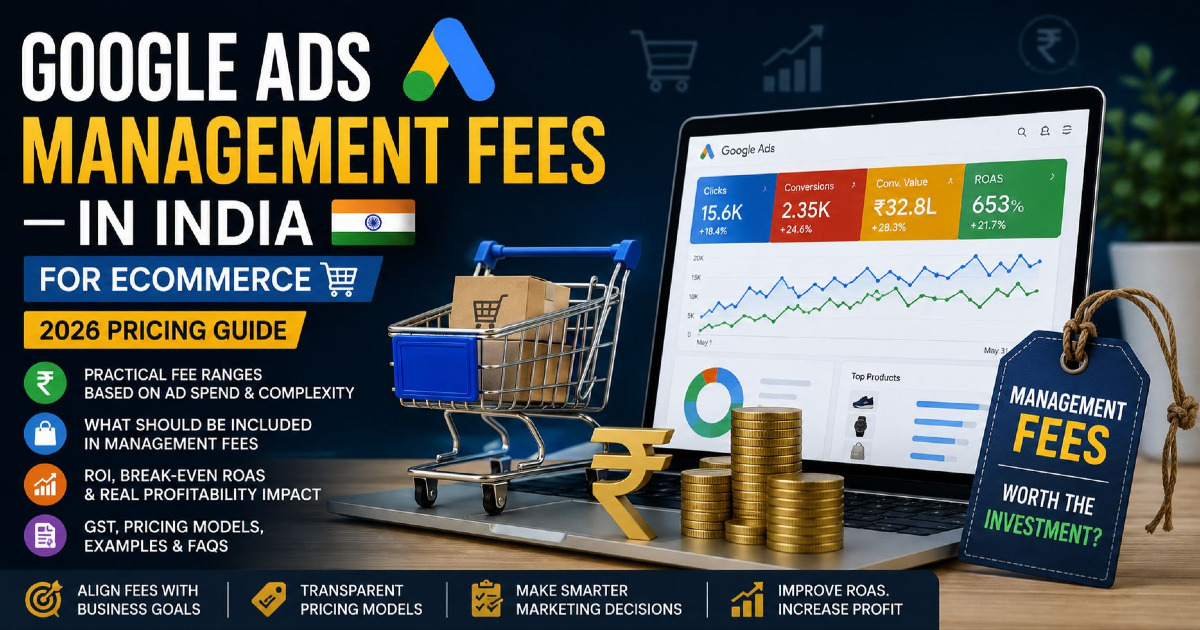
Google Ads management fees in India for an eCommerce business commonly start around ₹10,000–₹25,000 per month for smaller accounts and can move beyond ₹60,000–₹1,50,000 per month when the account involves larger advertising budgets, thousands of products, multiple markets, complex tracking, Merchant Center work, Performance Max, Shopping, Search and deeper profitability reporting. These figures are useful as market benchmarks, but they should not be treated as an official price list. There is no standard Google-approved management fee, and two eCommerce stores spending the same amount on advertising can require very different levels of work.
A ₹5 lakh monthly account selling 80 products in one country may be easier to manage than another ₹5 lakh account containing 15,000 SKUs, multiple feeds, frequent stock changes, four countries, different product margins and several Performance Max campaigns. Ad spend matters, but it does not describe the complete management workload.
This is why I would not choose an eCommerce Google Ads manager only by asking what percentage of ad spend they charge. The better way is to understand what the management fee is paying for, which parts of the account are actually being managed, and whether the final economics still make sense after the advertising fee is included.
Practical Google Ads Management Fee Benchmarks in India
Publicly advertised Google Ads management pricing in India varies widely. Lower-priced freelancers may quote below ₹10,000 per month, while experienced specialists, boutique agencies and larger teams can quote several times that amount. For an eCommerce business where Merchant Center, purchase tracking and product-level optimisation are part of the scope, I would use the following ranges as a practical starting point rather than as a fixed industry tariff.
| Monthly Google Ads Spend | Indicative Management Range | Typical eCommerce Scope |
|---|---|---|
| Below ₹1 lakh | ₹10,000–₹25,000/month | Smaller catalogue, limited campaign structure, core tracking and Merchant Center monitoring |
| ₹1 lakh–₹5 lakh | ₹20,000–₹50,000/month | Performance Max, Shopping/Search support, product analysis, feed work and regular optimisation |
| ₹5 lakh–₹15 lakh | ₹35,000–₹75,000/month | Multiple campaigns, deeper product segmentation, reporting, experimentation and profitability analysis |
| ₹15 lakh+ | ₹60,000–₹1,50,000+ or custom | Large catalogue, multiple markets, advanced measurement, creative coordination, feed operations and senior strategic involvement |
The ranges overlap intentionally because spend is only one pricing input. A ₹3 lakh account can sometimes require more work than a ₹10 lakh account. If the larger account has one mature Performance Max campaign, clean tracking and a stable product range, the management workload may be lower than a smaller account that needs a complete rebuild.
When comparing these numbers with a proposal, ask for the scope behind the fee. A ₹20,000 fee that covers campaign management only is very different from a ₹20,000 fee that also includes Merchant Center troubleshooting, product-feed improvements, Purchase tracking, landing-page feedback and commercial reporting.
eCommerce Management Pricing Should Not Be Based on Ad Spend Alone
Percentage pricing became popular because it is simple. If the agency charges 10% and the advertiser spends ₹3 lakh, the monthly fee is ₹30,000. If the advertiser scales to ₹8 lakh, the fee becomes ₹80,000. The calculation is easy, but the workload does not always increase in the same proportion.
An eCommerce account can become more complex without spending more money. A brand may enter another country, add thousands of products, introduce a second Merchant Center feed or rebuild its checkout while keeping the same monthly advertising budget. The opposite can also happen: spend may double while the campaign structure remains almost unchanged.
For eCommerce, I would price or evaluate management using at least these dimensions:
| Complexity Driver | Why It Affects Management Work |
|---|---|
| Number of products | Larger catalogues create more product, feed, inventory and performance-analysis work |
| Product margin differences | Low-margin and high-margin products cannot always share the same ROAS objective |
| Merchant Center complexity | Feed errors, supplemental feeds, promotions, disapprovals and custom labels require ongoing attention |
| Number of markets | Countries, currencies, languages, shipping rules and local demand increase complexity |
| Campaign mix | PMax, Standard Shopping, Search and other campaign types create different management requirements |
| Tracking | Purchase value, transaction IDs, enhanced conversions and attribution must remain accurate |
| Creative workload | PMax and wider Google inventory may require image, video and asset coordination |
| Promotion frequency | Frequent sales and seasonal changes require quicker budget, feed and message adjustments |
| Inventory volatility | Fast stock changes can make yesterday's best product tomorrow's unavailable product |
| Reporting requirements | Product profitability and customer reporting require more work than a monthly ROAS screenshot |
This is one reason a specialist may charge the same fee for two accounts with very different advertising budgets. They are pricing the amount of responsibility and analysis involved rather than automatically charging more every time the client increases Google's budget.
What an eCommerce Google Ads Management Fee Should Actually Cover
A retailer should expect more than campaign monitoring and a monthly report. Google Ads for eCommerce sits between advertising, Merchant Center, website data, inventory and commercial economics. If one of those areas is ignored, campaign optimisation can move in the wrong direction even when the Google Ads dashboard looks healthy.
Campaign Structure and Budget Allocation
The account should have a clear reason for each campaign. Performance Max may handle a scalable core product range, Search may protect important query ownership, and Standard Shopping may be used where tighter retail control or testing is required. The exact structure will differ between stores, but budget should not simply be spread equally because the campaigns exist.
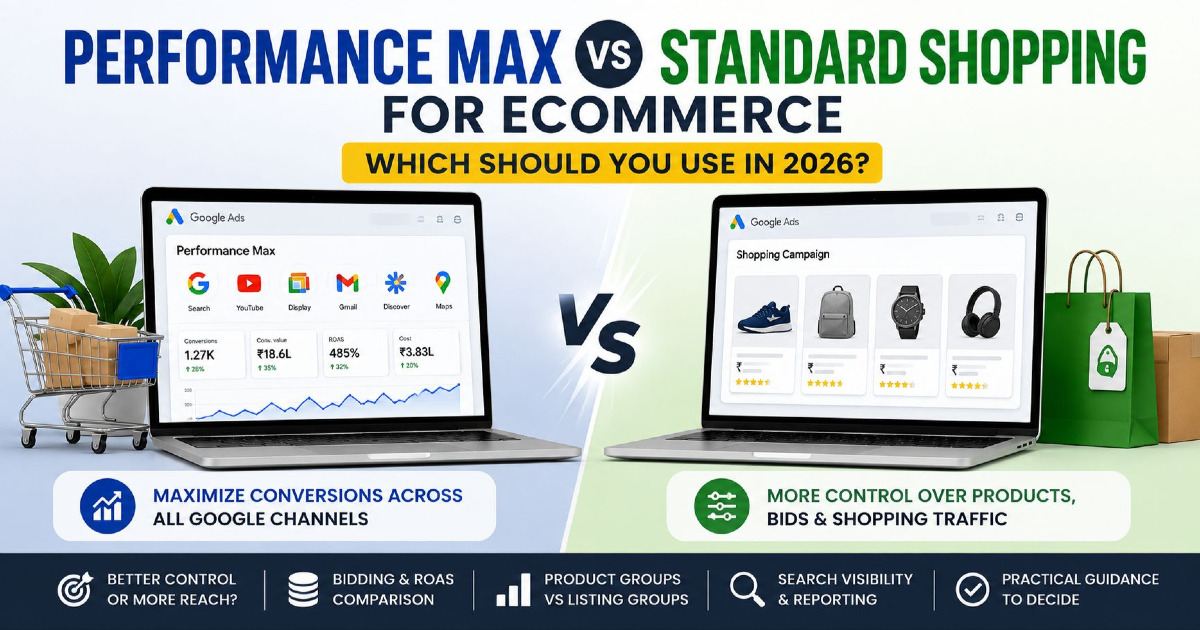
A manager should understand which product groups deserve growth budget, which need stricter controls, and when spend should be moved because demand, margin, inventory or performance has changed. The wider role of these campaign types is covered in my Performance Max vs Standard Shopping comparison.
Merchant Center and Product Feed Management
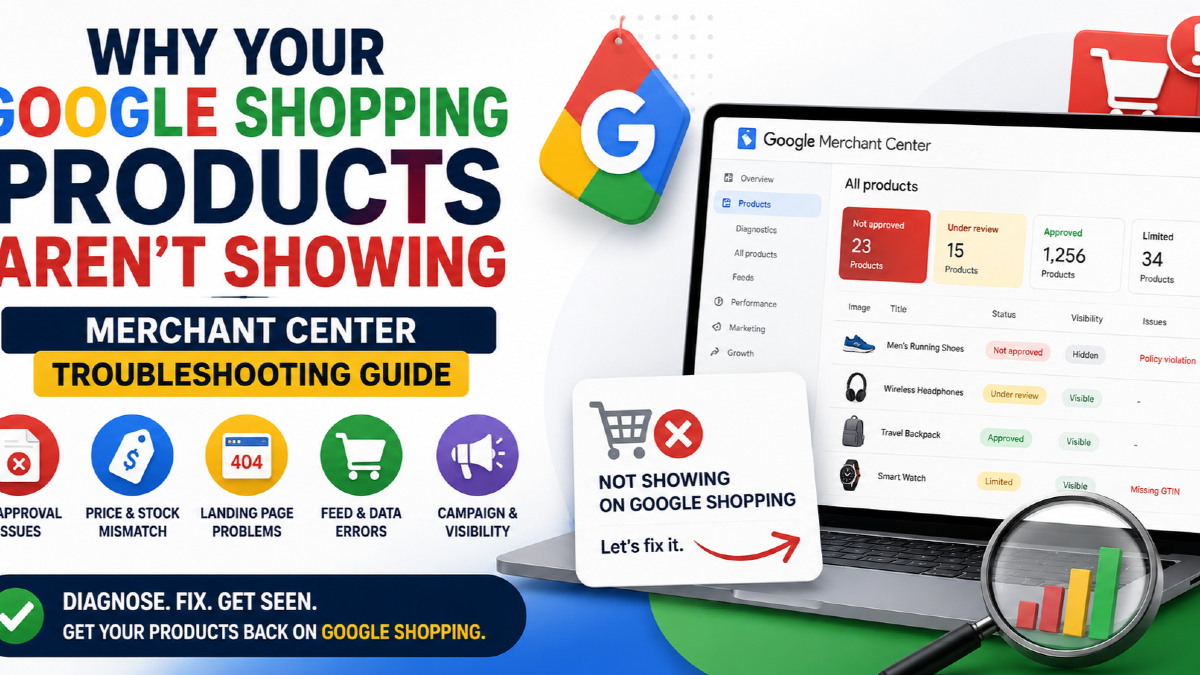
Merchant Center is one of the main operational differences between lead-generation Google Ads and eCommerce Google Ads. The manager should be able to identify product disapprovals, missing identifiers, weak titles, price or availability mismatches, incorrect product types and products receiving very little advertising exposure.
This does not mean every monthly management agreement includes complete feed engineering. It means responsibility needs to be clearly defined. If the agency says Merchant Center is outside its scope, someone else in the business must own it because both Shopping and retail-focused Performance Max campaigns depend heavily on product data.
For a retailer, Google Shopping management therefore involves more than search-term negatives. Feed structure and product information are part of campaign quality.
Product-Level Performance Analysis
A campaign can report a 500% ROAS while a small group of products generates most of the revenue and hundreds of other SKUs absorb spend without producing useful contribution. Campaign-level reporting alone cannot reveal enough about that situation.
Google expanded product reporting in 2026 so retailers can analyse product performance across more Google Ads campaign types and Performance Max networks. A modern eCommerce manager should therefore be reviewing products, categories, brands and inventory groups rather than stopping at the campaign total.
The management question becomes more specific: which products are generating value, which are receiving traffic without enough sales, which have no meaningful exposure, and which should be moved into a different campaign or budget group?
Performance Max Channel and Search Analysis
Performance Max reporting now provides much more visibility than early versions of the campaign. Channel performance can show how activity is distributed across Search, YouTube, Discover, Gmail, Display, Maps and other eligible inventory, while search-term and search-theme reporting gives additional information about the demand Google is finding.
This means “PMax is automated” is not a reason to avoid management work. Someone still needs to interpret the reports, check brand and non-brand behaviour, review search demand, look at product distribution, inspect asset performance and decide whether controls such as negative keywords, brand exclusions or URL exclusions are justified.
For stores using Performance Max as a major acquisition channel, the management fee should reflect that level of analysis rather than simply paying someone to increase or decrease the target ROAS once a month. The strategy side is covered in more depth on my Performance Max for eCommerce page.
Purchase Tracking and Conversion Value
Accurate Purchase data is one of the most valuable inputs in an eCommerce account. A manager should understand whether an order is firing once, whether the transaction ID is being passed correctly, whether revenue and currency match the store and whether Google is optimising towards the intended Purchase conversion.
This becomes particularly important when apps, checkout changes, theme changes, server-side implementations or new tracking tools are introduced. Waiting for a quarterly tracking review after the store has been recording duplicate revenue for six weeks can be expensive.
Tracking does not need to be rebuilt every month, but it should be monitored and revalidated after meaningful site or checkout changes. My eCommerce Google Ads measurement guide covers the technical foundation separately.
Profitability and Product Economics
ROAS is a revenue-efficiency metric, not a profit metric. If the manager does not understand that one product runs at 55% contribution before advertising while another runs at 20%, a single account-wide ROAS target can produce commercially poor decisions.
At minimum, the manager should have a working understanding of gross margin or contribution margin, returns, shipping subsidies, discounts and repeat-purchase behaviour where these materially affect the account. They do not need to become the finance department, but they should know what the business can afford to pay to acquire a sale.
Landing Page and Store Funnel Feedback
A Google Ads manager does not need to be the person developing the website, but they should be able to identify when the problem clearly sits after the click. High product-page traffic with weak add-to-cart activity, a large drop between checkout and Purchase, slow mobile performance or unclear delivery information can make campaign optimisation ineffective.
An eCommerce engagement should therefore include a way to communicate website problems back to the store team. Otherwise, Google Ads may keep changing bids and targeting while the largest conversion problem remains untouched.
Flat Fee, Percentage of Spend and Hybrid Pricing
There is no single pricing model that is automatically fair. Each model becomes reasonable or unreasonable depending on the account, scope and incentives created by the agreement.
| Pricing Model | How It Works | Where It Works Well | Main Risk |
|---|---|---|---|
| Flat monthly fee | One agreed fee for a defined scope | Stable responsibilities and predictable account complexity | Scope may outgrow the fee without being reviewed |
| Percentage of ad spend | Fee increases with monthly media spend | Accounts where larger budgets genuinely create more campaigns and work | Fee can rise faster than workload |
| Tiered retainer | Fee changes when the account enters defined scope or spend bands | Scaling eCommerce accounts | Bands need to be written clearly |
| Base fee + performance component | Retainer plus an agreed performance payment | Accounts with reliable commercial measurement | Attribution and incentive definitions can become messy |
Flat Monthly Fees Give Predictability
A flat fee is straightforward. If the scope is ₹30,000 per month, the business knows the management cost whether Google spends ₹2.5 lakh or ₹3 lakh. This model works well when the catalogue, markets, campaign responsibilities and reporting requirements are reasonably stable.
The important part is the scope review. If the brand expands from India into three additional markets, moves from 500 to 10,000 SKUs and expects the same provider to manage new feeds and additional campaigns, the original fee may no longer match the work. Flat pricing works best when both sides agree what would trigger a change in scope.
Percentage Pricing Needs a Cap or Logic at Higher Spend
Percentage-of-spend pricing is easy to understand but should be questioned as the account scales. At 10%, a ₹3 lakh media budget creates a ₹30,000 monthly fee. The same account spending ₹10 lakh produces a ₹1 lakh fee, even if the number of campaigns, markets and products remains almost unchanged.
That does not make percentage pricing unfair. A ₹10 lakh account can carry much more financial responsibility and may require stronger monitoring, testing and reporting. The issue is whether the additional fee reflects additional responsibility and workload rather than increasing automatically because Google was allowed to spend more.
For larger accounts, a declining percentage, fee cap or tiered retainer can often make the commercial relationship easier to understand.
Performance-Based Fees Are Harder for eCommerce Than They Look
A performance-based model sounds attractive because the provider earns more when the client earns more. The problem is defining which revenue the agency genuinely influenced.
Suppose Google Ads reports ₹30 lakh in Purchase value. Before calculating a performance fee, the business may still need to consider cancelled orders, returns, branded purchases, existing customers, attribution differences and products with very different margins. Paying a large bonus on gross platform-attributed revenue can reward activity that did not create equivalent incremental profit.
If performance pricing is used, define the metric before the campaign begins. Net new-customer revenue, contribution after advertising or another commercially meaningful measure may be more useful than gross Google Ads revenue, although each requires reliable tracking and agreement between both sides.
The True Monthly Cost of eCommerce Google Ads
The current Google Ads budget is not the same as the complete cost of running the acquisition programme. At the same time, avoid adding the same cost twice.
A practical formula is:
Total paid acquisition operating cost = Google Ads spend + management fee + paid-media-specific tracking/tools + creative or feed work charged separately + other agreed acquisition costs.
Wasted ad spend should not be added again because it is already included inside Google Ads spend. If ₹1 lakh is spent and ₹20,000 of that produced irrelevant or commercially useless traffic, the advertising cost is still ₹1 lakh, not ₹1.2 lakh. The purpose of management is to reduce the inefficient portion of that ₹1 lakh.
Similarly, testing does not automatically need a separate line added on top of the advertising budget. If a ₹5 lakh monthly media budget includes ₹50,000 allocated to testing new products or campaigns, the media cost remains ₹5 lakh. You only add another ₹50,000 if the business genuinely approves additional spend beyond the original ₹5 lakh.
GST Affects Cash Flow but Should Be Treated Correctly
Google currently applies 18% GST to applicable Indian Google Ads billing arrangements, with the exact CGST, SGST or IGST treatment depending on the billing situation. Qualifying SEZ arrangements can receive different treatment. Management invoices may also include GST depending on the provider's registration and supply details.
For budgeting, the business should understand the tax amount appearing on invoices. For profitability analysis, however, speak with your accountant about input tax credit and the correct accounting treatment. A business that can claim eligible GST input credit should not blindly treat the recoverable tax in the same way as an unrecoverable advertising expense.
TDS can also affect Indian payment and accounting workflows in some circumstances, but it should not be confused with an additional Google Ads management fee. Tax treatment depends on the entity, invoice and business situation, so this part should be confirmed with a qualified accountant rather than estimated from an advertising article.
Management Fees Change the Break-Even ROAS
This is one of the most important calculations missing from many Google Ads pricing discussions. A management fee may be operationally separate from advertising spend, but it still affects whether paid acquisition is profitable.
Assume an eCommerce business has a 40% contribution margin before advertising and management costs. This means ₹100 of net sales contributes ₹40 after product cost and other variable costs that the business has decided to include, but before paid acquisition.
If the store spends ₹5 lakh on Google Ads with no management fee, it needs approximately ₹12.5 lakh in equivalent net sales to cover the ₹5 lakh advertising cost:
₹5,00,000 ÷ 40% = ₹12,50,000
The advertising-only break-even ROAS is therefore:
₹12,50,000 ÷ ₹5,00,000 = 2.5x
Now add a ₹50,000 monthly management fee. Paid acquisition cost becomes ₹5.5 lakh.
₹5,50,000 ÷ 40% = ₹13,75,000 required net sales
Measured against the ₹5 lakh media spend shown inside Google Ads, the fee-adjusted break-even ROAS becomes:
₹13,75,000 ÷ ₹5,00,000 = 2.75x
The management fee has therefore moved the commercial break-even point from 2.5x to 2.75x. That does not mean the management service is expensive. It means its cost must be included when deciding whether the channel creates profit.
A Simple Fee-Adjusted ROAS Formula
If you know the contribution margin before advertising, Google Ads spend and management fee, the simplified break-even formula is:
Required revenue = (ad spend + management fee) ÷ contribution margin
And the equivalent platform ROAS required on Google Ads spend is:
Fee-adjusted break-even ROAS = (ad spend + management fee) ÷ (contribution margin × ad spend)
This is a planning model rather than a complete finance statement. Businesses with large return rates, repeat customer value, marketplace fees, COD losses or other important costs should adapt the contribution definition to their actual economics.
Higher Management Fees Can Still Produce Better Economics
The cheapest management option is not automatically the most economical. Consider two managers working with the same ₹5 lakh media budget and a store where net sales have a 40% contribution before advertising.
| Manager A | Manager B | |
|---|---|---|
| Management fee | ₹15,000 | ₹50,000 |
| Google Ads spend | ₹5,00,000 | ₹5,00,000 |
| Net attributed sales | ₹12,00,000 | ₹17,00,000 |
| Contribution before paid acquisition at 40% | ₹4,80,000 | ₹6,80,000 |
| Ad spend + management | ₹5,15,000 | ₹5,50,000 |
| Contribution after paid acquisition | -₹35,000 | ₹1,30,000 |
Manager B costs ₹35,000 more but produces substantially better economics in this example. This does not prove that expensive managers always outperform cheaper managers. It shows why the fee cannot be judged without the business outcome.
The reverse can also happen. Paying ₹75,000 for sophisticated reports and weekly meetings is wasteful if a simple, mature account produces the same result with ₹25,000 of competent management. Price should match the decisions and responsibilities the account actually needs.
eCommerce Management Should Be Judged by Decisions, Not Activity Counts
Change history is useful, but the number of changes made inside Google Ads is not a good measure of management quality on its own. A provider who changes bids, budgets and assets every day can create more noise than improvement. In a stable account, the best decision may sometimes be to leave a successful campaign alone while collecting enough data for the next meaningful decision.
Instead of asking whether someone “logged in every day”, I would ask whether the account has a clear decision process. The manager should be able to explain what changed, why it changed, what evidence supported the decision, what result was expected and what happened afterwards.
| Weak Management Evidence | Stronger Management Evidence |
|---|---|
| “We optimised the account this week.” | “Search demand for this product group became less profitable, so budget was moved towards the higher-margin category.” |
| “ROAS increased.” | “ROAS increased, but most of the gain came from branded returning customers, so we have not increased acquisition budget yet.” |
| “PMax is learning.” | “PMax channel and product reports show the drop is concentrated in this product group after stock and price changes.” |
| “The feed is fine.” | “97% of active priority SKUs are eligible, while these 34 products have pricing or GTIN issues that need correction.” |
The Management Scope Should Change as an eCommerce Account Grows
A store spending ₹50,000 per month usually does not need the same reporting infrastructure as one spending ₹20 lakh per month. At the smaller stage, the biggest value may come from correct tracking, clean Merchant Center data and a simple campaign structure. Adding five dashboards and ten campaign types would create unnecessary complexity.
As the account grows, the management requirement changes. Larger product ranges create a need for product segmentation, margin-aware budgeting, more structured feed management, deeper PMax reporting, customer acquisition analysis, creative planning and experimentation. The management fee should rise when the responsibility rises, not simply because a pricing spreadsheet says 10% of spend.
Provider Type Matters Less Than Who Owns the Account
Freelancers, independent specialists, boutique agencies and large agencies can all manage Google Ads successfully. The organisational label tells you much less than who actually makes decisions on your account.
| Provider | Indicative Monthly Range | Potential Strength | Area to Check |
|---|---|---|---|
| Freelancer | ₹10,000–₹25,000+ | Direct communication and lower overhead | eCommerce depth, availability and backup |
| Senior specialist | ₹20,000–₹60,000+ | Direct strategic involvement | Whether feed, creative and analytics needs are covered |
| Boutique agency | ₹30,000–₹75,000+ | Broader team support | Who actually manages the account daily |
| Larger/full-service agency | ₹60,000–₹1,50,000+ | Cross-functional resources and scale | Seniority, account attention and overhead |
These ranges overlap because provider quality varies considerably. A strong independent Google Ads expert can manage a complex eCommerce account more effectively than a large agency that assigns day-to-day work to a junior team. A strong agency can be the better choice when the business genuinely needs several specialists working together. The label is less important than the capability and accountability behind it.
Very Low Fees Usually Mean the Scope Is Smaller
A ₹5,000 monthly proposal is not automatically bad. It may be perfectly reasonable for a very small account with one campaign and minimal ongoing requirements. The concern appears when the same fee is presented as full eCommerce management for a large catalogue, Merchant Center, Performance Max, Search, conversion tracking, reporting, product analysis and frequent promotions.
At that point, the numbers should make you ask how much real time can be allocated to the account. If a provider needs to manage twenty or thirty clients at the same fee simply to make the service commercially viable, senior attention will naturally be limited.
The right response is not “cheap agencies are bad”. Ask exactly what is included and excluded. A limited scope priced honestly is better than an inexpensive “everything included” promise that cannot realistically be delivered.
High Fees Need to Buy More Than Reporting
The opposite problem also exists. Paying ₹75,000 or ₹1 lakh per month does not automatically create better management. At that level, I would expect more than a dashboard and a monthly call.
The account should be receiving senior decision-making, product-level analysis, measurement oversight, Merchant Center involvement where needed, testing plans, commercial interpretation and proactive communication when results change materially. If the same report is being read aloud every month without clear actions, the fee is difficult to justify regardless of the agency's size.
Red Flags in eCommerce Google Ads Management
The Provider Reports ROAS Without Asking About Margin
A manager can optimise a campaign towards high reported revenue while the store loses money after product costs, returns and fulfilment. If no one has ever asked which categories have healthy margins or what acquisition cost the business can support, the account may be optimising towards the wrong commercial target.
Merchant Center Is Treated as Somebody Else's Problem
A specialist does not necessarily need to make every feed edit personally, but they should recognise when Merchant Center is limiting advertising performance. Repeated product disapprovals, missing identifiers, weak titles or inventory mismatches cannot simply be ignored because the problem sits outside the Google Ads campaign screen.
Purchase Tracking Is Considered Correct Because Conversions Exist
Receiving Purchase events does not prove that measurement is accurate. Duplicate purchases, missing transaction IDs, wrong values or incorrect currencies can make automated bidding and performance reporting unreliable. Management should reconcile advertising data with real store orders rather than stopping at “the tag is firing”.
All Products Are Managed to the Same ROAS
A store may have categories with very different margins, return rates, repeat purchase rates and inventory priorities. Applying one target to every SKU because they live in the same Merchant Center account can make growth look simpler while hiding product-level losses.
PMax Performance Is Reported Only at Campaign Level
A campaign-level total is no longer enough for a serious retail account. Product reporting, channel reporting, search insights and Merchant Center diagnostics provide much more evidence. A manager does not need to change something after every report, but they should know what is driving the result.
More Changes Are Presented as Proof of Better Management
Accounts do not become better simply because someone makes 200 changes every month. Frequent unnecessary adjustments can interrupt useful learning and make cause and effect harder to understand. Good management is a sequence of justified decisions rather than a competition to create the longest change history.
Google Ads Revenue Is Never Compared With Store Revenue
Google Ads and the store will not always report identical numbers because attribution works differently, but material unexplained differences deserve investigation. If Google shows excellent growth while total store orders remain flat, the business needs to understand whether the campaign is creating new value, shifting attribution or concentrating on demand that already existed.
The Agency Earns More Whenever Spend Increases but There Is No Scaling Rule
Percentage pricing can work well, but there should be a commercial discussion about what happens when spend doubles or triples. If the management fee increases automatically while account complexity remains the same, ask whether a cap, declining percentage or new tier becomes more appropriate.
Performance Fees Are Based on Gross Platform Revenue
Performance incentives become risky when refunds, cancellations, returning customers and margin differences are ignored. Both parties should agree what revenue qualifies and how reversals or customer type are handled before a bonus is calculated.
Questions to Ask Before Agreeing to a Management Fee
| Question | Why It Matters |
|---|---|
| Who will actually manage the account? | The sales person and account manager may be different people |
| Is Merchant Center included? | Retail performance depends heavily on product data |
| Who owns feed changes? | Responsibility must be clear before problems occur |
| Is Purchase tracking included? | Measurement may require work outside Google Ads |
| How are product margins used? | Revenue alone may lead to poor allocation |
| How is PMax analysed? | Current reporting allows deeper channel and product diagnosis |
| Are creative assets included? | Some fees cover strategy only, while design/video may cost extra |
| Are landing-page changes included? | Recommendations and actual development are different services |
| What happens when spend doubles? | Important for percentage or tiered pricing |
| How are returns and cancelled orders handled? | Gross conversion value may overstate useful revenue |
| How is success measured? | Both sides should agree on the commercial objective |
| Who owns the Google Ads account and data? | The advertiser should retain appropriate access and continuity |
Example: ₹1 Lakh Monthly eCommerce Advertising Budget
Consider a smaller Shopify store spending ₹1 lakh per month. It has 150 active products, sells only in India and uses one core Performance Max campaign alongside a small brand Search campaign. Merchant Center is generally healthy and the store has reliable Purchase tracking.
A monthly management fee somewhere around ₹15,000–₹25,000 may be reasonable if it includes campaign management, Merchant Center monitoring, conversion checks, product analysis and reporting. Paying ₹60,000 would need a strong explanation because the fee would represent a very large addition to the media cost unless substantial work outside basic management is involved.
On the other hand, paying ₹5,000 for “complete management” may be unrealistic if the brand expects detailed product-feed work, tracking support, creative strategy and weekly commercial analysis as part of the same fee.
Example: ₹5 Lakh Monthly eCommerce Advertising Budget
Now consider a brand spending ₹5 lakh monthly across Performance Max, Shopping and Search, with 2,500 products, regular promotions and clear differences in category margins. This account needs more than basic campaign maintenance.
The manager may need to review product-level performance, Merchant Center health, search demand, budget distribution, margin groups, promotion changes, PMax channels, creative, Purchase accuracy and landing-page behaviour. A ₹30,000–₹60,000 management fee can make commercial sense depending on how much of that responsibility is actually included.
The important comparison is not whether ₹40,000 is 8% of spend. It is whether the decisions enabled by that ₹40,000 help the business use the ₹5 lakh media budget more profitably.
Example: ₹20 Lakh Monthly eCommerce Advertising Budget
At ₹20 lakh monthly spend, percentage pricing becomes more important to examine. A 10% fee would be ₹2 lakh per month. That may be justified if the provider manages several countries, complex feeds, customer acquisition programmes, creative coordination, product-level profitability and regular experiments. It may be difficult to justify if the account is one stable market with a mature campaign structure and limited monthly changes.
This is where a custom retainer, tiered pricing model or declining percentage can be more logical. The provider still receives appropriate compensation for senior responsibility, while the business does not automatically surrender another ₹1 lakh in fees whenever spend increases by ₹10 lakh.
When an eCommerce Business May Not Need Ongoing Management
Not every store needs a monthly agency or specialist relationship. A very small account with limited spend, a simple product catalogue and a capable internal marketer may be better served by a one-off audit, tracking setup and occasional consulting rather than paying a permanent retainer.
Ongoing management becomes more useful when the account has enough spend or complexity that regular decisions can materially change the business outcome. That can include multiple product groups, changing inventory, large budgets, several markets, ongoing PMax optimisation or insufficient internal Google Ads expertise.
If you are comparing ongoing service rather than only researching market rates, my Google Ads management services page shows how I currently structure management separately from this general pricing guide.
Management Fees Should Become Smaller Relative to the Value Created
A useful way to think about scale is that the fee should become easier for the business to absorb as the paid acquisition programme becomes stronger. If the company pays ₹30,000 to manage ₹2 lakh of media and the campaigns create useful contribution, the fee can be reasonable even though it represents 15% of spend. If the same management system later handles ₹10 lakh efficiently, a sensible fixed or tiered fee can become a much smaller percentage of the total acquisition programme.
The management provider still needs to be compensated for increased financial responsibility and complexity, but the commercial relationship should allow both the advertiser and provider to benefit from successful scaling.
Price Matters, but Scope and Economics Matter More
An eCommerce business should know what Google Ads management costs in India before choosing a provider, but the price table is only the beginning. A ₹15,000 fee can be expensive if it buys little useful work, while a ₹60,000 fee can be economical if it improves the allocation of a much larger advertising budget and creates additional contribution after all paid acquisition costs.
The most useful evaluation starts with five areas: the amount of media spend being managed, the complexity of the product catalogue, the quality of Merchant Center and measurement, the commercial differences between products, and the level of decision-making the provider actually owns.
Then include the fee in your profitability calculation. Do not double-count wasted spend, do not treat every testing allocation as an extra budget, and do not assume platform ROAS represents profit. Calculate what the store earns after product economics, advertising and management costs.
For an eCommerce account, that is the real purpose of professional Google Ads management. The job is not to create more changes inside the account or produce a more attractive dashboard. It is to help the business decide which products, campaigns and customers deserve the next rupee of advertising budget and to make sure the data behind those decisions can be trusted.
Frequently Asked Questions
How much does Google Ads management cost in India?
Publicly advertised fees vary widely, but smaller management engagements often fall around ₹10,000–₹25,000 per month, while experienced specialists and agencies working with larger or more complex accounts commonly charge ₹25,000–₹75,000 or more. Large eCommerce accounts involving several markets, thousands of products, advanced measurement and wider responsibilities can exceed ₹1 lakh per month. These are practical benchmarks rather than official Google pricing.
Is 10% of ad spend a fair Google Ads management fee?
It can be fair, particularly where workload and financial responsibility increase as spend grows. However, 10% becomes expensive at higher budgets if the campaign scope remains almost unchanged. For larger accounts, ask whether the percentage declines, has a cap or changes to a tiered retainer.
Is ad spend included in the management fee?
Normally no. Google Ads media spend is paid for advertising inventory, while the management fee pays the freelancer, specialist or agency responsible for strategy, implementation, optimisation and reporting. The contract should show these amounts separately.
Does GST apply to Google Ads in India?
Google currently applies 18% GST to applicable Indian billing arrangements, with CGST/SGST or IGST treatment depending on the billing situation. SEZ and other tax circumstances can differ. Management-service invoices may also include applicable GST. Businesses should confirm input tax credit and accounting treatment with their accountant.
What should eCommerce Google Ads management include?
At minimum, the scope should make responsibility clear for campaign strategy, budget allocation, Merchant Center, product analysis, Search or Shopping demand, Performance Max analysis, Purchase tracking and performance reporting. Larger accounts may also require feed work, creative coordination, experiments, margin-based segmentation and customer acquisition analysis.
Should an eCommerce manager optimise for ROAS?
ROAS is useful but should not be the only commercial measure. Product margin, returns, shipping costs, new versus returning customers, inventory and contribution after advertising can change whether a reported ROAS is profitable. The manager should understand the economics behind the target.
Is a freelancer cheaper than a Google Ads agency in India?
Freelancers usually have lower overhead and often quote lower fees, but the provider type alone does not determine value. A senior independent specialist may be more suitable for an eCommerce account than a large agency with junior account ownership, while an agency can be valuable where several specialised skills need to work together.
Should Merchant Center management cost extra?
It depends on the scope. Basic Merchant Center monitoring may be included in eCommerce Google Ads management, while large feed builds, complex rules, supplemental feeds or extensive data corrections may reasonably be priced separately. The important point is to agree who owns the work before campaign problems appear.
How can I tell whether my Google Ads management fee is worth it?
Compare more than account activity. Look at measurement accuracy, Merchant Center health, product-level decisions, contribution after advertising, new-customer performance where relevant, the quality of explanations behind changes and whether additional budget is being allocated more intelligently over time.
Does a higher management fee guarantee better Google Ads results?
No. Higher pricing can support more senior time, wider scope and deeper analysis, but price does not guarantee performance. The fee needs to be judged against the actual person managing the account, the work included and the commercial result produced.