
Meta Ads Not Working for Your Business? Reasons + Fix Strategy Guide.
If you’re running Meta Ads (Facebook + Instagram) and not getting results, you’re probably thinking:
- “I’m spending money but leads are not coming”
- “Leads are coming but no one is buying”
- “Meta ads worked for others, why not for me?”
- “Should I stop Meta Ads?”
Here’s the honest truth: Meta Ads is not dead.
Most of the time, the real issue is simple:
Your strategy is not matching your business type, pricing, and customer decision cycle.
And when that mismatch happens, Meta Ads starts showing all the “pain signals”:
- high CPL (cost per lead)
- low ROAS
- good clicks but no conversions
- leads coming but poor quality
- sales coming only sometimes (not consistently)
As a Performance Marketing Consultant, I’ve seen the same pattern again and again. When business owners say “Meta Ads is not working”, they usually mean one of these:
-
- They expected results in 3–7 days for a business that naturally needs 14–45 days to convert
- They ran only cold audience ads and skipped the warm audience journey
- They used the wrong campaign objective (boost/traffic) instead of leads or sales
- They got leads, but the follow-up system was weak or slow
This guide will help you fix it using a practical framework based on:
- Price point (AOV)
- Buyer psychology
- Daily budget requirement
- Time to convert (conversion window)
Why Meta Ads “Doesn’t Work” for Most Businesses
Meta Ads is not a magic button. It’s a distribution system.
That means ads don’t create demand out of nowhere. Ads amplify what’s already happening in your business:
- If your offer is strong, ads scale it
- If your funnel is confusing, ads expose it
- If your follow-up is slow, ads waste leads
Here are the most common reasons Meta Ads fails (especially for small and mid-size businesses):
- Wrong expectations: expecting instant results in high-ticket or service categories
- Wrong objective: running traffic campaigns and hoping for leads/sales
- Weak creatives: ads look generic, no clear hook, no reason to stop scrolling
- Low daily budget: not enough data to exit the learning phase properly
- No retargeting: losing warm buyers who needed a second or third touch
- Slow response: leads go cold when the business replies late
If your Meta Ads feels “unstable” or “random”, it’s usually one of these six problems.
Now let’s get into the most important part — the framework that fixes everything.
The Real Framework: Meta Ads Works Differently by Price Category
Your price decides your buyer behaviour.
A customer buying a ₹499 product behaves very differently from someone considering a ₹49,999 service.
That’s why one Meta Ads strategy cannot work for every business.
Instead of asking:
“Does Meta Ads work?”
Ask this:
How long does my buyer take to decide, and what proof do they need before they pay?
Once you understand that, your campaign structure becomes much easier:
- you set the right expectations
- you choose the right campaign objective
- you plan retargeting properly
- you stop wasting money on the wrong approach
Let’s break it down category by category.
1) Low Ticket Products (₹200 to ₹2,500): Fast Conversions
Examples: snacks, basic clothing, accessories, small skincare items, low-cost bundles, kitchen tools, mobile accessories, daily-use items.
If your product price is between ₹200 and ₹2,500, your biggest advantage is simple: people don’t overthink the purchase. This is the category where Meta Ads can give quick wins, but only if your offer and creatives match how buyers behave.

How buyers think before purchasing low ticket products
Low ticket buyers usually don’t do deep research. They purchase based on emotion and speed. The decision is often made in a few seconds:
- “This looks useful.”
- “Price is affordable.”
- “Let’s try once.”
- “Worst case, I lose a few hundred rupees.”
This is exactly why Meta Ads works well for low-priced products. It’s a scroll-based platform where good creatives can trigger instant decisions.
Buyer psychology (Impulse buying triggers)
In this price range, customers buy when they feel one strong trigger:
- Offer trigger: “Buy 1 Get 1” / bundle deal / discount
- Convenience trigger: solves a small daily problem
- Visual trigger: product looks premium or satisfying to use
- Trust trigger: COD available, easy returns, real reviews
- Scarcity trigger: limited stock, limited time deal
If your ad is not hitting any trigger, the audience will scroll, even if your product is good.
Time to convert (How fast results should come)
Low ticket products typically convert fast because the decision is low-risk.
Expected conversion timeline:
- Same session purchase: within 5–30 minutes (best case)
- Quick conversions: same day to 3 days
- Some users still need retargeting: up to 7 days
So yes, if you’re selling a low ticket product and your Meta Ads is set up correctly, you can start seeing purchases quickly. But you still need to test multiple creatives to find a winner.
Daily budget expectations (Realistic numbers)
Many businesses can start with ₹300 to ₹1,000/day for low ticket products, but only when:
- your product has strong demand
- your website loads fast
- your checkout is smooth
- your creatives are scroll-stopping
Here’s a more practical way to think about budget:
- If your product is ₹499–₹999, your first goal should be to generate enough traffic + add-to-carts daily to train the algorithm.
- If your AOV is ₹1,500–₹2,500, you need stronger trust (reviews + returns) and retargeting will matter more.
In most cases, if your daily budget is too low, Meta won’t get enough purchase signals, and you’ll feel your ads are “stuck”.
What works best for low ticket Meta Ads (Winning strategy)
Low ticket ads win by creative volume + testing. You don’t need one perfect ad. You need multiple strong angles.
Best performing creative formats:
- Product demo video: show how it works in 5–10 seconds
- Problem → solution: show the pain point first, then the product
- UGC / review style: real person explaining the experience
- Offer creatives: combo deal, discount, free delivery, COD
- Before-after / transformation: when applicable
Best campaign approach:
- Cold audience: Sales / Purchase objective (website conversions)
- Retargeting (very important): 3-day and 7-day website visitors
- Catalog/Shop ads: if you have multiple SKUs and proper tracking
Landing page + checkout must be simple (Most ignored part)
Low ticket purchases can fail even with good ads if your website experience is weak. In this price range, users have low patience. If the page doesn’t load quickly or looks untrustworthy, they’ll exit.
Fix these on your product page:
- Fast loading speed (especially on mobile)
- Clear price + clear discount (no hidden surprises)
- COD (if it makes sense for your market)
- Return / replacement policy written clearly
- Reviews or proof (even 5–10 reviews help)
- Simple checkout (avoid 3–4 steps)
Why results fail in low ticket products (Common mistakes)
When low ticket Meta Ads doesn’t work, the reason is usually not targeting. It is most often one of these:
- Weak creative: looks like a poster, not a real user experience
- Too many details in the ad: users don’t read, they scan
- Wrong objective: traffic or engagement campaigns for sales goals
- No retargeting: losing warm buyers who needed one more touch
- Slow website: mobile users bounce fast
- Offer mismatch: product is okay but the deal is not attractive
Quick fix tip: If you are not getting sales, don’t change audience first. Launch 3 new creatives and improve the product page speed. In low ticket, creative testing gives faster improvement than audience tweaks.
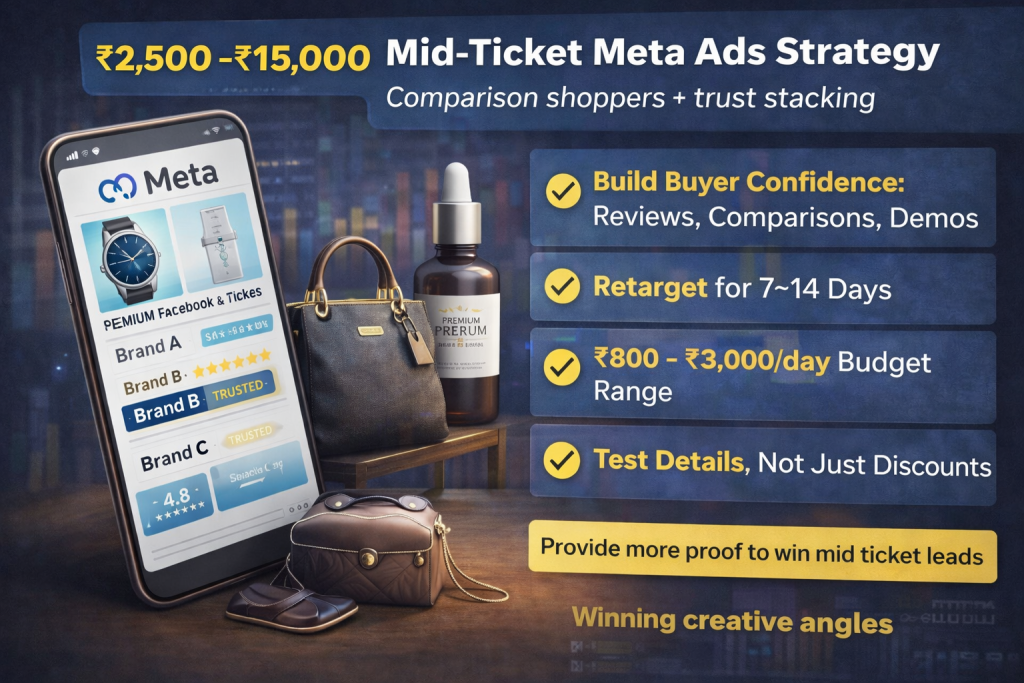
2) Mid Ticket (₹2,500 to ₹15,000): Comparison + Trust Needed
Examples: premium fashion, branded accessories, beauty devices, grooming products, mid-range gadgets, premium home essentials.
If your product pricing sits between ₹2,500 and ₹15,000, you are no longer in the “impulse buy” zone.
In this range, buyers are interested… but they also want to feel confident they’re making the right decision. Your job is not only to get clicks — your job is to win the comparison.
What changes in buyer behaviour at mid ticket pricing?
At mid ticket, customers start behaving like smart shoppers. They will usually:
- compare 2–5 brands before buying
- check reviews on Instagram, Google, marketplaces, or YouTube
- open the website multiple times before purchase
- ask questions like “Is it worth it?” and “Is this better than the cheaper option?”
This is why many business owners feel Meta Ads is not working in this category. Ads can bring traffic, but conversions only happen when you provide enough proof and clarity to win the decision.
Buyer psychology: they want a reason to pay more
A mid ticket buyer is willing to spend, but they need a strong reason to choose you. They are thinking:
- Quality check: “Will it last?”
- Value check: “Is this worth the price?”
- Trust check: “Is this brand genuine?”
- Safety check: “What if it doesn’t fit / doesn’t work?”
So your ads must communicate more than just features. Your ads must communicate confidence.
Time to convert (realistic conversion window)
Mid ticket products usually don’t convert instantly. Most conversions happen after the buyer has seen your brand more than once.
Expected conversion timeline: 3 to 14 days
Some buyers may still convert after 14 days if they are waiting for salary date, festival offers, or a better deal.
Budget expectations (why this category needs consistency)
In most niches, a daily spend of ₹800 to ₹3,000/day gives more stable results because you need enough volume for:
- creative testing (multiple angles)
- audience testing (broad + interest mixes)
- retargeting (warm users across 7/14 days)
When budget is too low, the campaign often stays in learning mode longer, and results look unpredictable.
What works best in Meta Ads for mid ticket (winning creative angles)
In this range, the goal is to help the buyer justify the purchase. These angles work best:
- Proof creatives: reviews, UGC, customer reactions, real screenshots (with clean design)
- Comparison creatives: “Why this is better than regular options” (materials, warranty, durability)
- Demo + experience: show usage, quality close-ups, real-life outcomes
- Objection breaker ads: fit issues, return worries, quality doubts, delivery concerns
- Authority ads: featured in / used by / trusted by (if applicable)
Pro tip: Mid ticket buyers respond strongly to “details”. A clean breakdown of quality, benefits, and proof often beats over-discounting.
Best retargeting plan for mid ticket (simple but powerful)
Mid ticket needs retargeting because buyers rarely purchase in the first visit. A simple structure works well:
- Day 1–3 retargeting: proof + testimonials
- Day 4–7 retargeting: product benefits + FAQ ads
- Day 8–14 retargeting: offer / urgency / bundle push
This setup matches how people decide: first they trust you, then they justify the purchase, and only then they respond to an offer.
Common mistake (why people say “Meta Ads not working”)
The biggest mistake in mid ticket campaigns is judging performance too quickly.
- running ads for 3–4 days
- changing targeting daily
- turning off campaigns before retargeting builds momentum
If you sell mid ticket products, give your campaign enough time to build data and let retargeting do its job. This is where consistent results start showing.
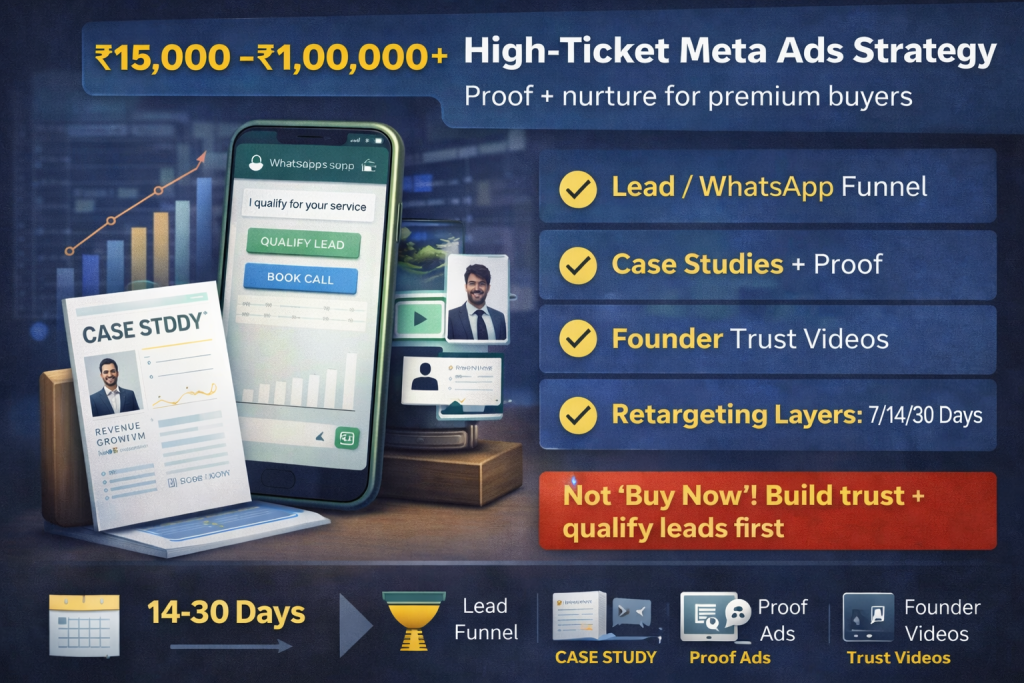
3) High Ticket (₹15,000 to ₹1,00,000+): Proof + Nurture Required
Examples: premium services, high-value collections, expensive packages, consulting, education programs, franchise opportunities, wedding packages, high-end B2B solutions.
If your offer is priced between ₹15,000 and ₹1,00,000+, Meta Ads can still work extremely well — but not the way most people run it.
High-ticket buyers don’t purchase because your ad looks good.
They purchase when they feel one thing: confidence.
And confidence doesn’t come from one ad. It comes from multiple touchpoints, proof, and a clear nurture process.
What changes when you move into high ticket pricing?
In high ticket, the buyer is not only buying your product/service.
They are also buying:
- your credibility
- your process
- your reputation
- your promise (and whether you can deliver it)
This is why high ticket performance marketing needs a different structure. It’s less about “discount and urgency” and more about trust-building and qualification.
Buyer psychology: High-ticket is a high-risk decision
When someone spends ₹15,000+ online, they naturally think:
- “What if this is not worth it?”
- “What if I get scammed?”
- “What if it doesn’t work for me?”
- “Will I get support after payment?”
- “Who else has bought this and what results did they get?”
So your ad strategy must answer doubts before they even ask.
In this range, trust is the real currency.
Time to convert: you’re buying attention first, then the decision
High ticket conversions usually don’t happen in one visit. A typical buyer journey looks like this:
- Step 1: sees your ad and gets curious
- Step 2: watches your videos / checks your profile
- Step 3: visits the website or sends a WhatsApp message
- Step 4: asks questions / checks proof
- Step 5: final decision after follow-ups
Expected conversion timeline: 14 to 30+ days (sometimes longer, depending on niche and ticket size)
This is why judging high-ticket Meta Ads in 3–5 days is the fastest way to kill a winning campaign.
Budget expectations (why high-ticket needs more testing power)
High ticket campaigns need more budget because:
- CPM is often higher for premium audiences
- you need multiple creatives running at once
- you need enough warm traffic for retargeting
- you need room for learning and optimization
A practical budget range for most high ticket offers is ₹1,500 to ₹5,000/day.
If your competition is aggressive (coaching, real estate, finance, education), budgets may need to be higher for consistency.
What works best for high-ticket Meta Ads (the winning structure)
For high-ticket, the goal is not “instant purchase”. The goal is to create a pipeline of qualified leads and convert them through proof + follow-up.
Here’s what works best:
- Lead funnel or WhatsApp funnel: move people into a conversation (instead of forcing a direct buy)
- Case study ads: real results, real people, real outcomes (before-after, revenue growth, transformation)
- Founder-led trust videos: the face of the brand explaining the offer, process, and expectations
- Authority proof: client logos, media mentions, certifications (only if genuine)
- Retargeting layers: 7/14/30-day strategy based on engagement level
High-ticket creatives that convert:
- “Here’s exactly how the process works” (step-by-step breakdown)
- “Mistakes people make before buying this service” (educational trust)
- “Client story: problem → journey → result” (case study format)
- “Who this is for / who this is not for” (qualification improves lead quality)
Retargeting strategy for high ticket (warm audience conversion engine)
High ticket is where retargeting becomes your profit machine. A simple, effective flow is:
- Day 1–7: proof ads + FAQs + “how it works” content
- Day 8–14: case studies + objection handling + trust videos
- Day 15–30: call booking push + limited slots + urgency only after trust is built
This structure works because it matches buyer mindset: they trust first, then decide.
Why high-ticket Meta Ads fail (and what to fix first)
Most high-ticket campaigns fail for simple reasons:
- Selling high ticket like low ticket: one ad + “Buy Now” approach
- No proof: no case studies, no credibility, no real outcomes shown
- Weak qualification: getting lots of leads but wrong audience
- No follow-up system: leads come, but nobody calls or nurtures
- Offer confusion: unclear pricing, unclear deliverables, unclear results
Quick fix tip: If your high-ticket CPL is okay but conversions are low, don’t blame Meta Ads first. Fix your lead nurturing: follow-up speed, script, proof sharing, and process clarity.
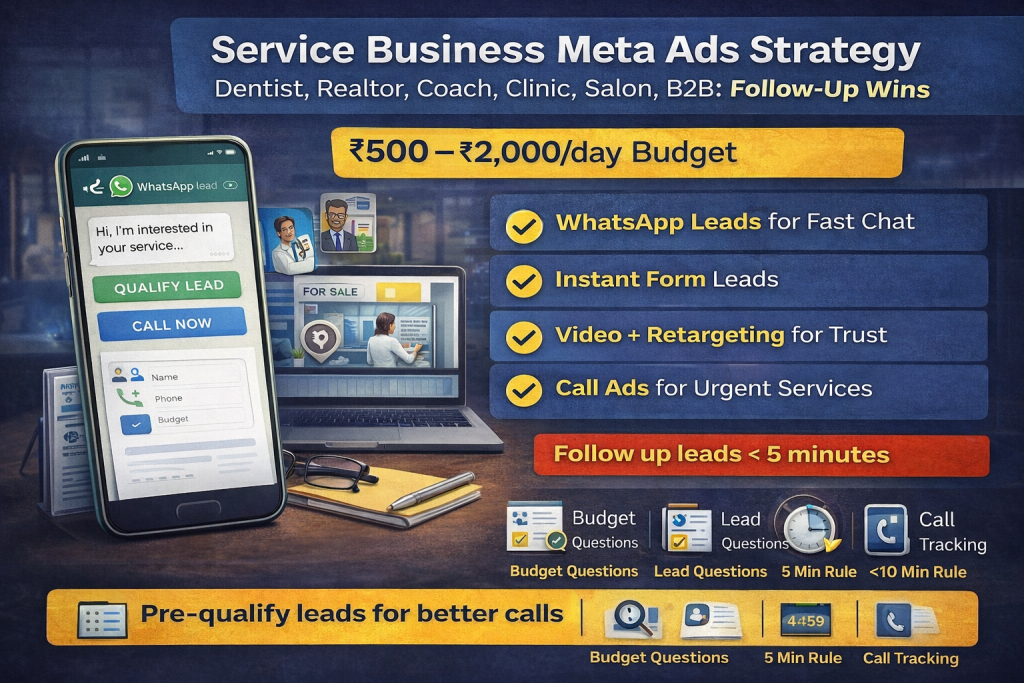
4) Service Businesses (Dentist, Realtor, Coach, Clinic, Salon, B2B): Follow-Up Wins
If you run a service business, Meta Ads can generate leads consistently — but results depend on more than just targeting and creatives.
In service businesses, your ROI is decided by two things:
- Lead quality (are you getting the right type of enquiries?)
- Response time (how fast you convert enquiries into appointments?)
This is where many service business owners feel Meta Ads “doesn’t work”. Leads come in… but bookings don’t happen. The real gap is usually between lead generation and lead conversion.
How service buyers behave (they are not buying instantly)
Unlike product-based businesses, service customers don’t purchase with one click. Even if they need the service, they want quick confirmation before they trust you.
Most service buyers ask these questions in their mind:
- Trust: “Is this provider genuine and experienced?”
- Pricing: “Is it affordable or premium? What’s the range?”
- Process: “What happens after I book? Consultation? Visit? Call?”
- Proof: “Do they have real reviews and real results?”
- Convenience: “How far is the location? What are timings?”
This is why service ads should not only sell the service — they should reduce doubt and make the next step easy.
Time to convert (service businesses have mixed timelines)
Service conversion time depends on urgency.
- Urgent services: dental pain, emergency repair, quick appointment = faster conversions
- Considered services: real estate, coaching, high-value B2B = slower conversions
Expected conversion timeline: 7 to 45 days
That means if your business is service-based, you should track not only leads, but also how many leads became:
- WhatsApp conversations
- phone calls
- appointments booked
- visits completed
- final closures
Budget expectations (local targeting + consistent leads)
In many Indian cities, service businesses can start with ₹500 to ₹2,000/day if the offer, targeting, and follow-up process are clear.
However, in highly competitive niches (real estate, cosmetic clinic, finance, coaching), budgets may need to be higher to maintain stable daily leads.
What works best for service business Meta Ads (best campaign formats)
Service campaigns work best when you remove friction and push the user toward a quick action.
- WhatsApp lead campaigns: best for quick replies and higher intent conversations
- Instant form leads: works when you add qualification questions (budget, city, requirement)
- Call ads: powerful for urgent services where direct calling is natural
- Video + retargeting: trust building for slow-decision services like real estate or coaching
How to improve lead quality (pre-qualify before you call)
If you are getting “cheap leads” but no serious customers, you don’t need more leads. You need better filtering.
Ways to improve lead quality:
- mention a starting price or package range
- clarify who the service is for (and who it is not for)
- add questions in the lead form (city, budget, timeline, requirement)
- use service-specific creatives (real work, real cases, real clinic/office)
The biggest conversion lever: follow-up speed
In service businesses, the fastest responder usually wins the lead.
Most people contact 2–3 providers at the same time. If you reply late, they will book elsewhere.
A practical rule that works almost everywhere:
- Reply within 5 minutes for WhatsApp leads
- Call within 10–15 minutes for lead form enquiries
- Follow up again after 24 hours if there’s no response
This one change alone can double appointment bookings without increasing ad spend.
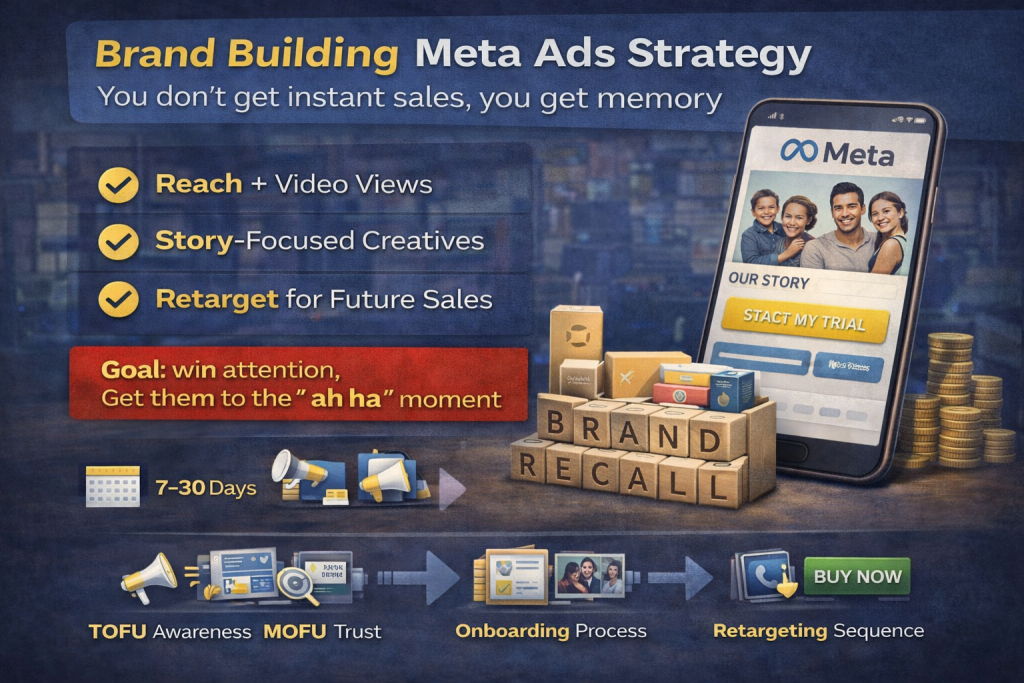
5) Brand Building: You Don’t Get Instant Sales, You Get Memory
Brand building campaigns are one of the most misunderstood parts of Meta Ads.
Many business owners run Reach or Video Views ads for a few days, see likes and views, and then stop because:
- “Sales didn’t come”
- “Meta Ads is not working”
- “Only engagement is coming, not customers”
But brand campaigns are not designed to give instant sales.
Brand campaigns are designed to do something more powerful:
Make people remember you.
What brand building actually does (in simple words)
Brand building works like this:
- People see your content repeatedly
- They start recognizing your brand name and face
- They trust you faster when they see you again
- When they are ready to buy, they choose the brand they remember
This is why strong brands don’t depend only on discounts. They depend on recall.
In Meta Ads terms, brand building is the top layer of the funnel:
- TOFU (Top of Funnel): attention + recall
- MOFU (Middle of Funnel): trust + consideration
- BOFU (Bottom of Funnel): conversion + sales
If you only run BOFU conversion ads, you will always fight higher CPMs and expensive leads.
Time to convert (brand building is a long game)
Brand building is not a “today to tomorrow” strategy.
Expected conversion timeline: weeks to months
And that’s normal. The goal here is not instant purchase. The goal is to make future conversions easier and cheaper.
What works best for brand building on Meta Ads
Brand building works best when your content feels natural inside the feed. It should not look like a typical advertisement.
Best campaign types:
- Reach campaigns: maximum visibility + stable frequency
- Video views campaigns: build warm audiences for retargeting
- Engagement campaigns: useful for social proof in some cases
Best creative formats:
- Story-based creatives: founder story, why the brand started, real journey
- Behind-the-scenes: team, process, packaging, quality checks
- Educational content: tips, mistakes, “how to choose” content
- Trust creatives: client results, testimonials, real people, real experiences
How brand building turns into sales (the right way)
The right way to run brand building is simple:
- Step 1: Run reach/video campaigns to cold audience
- Step 2: Retarget video viewers and engaged users
- Step 3: Show proof + offers to warm audience
- Step 4: Convert through leads or sales campaigns
This approach works because people don’t trust new brands instantly, but they trust familiar brands faster.
Common mistake (why business owners feel it’s useless)
The biggest mistake is running brand campaigns and measuring them like sales campaigns.
Brand building should be tracked using brand metrics like:
- Reach
- Frequency (how often people see you)
- Video watch time
- Profile visits
- Website visits from warm users
Then, your conversion campaigns should be tracked using:
- Cost per lead / cost per purchase
- Conversion rate
- ROAS
Quick fix tip: If your sales campaigns are expensive, don’t only “optimize ads”. Start building warm audiences through brand content. It reduces costs over time and improves conversion rate.
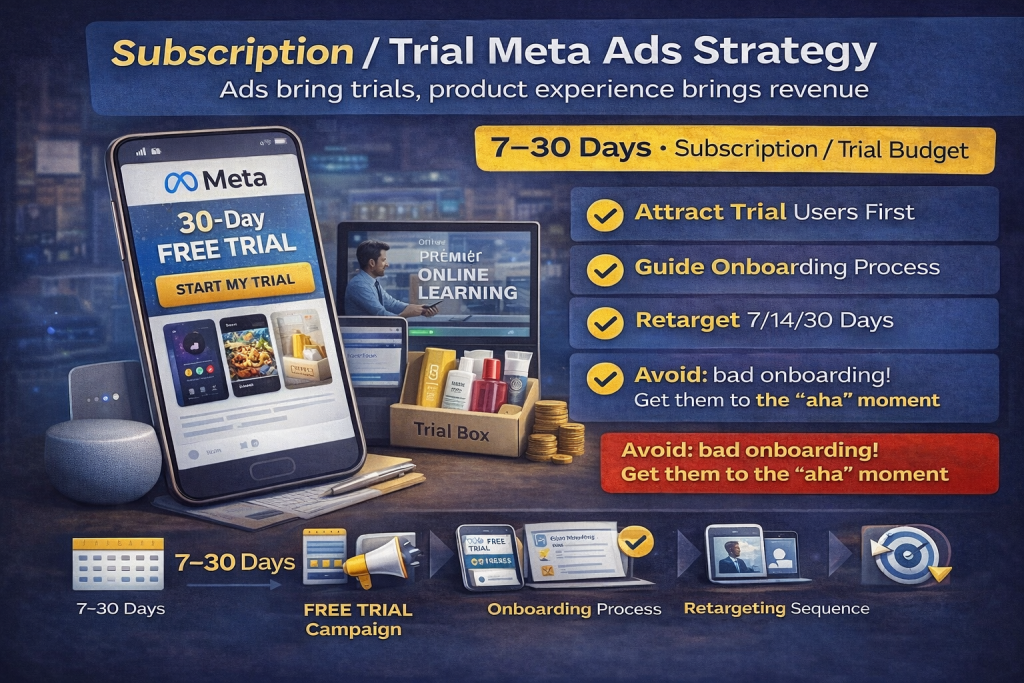
6) Subscription / Trial: Ads Bring Trials, Product Experience Brings Revenue
Subscription and trial-based businesses are a different game.
Meta Ads can generate a lot of trial users or signups, but getting signups is only the first step.
The real profit in subscriptions comes from:
- activation (did the user actually use the product?)
- retention (did the user continue after trial?)
- renewals (did they pay again next month?)
This is why many founders say:
- “Leads are coming but revenue is not coming”
- “We got signups but people are not paying”
- “Trial users are increasing but subscriptions are not growing”
In subscription models, ads are only the entry point. The product experience decides your revenue.
Buyer psychology: “Let me try first” mindset
Subscription buyers usually don’t want to commit immediately. They want to test the experience.
Most trial users are thinking:
- “Is this actually useful for me?”
- “Can I understand how to use it quickly?”
- “Will I get results in a few days?”
- “Is it worth paying monthly?”
If your trial experience doesn’t give them a quick win, they will drop — even if your ads are perfect.
Time to convert (trial to paid subscription)
Subscription conversions usually happen inside the trial window or shortly after.
Expected conversion timeline: 7 to 30 days
Some customers convert fast (within 24–72 hours), but many users need reminders, proof, and product education during the trial period.
What works best for subscription Meta Ads (the right approach)
For trials and subscriptions, you should build the funnel in 3 stages:
- Stage 1: Get trial users (low friction)
- Stage 2: Push activation (help them experience value quickly)
- Stage 3: Convert to paid plan + retain users
What works best:
- Trial campaigns: focus on clear value, not too many features
- Strong onboarding: explain “how to start” in simple steps
- Retargeting for trial users: bring back users who signed up but didn’t activate
How to improve activation (most important metric)
Activation means the user reaches their first “aha moment”. This is the moment they feel:
“Okay, this is actually useful. I should continue.”
To improve activation, focus on:
- simple onboarding steps (avoid long tutorials)
- quick results within 10–30 minutes (if possible)
- in-app reminders or WhatsApp/email nudges
- customer support that replies fast during the trial period
Retargeting strategy for subscription/trial users
In subscription businesses, retargeting is not just for sales — it’s for bringing trial users back to the product.
A simple retargeting flow:
- Day 1–3: “How to use it” + quick setup content
- Day 4–7: testimonials + results proof
- Day 8–14: feature benefits + use-case based creatives
- Day 15–30: upgrade reminder + limited-time offer (only if needed)
This helps you convert inactive trial users into paying customers without continuously increasing ad spend.
Common mistakes (why subscription ads feel unprofitable)
Subscription campaigns often fail because businesses focus only on signups and ignore what happens after signup.
- Optimizing only for “trial signup” instead of paid conversion
- Weak onboarding (users don’t understand how to start)
- No nurturing during trial (no reminders, no education)
- No tracking of activation metrics
- No retargeting for inactive users
Quick fix tip: If you’re getting trials but not paid users, the fastest improvement usually comes from onboarding + activation improvements, not from changing targeting.
How Much Budget Is Enough for Meta Ads? (Simple Answer)
There is no “perfect budget” that works for every business. But there is a practical way to know if your Meta Ads budget is enough.
Meta Ads needs budget for one main reason:
To collect enough conversion signals to learn what works.
If the budget is too low, two things happen:
- Meta doesn’t get enough data to optimize
- Your results look random (some days good, some days terrible)
Budget rule for lead generation campaigns (CPL-based)
If your goal is leads (WhatsApp leads, instant form leads, website leads), a simple budget rule is:
Daily budget = 3x to 5x your expected CPL
Example: If your average CPL in your niche is around ₹150, your daily testing budget should be around ₹450 to ₹750/day.
This gives you enough volume to judge:
- lead quality
- cost stability
- creative performance
Budget rule for purchase / conversion campaigns (CPA-based)
If your goal is purchases (ecommerce sales), Meta needs more signals than most people expect.
During testing, try to reach a point where you can generate:
1 to 3 purchases per day (when possible)
If you get 1 purchase in 7 days, you may still get results, but the learning will be slow and scaling becomes difficult.
A more realistic way to decide budget (based on business numbers)
If you want a practical check, use these questions:
- What is your gross margin? (so you know how much you can spend to acquire a customer)
- What is your average order value (AOV)?
- What is your lead-to-sale ratio? (example: 20 leads = 1 sale)
- What is your ideal cost per acquisition (CPA)?
Budget becomes easy when you stop guessing and start working backwards from business math.
Leads Are Coming But Sales Are Not? Here’s Why
This is one of the most common situations in Meta Ads:
- leads are coming
- messages are coming
- forms are being filled
- but revenue stays flat
When this happens, the problem is usually not “Meta Ads stopped working.”
The real issue is that your funnel is leaking after the lead stage.
1) Your leads are not qualified (volume is high, intent is low)
If your form or WhatsApp ad is too generic, you attract everyone. That creates cheap CPL, but low conversions.
Symptoms: too many “price pls” / “just asking” / “not picking calls” leads.
2) Your offer is not clear enough to take action
People buy clarity. If your offer feels confusing, they delay the decision.
Common clarity gaps:
- what exactly is included
- what result they can expect
- how long it takes
- what happens after payment/booking
3) The landing page or lead experience breaks trust
A landing page doesn’t need to be fancy, but it must answer buyer questions quickly.
Examples of trust breakers:
- missing proof
- unclear service process
- no FAQs
- no strong reason to choose you vs others
4) The sales process is slow (and competitors close faster)
Meta Ads delivers leads. Your closing system converts them.
If response time is slow, calls are missed, or follow-ups are inconsistent, your lead-to-sale ratio will collapse.
5) You are tracking the wrong success metric
Many campaigns look “good” on paper because CPL is low.
But the real metric is:
- Cost per qualified lead
- Cost per appointment
- Cost per sale / customer acquired
Quick reminder: Cheap leads don’t pay your bills. Customers do.
Meta Ads Checklist (Quick Fix)
If your Meta Ads is unstable or not performing, use this checklist before making major changes.
This checklist is designed to fix the most common performance gaps in a clean, step-by-step way.
Creative checklist (what you must test)
Most Meta Ads results improve faster by changing creatives than by changing audiences.
- 1 demo/explainer creative: show what it is and how it works
- 1 proof creative: reviews, results, testimonials, case studies
- 1 problem-solution creative: pain point first, then solution
- 1 “why choose us” creative: differentiation, quality, process, outcomes
- 1 direct offer creative: package/pricing hook (only if it fits your category)
Extra tip: If your frequency is rising and results drop, you may be facing creative fatigue. Refresh creatives before blaming targeting.
Campaign + optimization checklist
- use the right campaign objective for your goal (leads or sales, not random traffic)
- avoid changing things daily (let the data settle)
- test 2–4 creatives per ad set to find a stable winner
- track meaningful events (lead, purchase, booked call), not vanity metrics
Funnel checklist (what must be clear)
- clear offer: what they get + who it is for
- clear pricing range: remove “surprise pricing” fear
- strong proof: reviews, results, credibility points
- simple next step: WhatsApp, call, booking, or purchase
- objection handling: FAQs that answer common doubts
Retargeting checklist (warm audience conversion layer)
Retargeting is not optional if you want consistency.
- 7 days: engaged audience and video viewers
- 14 days: website visitors / lead openers
- 30 days: high-intent users (add-to-cart, form started, repeat visitors)
What to Do Next (7-Day Fix Plan)
If your Meta Ads performance feels stuck, follow this simple 7-day plan. It fixes the foundation before you scale.
- Day 1: Fix tracking and reporting (Pixel, events, lead tracking, purchase tracking)
- Day 2: Improve offer clarity (headline, benefits, proof, CTA)
- Day 3: Launch 3 new creatives (new angle, new hook, new format)
- Day 4: Build warm audience targeting (engagers, visitors, video viewers)
- Day 5: Pause weak creatives and control wasted spend
- Day 6: Scale stable ads slowly (increase budget by 20–30%)
- Day 7: Review funnel performance (leads to calls to sales, not only CPL)
Note: The goal of this plan is simple: remove guesswork and create predictable performance.
Final Thoughts: Meta Ads Works When the Strategy Matches Your Business
Meta Ads works, but it does not work with one template for everyone.
Your results become predictable when you align:
- your pricing (how people decide)
- your conversion timeline (how long they need)
- your offer clarity (why they should choose you)
- your proof (what removes doubt)
- your follow-up system (how leads become customers)
If these pieces are in place, Meta Ads becomes less stressful and more scalable.
Need Help With Meta Ads Management?
If you want a performance-focused Meta Ads strategy built for your business (not generic templates), I can help.
What you get when we work together:
- Offer + funnel review (fix clarity and conversion gaps)
- Creative strategy planning (angles, formats, messaging)
- Campaign setup + optimization (testing, scaling, stability)
- Retargeting structure (warm audience conversion system)
- Weekly reporting (simple insights + next-step actions)
Want a quick strategy suggestion?
You can message me or book a consultation through vijaybhabhor.com.
FAQs
1) Why are Meta Ads not working for my business?
Meta Ads usually doesn’t work when the campaign goal, offer, and funnel don’t match your business model. Common reasons include wrong objective selection, weak creatives, low budget for learning, missing retargeting, and expecting fast conversions in a slow decision category.
2) How long does Meta Ads take to give results?
It depends on pricing and decision time. Some products convert quickly, while service and high-ticket offers often take longer. A realistic range can be a few days to several weeks depending on proof, follow-up, and buyer trust.
3) What daily budget is good for Meta Ads?
For lead generation campaigns, start with 3x to 5x your expected CPL. For purchase campaigns, aim for enough budget to generate multiple conversion signals during testing so Meta can optimize effectively.
4) Why am I getting leads but not sales?
Most commonly, leads are not qualified, the offer is unclear, follow-up is slow, trust-building is missing, or the funnel has gaps after the lead stage. In such cases, improving lead quality and conversion process usually gives better ROI than only changing targeting.