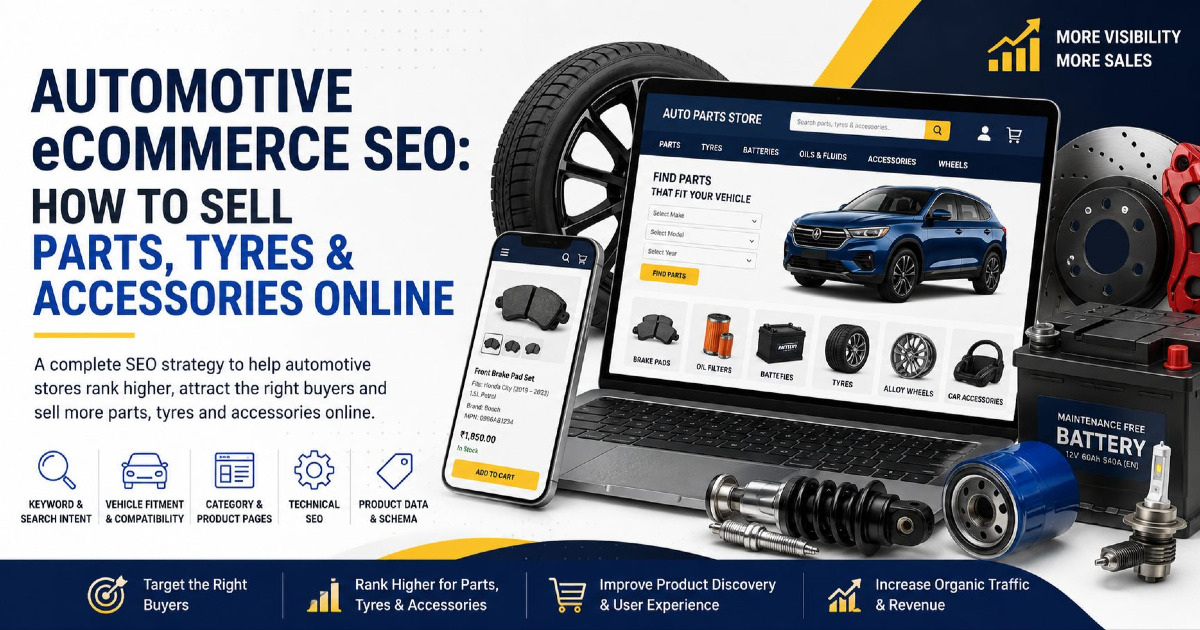
Selling automotive products online is very different from selling normal lifestyle products. A customer buying a T-shirt mostly needs the right colour and size. A customer buying a brake pad, battery, tyre, alloy wheel or oil filter first needs to know whether the product is actually suitable for the vehicle. If the store cannot answer that clearly, getting more Google traffic will not solve the real problem.
This is where SEO for an automotive eCommerce store becomes interesting. Customers may search by vehicle, part name, tyre size, part number, brand, technical specification or even by a problem they are trying to solve. Someone may search for “brake pads for Honda City 2021”, another person may search a Bosch part number directly, while a tyre customer may start with “205/55 R16”. All three customers are shopping for automotive products, but they are using Google in completely different ways.
A good automotive SEO strategy therefore starts with understanding the catalogue properly. Your categories, product data, fitment information, filters and product pages must work together so that Google can find the right page and the customer can confidently choose the right item.
This guide is written for auto-parts retailers, tyre sellers, accessory brands, distributors, manufacturers and traditional automotive businesses that are now selling online through Shopify, WooCommerce or a custom eCommerce store. It is not a dealership SEO guide and it is not about getting test-drive enquiries. The focus here is selling physical automotive products through organic search.
Automotive Products Do Not All Need the Same SEO Strategy
The first mistake is treating every item in an automotive catalogue like a spare part. A brake pad needs vehicle compatibility. A tyre can often be found through tyre size. Engine oil may be searched by viscosity and manufacturer approval. A dashboard cleaner usually does not need vehicle fitment at all.
I would divide an automotive catalogue into three broad types before doing keyword research or creating SEO pages.
| Product Type | Examples | What Usually Helps the Customer Choose |
|---|---|---|
| Vehicle-fit products | Brake pads, filters, suspension, clutch parts, wipers | Make, model, year, engine, part number and position |
| Specification-fit products | Tyres, batteries, oils, bulbs, alloy wheels | Size, capacity, rating, technical specification and sometimes vehicle |
| Universal products | Car shampoo, phone holders, vacuum cleaners, cleaning cloths | Features, size, use, quality, brand and price |
This simple difference changes the whole SEO plan. A universal tyre inflator should not have thousands of pages saying “Tyre Inflator for Honda City”, “Tyre Inflator for Toyota Corolla” and “Tyre Inflator for Ford Focus” when the same product works with almost every normal passenger vehicle. Those pages add very little value.
On the other hand, a brake pad that fits only selected Honda City models needs strong compatibility information because fitment is part of the buying decision.
Build the Product Catalogue Properly Before Chasing Keywords
Automotive SEO is heavily dependent on product data. If your product database contains poor information, creating hundreds of SEO pages will only spread that poor information across the website.
Imagine these two product records.
| Weak Product Data | Useful Product Data |
|---|---|
| Brake Pad | Bosch Front Brake Pad Set |
| SKU: 123 | MPN: 0986AB1234 |
| Car Part | Fits selected Honda City models |
| - | Position: Front |
| - | Vehicle years: 2019–2023 |
| - | Engine: 1.5 Petrol where applicable |
| - | OE reference where verified |
| - | Current stock status |
The second record gives you far more options. You can create a clearer product title, better internal search results, stronger filters, useful category pages, more accurate structured data and better Merchant Center information. The first record forces your content team to guess.
This is why an automotive eCommerce SEO project often needs catalogue cleanup before large-scale content work starts.
Understand How People Search for Automotive Products
Automotive searches normally become more specific as the buyer gets closer to the purchase. Some customers know exactly what they need. Others know only the vehicle or problem.
| Search Style | Example | Best Type of Landing Page |
|---|---|---|
| Product type | brake pads | Category |
| Vehicle + product | brake pads for Hyundai Creta | Vehicle/product category |
| Vehicle + year + product | 2022 Creta brake pads | Fitment-aware category or product result |
| Exact part number | Bosch 0986AB1234 | Product page |
| Specification | 205/55 R16 tyres | Tyre-size category |
| Brand + specification | Michelin 205/55 R16 | Brand/specification category where useful |
| Problem | brake squeaking when stopping | Helpful article leading to relevant parts |
| Universal product | best car dashboard cleaner | Category, product or guide depending on intent |
This is why normal keyword research tools are only one source of information. Your own internal site search, customer-support questions, marketplace listings, paid-search terms, product enquiries, part-number searches and returned-product reasons can reveal valuable language that keyword tools may not show clearly.
For the wider process of turning search demand into categories, product pages and content, my eCommerce keyword research guide explains page ownership in more detail.
Your Store Should Let Customers Shop in More Than One Way
Some buyers know the product. Some know the car. Some know the brand. Others know only a technical specification. A strong store should support these different shopping paths without creating a confusing SEO structure.
A large automotive site may therefore allow users to shop by product type, vehicle, brand and selected technical specifications. That does not mean every possible combination deserves a separate indexable page.
| Shopping Route | Example |
|---|---|
| Shop by part | Brakes → Brake Pads |
| Shop by vehicle | Honda → City → Braking Parts |
| Shop by brand | Bosch → Filters |
| Shop by tyre size | 205/55 R16 |
| Shop by battery specification | 12V → 45Ah |
The SEO challenge is making sure these paths help customers without creating five near-identical pages targeting the same search. One search intent should normally have one strong page owner.
Vehicle Fitment Is Important for Parts That Actually Need It
For vehicle-specific products, compatibility is one of the biggest reasons a customer either purchases or leaves the website. If someone is buying brake pads, an air filter or a suspension component, they need to know whether it fits their exact vehicle.
A typical vehicle finder may ask for the year, make, model and sometimes engine or vehicle variant. This works well as a shopping tool because it reduces the product list to compatible items.
The SEO mistake is assuming that every possible selection should automatically create an indexable page.
Suppose the database contains hundreds of makes, thousands of models, several years and several engine variants. Automatically multiplying every possible combination by every product category can create an enormous number of thin URLs.
A useful landing page such as “Brake Pads for Honda City” can make sense if enough people search for it and the store has enough compatible products. A highly specific page containing one product for one small engine/year combination may not need separate search visibility.
Your Vehicle Finder and Your Google SEO Pages Are Not the Same Thing
This point is important because many automotive platforms confuse the two.
The vehicle finder should help the customer find the correct products. It can create temporary filter states and highly specific results. Google does not need to index every one of those states.
Your permanent SEO pages should be the combinations that have real customer demand and enough inventory to remain useful. In many cases, the store can use thousands of fitment combinations internally while exposing only a smaller group of strong landing pages to Google.
This protects the website from creating a huge number of weak pages while still giving customers accurate fitment.
Do Not Hide All Compatibility Information Inside a JavaScript Selector
A vehicle finder can improve the user experience, but useful compatibility information should also appear clearly on the product page where practical.
A brake-pad page could show something like:
| Compatibility | Details |
|---|---|
| Honda City | Selected 2019–2023 models |
| Honda Amaze | Selected 2018–2023 models |
| Position | Front axle |
The exact compatibility should always come from reliable fitment data. Do not add a model name merely to capture a keyword if you are not certain that the product fits the vehicle.
Wrong fitment is much worse than missing SEO traffic because it creates returns, customer complaints and loss of trust.
Tyre SEO Needs Its Own Category Strategy
Tyres are one of the clearest examples of why automotive eCommerce cannot rely only on Year–Make–Model pages. Many tyre buyers already know the size they need and search directly by specification.
A customer might search for “205/55 R16 tyres”, “Michelin 205/55 R16”, “SUV tyres for highway driving” or “tyres for Toyota Corolla”. These searches can lead to different landing pages even though they may eventually show some of the same products.
A useful tyre structure may contain the main tyre category, size-based categories, important brand pages and selected vehicle-specific tyre pages.
| Possible Page | When It Makes Sense |
|---|---|
| /tyres/ | Main tyre category |
| /tyres/205-55-r16/ | Strong size-based demand |
| /tyres/michelin/ | Useful brand demand |
| /hyundai/creta/tyres/ | Vehicle-specific demand and useful inventory |
What you should avoid is blindly generating every possible size, brand, vehicle, fuel type and price combination. That can produce thousands of pages with only one or two products.
A Tyre Product Page Needs More Than the Tyre Name
Tyre specifications affect safety and compatibility, so the product page should show the important technical details clearly.
| Tyre Detail | Example |
|---|---|
| Brand | Michelin |
| Model / pattern | Primacy 4 |
| Width | 205 |
| Aspect ratio | 55 |
| Rim size | 16 inch |
| Load index | Where applicable |
| Speed rating | Where applicable |
| Construction / tubeless | Accurate product specification |
| Warranty | Manufacturer terms where applicable |
A good page also explains the information customers normally want before purchasing. This may include intended use, comfort, road-noise characteristics, wet grip or suitable vehicle applications where you have reliable manufacturer data.
Alloy Wheels Need a Different Compatibility System
An alloy-wheel customer may search by size, vehicle or style, but wheel fitment can involve several technical measurements. Diameter alone is not enough.
Useful product data can include wheel diameter, width, bolt pattern or PCD, offset and centre bore. Depending on the market and vehicle, other details may also matter.
This gives you search opportunities such as “17 inch alloy wheels”, “5x114.3 alloy wheels” or “alloy wheels for Hyundai Creta”, but only create pages where the inventory and fitment data are good enough to make the result useful.
Never promise vehicle compatibility from wheel diameter alone. The page should clearly explain the measurements customers need to verify.
Battery SEO Mixes Vehicle Fitment With Technical Specifications
Battery customers can search by vehicle or by specification. Someone may search “battery for Maruti Swift”, while another customer may already know they need a 12V 45Ah battery.
A useful battery page should therefore make key information easy to understand: voltage, capacity, physical dimensions where important, terminal position, technology type, warranty and vehicle compatibility where verified.
A battery category can also support educational content around choosing the right capacity, understanding battery types and recognising signs of a weak battery. The content should help customers select products rather than simply exist for traffic.
Engine Oil and Lubricants Need Specification-Based SEO
Oil customers often search using viscosity grades and manufacturer specifications. Searches such as “5W30 engine oil”, “fully synthetic 5W40”, “engine oil for diesel SUV” and vehicle-specific oil searches can all have buying intent.
An oil product page should make viscosity, oil type, pack size, API/ACEA specification and genuine manufacturer approvals clear wherever those details apply. Do not casually claim an OEM approval just because the viscosity looks correct.
The same principle applies to transmission fluids, brake fluids, coolant and other technical liquids. Search optimisation should be built around real product specifications, not keywords added without technical support.
Accessories Need to Be Split Into Vehicle-Specific and Universal Products
Automotive accessories cover a huge range of products. Floor mats, seat covers, mud flaps and some roof accessories can be strongly vehicle-specific. Phone holders, tyre inflators, cleaners, vacuum cleaners and many chargers can be universal.
These products should not use the same SEO setup.
A model-specific floor mat can target a search like “floor mats for Toyota Fortuner”. A universal phone holder should normally be optimised around product features, mounting style, device compatibility and use rather than creating pages for every vehicle model.
This saves the site from producing unnecessary fitment pages and makes the content more useful to shoppers.
Car-Care Products Follow Problem and Use-Based Search
Car-care customers may search for a problem rather than a vehicle. Searches may include “remove water spots from car”, “dashboard polish”, “car shampoo for ceramic coating”, “microfibre cloth for car detailing” or “scratch remover for black car”.
The SEO strategy should therefore focus on product type, surface, use and problem. Vehicle compatibility is normally irrelevant unless the product has a real restriction.
This is also one of the best categories for useful informational content because customers often need instructions before they buy.
Part Numbers Can Bring Highly Valuable Search Traffic
Automotive shoppers often search exact numbers because mechanics, catalogues and existing parts may already give them an identifier.
Depending on the product, this may include the manufacturer part number, OE/OEM reference, GTIN, brand code or another recognised identifier.
If a genuine identifier exists, make it easy to find on the product page. Do not hide important part numbers only inside an image or PDF.
A page might contain:
| Field | Example |
|---|---|
| Brand | Bosch |
| Manufacturer part number | 0986AB1234 |
| SKU | Your internal store SKU |
| OE reference | Only where correctly verified |
| GTIN | Where the manufacturer provides one |
These searches may have lower volume than broad category keywords, but the person searching an exact part number can be much closer to buying.
Do Not Confuse Genuine, OEM and Aftermarket Parts
This is an important content-quality issue in automotive ecommerce.
A part that fits a Toyota vehicle is not automatically a Toyota-branded part. A Bosch replacement part should not be described as a “Toyota genuine part” simply because it is compatible with a Toyota model.
Use terms such as genuine, OEM, OE replacement, aftermarket, performance or refurbished only when they accurately describe the product. Wrong terminology can confuse customers and create problems in product feeds as well.
The same rule applies to product identifiers. Use the identifiers of the product you are actually selling rather than copying another manufacturer's identity because it is a compatible replacement.
Product Pages Should Answer the Questions a Buyer Has Before Ordering
One of the biggest content problems on automotive stores is a product page that contains only the manufacturer title, price and two lines copied from the supplier.
A good product page should make the purchase decision easier.
| Customer Question | Useful Product Information |
|---|---|
| What is this? | Clear part or product name |
| Will it fit? | Verified vehicle/specification compatibility |
| Which version is it? | Brand, MPN, OE references and variation details |
| Where is it used? | Front/rear, left/right or suitable application where relevant |
| What is included? | Quantity and package contents |
| What are the specifications? | Dimensions, ratings, material, capacity or other relevant details |
| Can I return it? | Clear return/fitment policy |
| Is it available? | Accurate stock information |
This is much more useful than changing a supplier description with synonyms just to make the text look “unique”.
My eCommerce on-page SEO guide covers category and product optimisation in more depth.
Manufacturer Copy Is Not Enough When Everyone Sells the Same Product
Automotive distributors often give dozens of retailers the same catalogue title, same specification table and same description. If every seller publishes exactly the same information, the search results can contain many almost identical product pages.
Your advantage can come from information the customer actually finds useful: better fitment explanation, measurements, installation notes, cross-reference information, photographs, package contents, comparisons, warranty information and clear return rules.
You do not need to rewrite factual specifications into fancy language. Keep technical facts accurate. Add useful information around them.
Category Pages Should Help People Choose, Not Block the Products With SEO Text
An automotive category is primarily a shopping page. Someone landing on “Brake Pads” or “205/55 R16 Tyres” normally wants to see products quickly.
Do not push the product grid far down the page because somebody believes every category needs 1,500 words before the first item appears.
Useful category content may explain selection criteria, important specifications, fitment, brand differences or what information the customer should check before ordering. Keep it close to the actual buying decision.
Be Careful With Vehicle Pages That Show the Same Products
Fitment databases make it easy to generate thousands of vehicle pages automatically. The danger appears when many pages contain almost the same products and almost no unique information.
For example, creating separate pages for every trim level of the same vehicle may not be useful if all of those pages show the same brake pads, filters and accessories.
Before making a vehicle page indexable, check whether it serves useful search demand and whether the inventory is strong enough. Fewer useful pages are normally better than hundreds of weak combinations.
Filters Can Create a Huge Technical SEO Problem
An automotive store can have filters for make, model, year, engine, brand, price, product type, specification, position, stock and many other attributes. Combining those filters can create an enormous number of URLs.
For example:
/brake-pads?make=honda
/brake-pads?make=honda&model=city
/brake-pads?make=honda&model=city&year=2021
/brake-pads?make=honda&model=city&year=2021&brand=bosch
These pages can be useful for customers without all becoming search landing pages.
Create indexable filter/category pages only where there is meaningful demand and useful inventory. Keep ordinary shopping combinations under control so Google does not spend time crawling thousands of near-duplicate states.
My URL parameters guide explains the technical side of filter and parameter URLs separately.
Do Not Depend Only on a Product Finder for Google Discovery
A customer may use Year–Make–Model or VIN search to reach a product, but Google usually discovers pages by following links and known URLs rather than filling out vehicle-finder forms like a shopper.
Important categories and product pages therefore still need normal crawlable links and a sensible store structure.
A vehicle finder should improve product matching. It should not become the only way Google can find a high-value product.
Internal Search Can Reveal Missing SEO Opportunities
Automotive stores often have valuable internal-search data because customers type exact part numbers, vehicle names and technical specifications into the search box.
If hundreds of visitors regularly search for “Creta brake pads” but the website has no useful landing page for that need, the internal-search data has found a possible SEO opportunity.
The same applies to failed searches. If customers repeatedly search a part number that your system cannot recognise even though the product is in stock, your catalogue data or search synonyms may need work.
Technical SEO Becomes More Important as the Catalogue Grows
Automotive ecommerce can produce a very large number of URLs because one product may fit many vehicles and one vehicle may use thousands of products. Filters and variant states can increase the number further.
The technical setup therefore needs stable product URLs, useful category pages, controlled parameters, crawlable pagination, correct canonical tags and clean XML sitemaps.
A canonical tag tells Google which URL you prefer when several URLs show the same or very similar content. The deeper crawling, rendering and catalogue rules are covered in my eCommerce technical SEO guide.
Your XML Sitemap Should Contain the Pages You Actually Want Google to Find
An automotive product sitemap should not include every filter, search state and redirect created by the store.
Active canonical product pages, useful categories and other genuine search pages normally belong in the sitemap. Redirecting URLs, deleted products and ordinary filter combinations normally do not.
Temporarily out-of-stock products can remain in the sitemap when the product page is still live, indexable and expected to remain useful.
My eCommerce XML sitemap guide covers product, category, variant and stock-status decisions in more detail.
Product Structured Data Should Match the Product the Customer Sees
Structured data can help Google understand product information such as brand, identifiers, price and availability. For automotive stores, accuracy matters because the product may already have several technical IDs and compatibility references.
Do not add unsupported properties or invent compatibility markup only because you want Google to understand every vehicle the product fits. Use supported Product information correctly and make important fitment information clear in the visible page content.
Where variants are genuine product variations, ProductGroup or suitable Product/Offer structures may be useful depending on how the store is built.
Your Product Page and Merchant Center Should Agree
If you also use Google Merchant Center, your website and product feed should describe the same item.
| Information | Should Be Consistent |
|---|---|
| Landing page | Correct product URL |
| Brand | Actual manufacturer/brand |
| GTIN | Correct identifier where available |
| MPN | Correct manufacturer part number where available |
| Price | Same current price |
| Availability | Same stock state |
| Image | Accurate product image |
This does not mean the SEO article should become a Google Shopping tutorial. The point is simply that product information should not change depending on which Google system reads it.
Out-of-Stock Parts Do Not Automatically Need to Disappear
Many automotive parts go temporarily out of stock, especially imported components, special-order items and products with long supply cycles.
If the item is expected to return, the page can normally remain live. Show the correct availability and useful alternatives rather than deleting the URL every time stock reaches zero.
This keeps the product page stable and also helps customers who are still researching the part number or specifications.
Superseded Part Numbers Need Special Attention
Automotive manufacturers sometimes replace an older part number with a newer one. This is different from a normal product deletion because customers may continue searching for the old number for years.
Suppose:
Old part number:
12345-A

New replacement:
12345-B
If the manufacturer has officially replaced A with B and the new product is a genuine substitute, the old page can guide the customer towards the new item. Depending on the situation, a relevant redirect may also make sense.
The replacement page should ideally mention the older reference so customers searching the old number can understand what changed.
Do Not Redirect Every Discontinued Part to a Generic Category
A discontinued alternator should not automatically redirect to the homepage or a huge “Car Parts” category simply because the store wants to avoid a 404.
If there is a genuine replacement, send customers there. If the old page still provides useful specification or compatibility information, keeping it available may sometimes make sense. If nothing useful remains, a proper unavailable response can be more accurate than a misleading redirect.
Content Should Help Customers Maintain, Choose and Understand Products
The blog strategy for an automotive eCommerce store should support the product catalogue. Generic articles such as “Top Cars of the Year” may attract traffic, but they are often far away from the products the store actually sells.
Better topics solve questions that naturally lead towards parts, tyres or accessories.
| Useful Article | Natural Product Connection |
|---|---|
| How to read a tyre size | Tyre-size categories |
| When should brake pads be replaced? | Brake pads |
| 5W30 vs 5W40 engine oil | Engine-oil categories |
| AGM vs conventional battery | Car batteries |
| How to find an automotive part number | Part-number search and products |
| How to choose the right wiper blade size | Wipers |
| What does PCD mean on alloy wheels? | Alloy wheels |
| OEM vs aftermarket car parts | Replacement-part categories |
Good informational content should answer the question properly first. The product link should appear naturally when the reader genuinely needs the next step.
Internal Links Should Connect Advice With the Right Products
A guide explaining how to read tyre size can link to tyre-size categories. An article about brake-pad wear can link to the brake-pad section. A battery guide can connect to suitable battery categories.
This makes much more sense than inserting random product links into every article.
Internal linking also helps Google understand which guides, categories and products belong together, while customers get a clear route from research to shopping.
Shopify Automotive Stores Need to Keep Fitment Data Organised
Shopify gives sellers a strong base for normal eCommerce, but automotive fitment often needs additional product data or applications because Year–Make–Model compatibility is more complex than ordinary product options.
Whether you use metafields, tags, an automotive fitment app or a separate database, avoid maintaining the same compatibility information manually in several places. If one system says the part fits a 2022 vehicle and another says it does not, customers will lose confidence.
Keep product URLs stable and be careful when apps create additional filter or fitment URLs that could become crawlable.
WooCommerce Automotive Stores Need Clear Plugin Roles
WooCommerce can be very flexible for large automotive catalogues, but the final setup may depend on WordPress, WooCommerce, your theme, SEO plugin, product-filter plugin, fitment plugin and feed tools.
The main risk is several plugins trying to control the same thing. One plugin may create product schema, another adds a second Product entity, while a filter plugin creates thousands of indexable URLs.
Use plugins to support the store structure you have decided rather than allowing each plugin to create its own SEO rules.
Custom Automotive Stores Need SEO Built Into the Catalogue System
Large distributors and specialist automotive businesses often use custom inventory or ERP systems. In these stores, SEO cannot be added only at the frontend after development is finished.
The product database should provide enough information to generate correct product names, URLs, categories, fitment, stock information, structured data and sitemap entries automatically.
When a product changes status, the website should know whether the page remains live, points to a replacement or is removed. When a new vehicle is added, the fitment system should connect products without creating thousands of unnecessary search pages.
Global Automotive Stores Need to Handle Vehicle Naming Carefully
Automotive search becomes more complex when selling internationally because the same vehicle, engine or product may use different naming in different countries. A model available in India may have another variant or engine lineup in Europe, the Middle East or North America.
Do not simply copy one country's fitment catalogue into every market. Product availability, vehicle specifications, terminology, currency, shipping and regulations may differ.
International pages should be based on the products and vehicles genuinely available in that region.
Measure SEO by Product Discovery and Revenue, Not Only Rankings
Rankings are useful, but an automotive store ultimately needs customers to find the correct products and buy them.
I would pay attention to category traffic, product-page traffic, part-number searches, vehicle landing pages, product views, Add to Cart, purchases and organic revenue.
A page can rank well for a broad automotive keyword and still create very little business. Another category may have lower traffic but attract customers searching exact tyre sizes or part numbers who purchase at a much higher rate.
Search Console data can also reveal vehicle or part combinations where the store receives impressions but does not yet have the best page.
Returns Can Tell You Where SEO and Product Data Are Failing
Return reasons are particularly useful in automotive ecommerce.
If customers repeatedly return products because “does not fit my vehicle”, the problem may not simply be customer care. The product page, compatibility data, search landing page or vehicle finder may be giving people too much confidence in the wrong match.
If one category gets good organic traffic but a high fitment-related return rate, improving that product information can be more valuable than trying to increase traffic further.
If You Also Have a Physical Store or Fitting Centre
Some automotive eCommerce businesses also operate tyre-fitting centres, parts counters, workshops or pickup locations. In that case local SEO can support the ecommerce strategy, especially for searches where customers want both the product and installation.
Examples include tyre fitting, battery replacement, wheel alignment and accessory installation. Keep those local-service pages separate from national product/category pages so Google and customers can understand whether a page is selling a product online or promoting a local service.
Common Automotive eCommerce SEO Problems
A common problem is creating thousands of Year–Make–Model pages simply because the database allows it. Many of these pages contain the same products and almost no useful information. The better approach is to keep the full fitment system for customers while making only the strongest search combinations indexable.
Another problem is using generic supplier descriptions on every product page. In automotive ecommerce, factual manufacturer specifications should remain accurate, but the retailer can still add value with verified compatibility, dimensions, package details, installation notes, better images and helpful comparisons.
Stores also create problems when they call aftermarket products “genuine” or use an OEM brand in the title simply because the product fits that manufacturer's vehicle. Compatibility and manufacturer identity are different things.
Filter URLs are another major source of technical problems. Make, model, year, engine, brand, position and price can quickly create a huge number of combinations. Only search-worthy landing pages should become part of the indexable SEO structure.
Finally, many stores concentrate so heavily on Google that they forget the customer. Ranking a brake pad page is not useful if the customer still cannot tell whether it fits the front or rear axle, which model years it supports or what is actually included in the box.
What a Strong Automotive eCommerce Store Looks Like
A strong automotive store does not need the largest number of SEO pages. It needs pages that correctly match how customers search and how products are selected.
Vehicle-specific parts should have reliable fitment. Tyres should be easy to browse by important sizes and relevant vehicle applications. Batteries and oils should expose the specifications customers use to choose them. Universal accessories should be optimised around their real features and use cases rather than unnecessary vehicle combinations.
Product identifiers should be accurate. Category pages should help customers shop. Filters should improve product discovery without producing an uncontrolled URL problem. Informational content should answer genuine maintenance and buying questions and connect naturally to relevant product categories.
Automotive SEO Works Best When the Product Data Is Right
If there is one lesson to take from this guide, it is that automotive eCommerce SEO starts deeper than titles and meta descriptions.
A weak catalogue with missing part numbers, poor compatibility data, confusing categories and unreliable stock cannot be fixed simply by adding more keywords. The website needs to understand what each product is, which vehicles or specifications it suits, how customers search for it and which page should appear in Google.
Once that foundation is correct, SEO becomes much more practical. You can create useful category pages instead of thousands of thin filters. Product pages can answer real compatibility questions. Content can support the parts customers actually buy. Merchant Center receives cleaner information, and organic visitors reach pages that are more likely to help them choose correctly.
For the wider strategy covering categories, products, technical SEO and ecommerce content, read my eCommerce SEO guide. If you sell automotive parts, tyres, batteries, lubricants, accessories or other vehicle products and need help improving the organic structure of your store, my eCommerce SEO services focus on building search visibility around the catalogue rather than chasing disconnected keywords.