YouTube processes over 500 hours of video uploaded every minute. The platform has approximately 2.7 billion logged-in monthly users. At that scale, the question of which video any individual person sees next cannot be answered by a simple ruleset. It requires a prediction system capable of inferring what a specific person wants to watch before they know they want to watch it. That prediction system is what people call the YouTube algorithm, and it is significantly more sophisticated than most creators and marketers understand it to be.
Most explanations of how YouTube works focus on what creators should do: post consistently, optimise thumbnails, write descriptions. This article explains what YouTube is actually doing: running a multi-stage AI system that models user behavior, predicts satisfaction, and ranks billions of candidate videos in milliseconds to serve a single viewer one recommendation. Understanding the system rather than the tactics produces a fundamentally different, and fundamentally more effective, approach to the platform.
What Is the YouTube Algorithm?
The YouTube algorithm is not a single system. It is a collection of machine learning models working in sequence to solve one objective: predict which video a specific user will find most satisfying at this specific moment, and present that video in a way that earns a click.
The confusion about how YouTube works comes from conflating three distinct systems that each operate on different signals and serve different functions. YouTube as a recommendation engine suggests videos based on behavior history. YouTube as a search engine ranks videos based on query relevance and engagement. YouTube as an advertising platform determines which content attracts advertiser spend and at what rate. These three systems interact but they are not the same system and they do not respond to the same inputs.
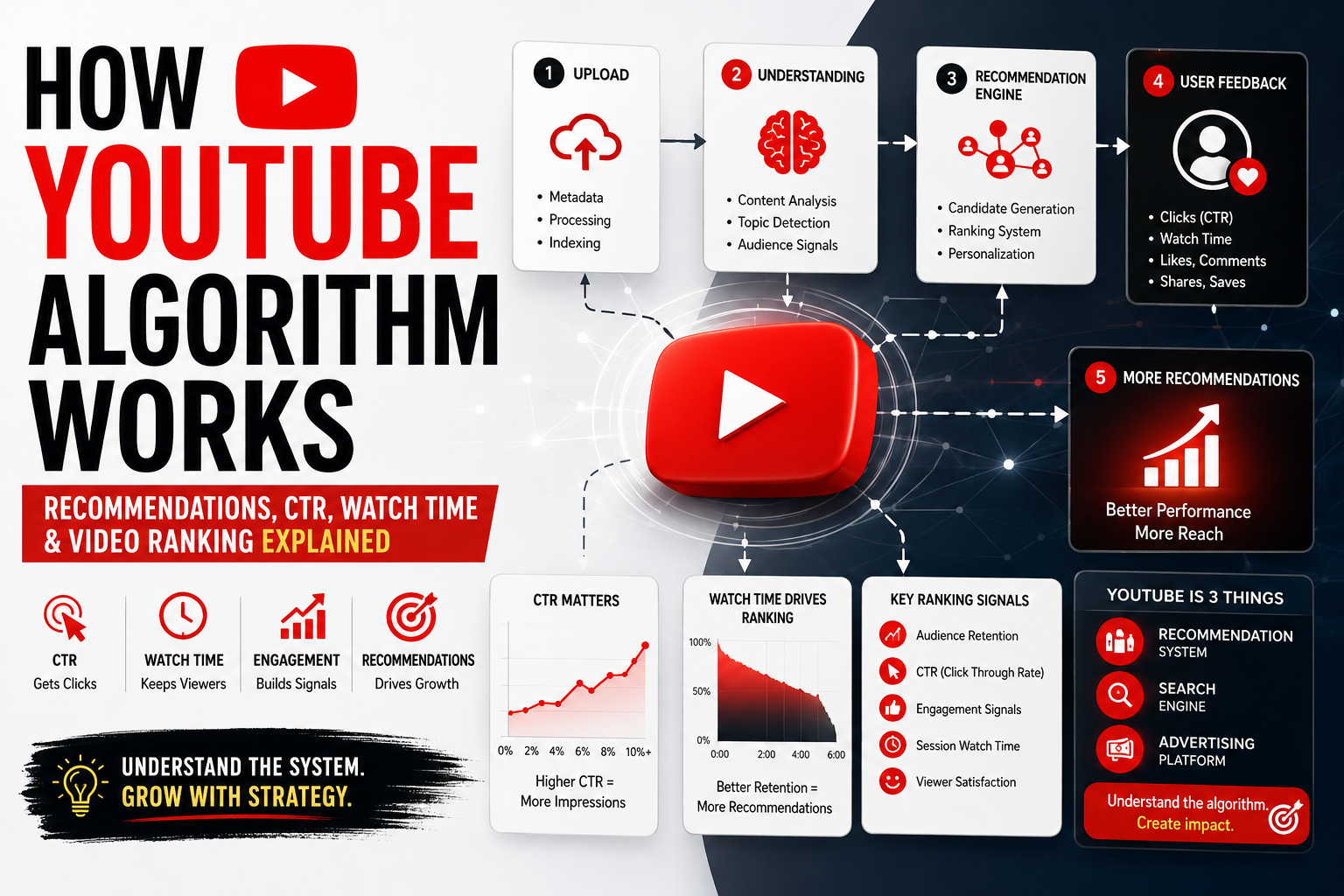
Google's own research papers on YouTube's recommendation system, published through the ACM RecSys conference and Google AI, describe the architecture as a two-stage process: candidate generation followed by ranking. In the candidate generation stage, the system narrows billions of videos down to hundreds of candidates for a specific user based on broad behavioral signals. In the ranking stage, those hundreds of candidates are scored against dozens of features to produce the final ordered list the user sees. The objective function that guides the ranking is not raw view count or even total watch time. It is a prediction of user satisfaction, which YouTube models using a combination of explicit signals (likes, shares, subscriptions) and implicit signals (did the viewer watch the next video, did they leave the platform immediately after, how long did this session last).
| YouTube System | Primary Function | Primary Goal |
|---|---|---|
| Recommendation engine | Suggests videos on homepage, suggested feed, and after video ends | Maximize user satisfaction and session duration |
| Search ranking system | Orders videos in response to typed queries | Match query intent with most relevant, satisfying content |
| Shorts feed system | Sequences short-form videos in the Shorts tab | Maximize swipe-through satisfaction and session continuation |
| Notification system | Decides which subscribers receive upload notifications | Send notifications only when click probability is high |
| Advertising system | Matches ads to viewers based on content and behavior signals | Maximize advertiser value and viewer experience compatibility |
The practical implication of this architecture is that YouTube is not rewarding content that follows a formula. It is rewarding content that produces specific measurable viewer behaviors. The formula that works today works because it reliably produces those behaviors in a specific audience segment, not because YouTube's engineers wrote a rule saying that consistent upload schedules or 10-minute videos are preferred. When viewer behavior changes, the system recalibrates, and creators who built strategies around observed patterns rather than the underlying mechanism are the ones who lose visibility without understanding why.
What Happens When You Upload a Video on YouTube?
The first 24 to 48 hours after a video upload are the most consequential period in that video's life on the platform. What happens in this window determines whether the video receives broad distribution or remains in a holding pattern that most creators interpret as the algorithm ignoring them. It is not being ignored. It is being tested.
Stage 1: Metadata Processing and Initial Indexing
The moment a video is uploaded and published, YouTube's systems process the metadata associated with it: the title, description, tags, closed captions or auto-generated transcript, and thumbnail image. This metadata serves as the initial classification signal that tells YouTube's systems what the video is about before any viewer has watched a single second. The title and description are processed as text, the thumbnail is processed through computer vision models, and the transcript is processed for topical keyword signals that may not appear in the title or description. A video with a strong metadata alignment, where the title, description, thumbnail visual, and transcript all reinforce the same topic cluster, enters the testing phase with a more precise audience targeting foundation than a video with mismatched signals across these elements.
Stage 2: Initial Audience Testing
YouTube does not release a new video to your entire subscriber base immediately. It selects a sample of viewers most likely to be interested based on channel history, subscriber behavior, and topic signals from the metadata. This initial test audience is typically a subset of your most engaged recent viewers. The system shows the video to this test group and measures two signals above all others: CTR (click-through rate from impression to play) and average view duration in the first few minutes. These two signals together answer the most important question the system needs to answer about any new video: does this video do what it promises? A high CTR confirms the thumbnail and title created compelling interest. Strong early retention confirms the video delivered on that interest after the click. A video that earns both signals in the initial test receives significantly broader distribution in the next stage.
Stage 3: Recommendation Expansion
A video that passes the initial test enters an expansion phase where it is recommended to progressively broader audiences: first to all active subscribers, then to viewers of similar content on the channel, then to viewers of similar content across the platform. This expansion is not linear or guaranteed. It is gated by performance at each stage. A video that performs well with subscribers but poorly with the broader similar-content audience stops expanding at that boundary because the performance data suggests the video is valuable to a specific audience segment but not broadly beyond it. This is not algorithmic punishment. It is accurate audience modeling.
Stage 4: Long-Tail Distribution
Videos that survive the initial test phase continue receiving impressions indefinitely based on how well they match incoming viewer sessions. A video that perfectly satisfies a specific type of viewer will continue receiving recommendations to that viewer type for months or years after upload. This is why some videos on small channels experience a sudden surge of views long after publication: the video's behavioral signal profile has been matched to an audience segment that has grown or whose behavior has shifted toward the video's topic. The evergreen potential of YouTube content is entirely determined by the specificity and consistency of the viewer satisfaction signal the video produces.
How YouTube Recommendation System Works
The recommendation system described in YouTube's published research operates on a principle that is counterintuitive to most creators: it is not primarily about your video. It is primarily about the viewer. The system's input is a user profile, not a video profile. YouTube predicts what any given user wants next based on what that user has watched, clicked, finished, and returned to watch again across their entire history on the platform. Your video either matches the predicted preference of enough users to receive recommendations, or it does not.
Candidate Generation: Narrowing Billions to Hundreds
The candidate generation stage uses a technique called collaborative filtering, which is the same underlying approach used by Netflix, Spotify, and Amazon recommendation systems. The fundamental insight behind collaborative filtering is that people with similar watch histories tend to enjoy similar future content. YouTube builds mathematical representations of both users and videos called embeddings. A user's embedding captures their behavioral preferences as a point in high-dimensional space. A video's embedding captures its content characteristics and the behavioral profile of users who have engaged with it. Candidate generation is essentially a nearest-neighbor search: find the videos whose embeddings are closest to the current user's embedding. This produces hundreds of candidates that are statistically likely to match the user's preferences based on population-level behavioral patterns, without the system needing to evaluate every video on the platform for every user.
Ranking: Scoring Hundreds of Candidates
The ranking stage takes the hundreds of candidates generated in the first stage and applies a more computationally expensive scoring model to order them. This scoring model evaluates each candidate video against a much larger feature set: the user's recent viewing behavior, the time of day, the device being used, the length of the current session, whether the user has previously watched this channel or topic, how this specific video has performed with similar users, and dozens of other contextual signals. The ranking model's objective is to predict the probability that this specific user will watch this video, find it satisfying based on their behavioral completion patterns, and continue watching on the platform afterward. The final recommendation ranking reflects this multi-objective prediction, not a single metric like view count or subscriber count.
User Satisfaction Modeling: Beyond Watch Time
The most important conceptual shift in understanding YouTube's recommendation system is that watch time is a proxy metric, not the objective. The true objective is user satisfaction, which YouTube models using a combination of post-watch signals. Did the viewer leave YouTube immediately after the video? Did they immediately start another video, and if so, was it from the same channel? Did the viewer give explicit feedback through a like, dislike, or survey response? Did the viewer share the video? Did the viewer return to the same channel within the next few days? YouTube's system learns from all of these signals to build a prediction model that goes far beyond simply recommending whichever video has the highest watch time. A video that generates 8 minutes of watch time but causes the viewer to leave the platform scores lower in this model than a video that generates 5 minutes of watch time and triggers the viewer to watch three more videos in succession.
| Signal | Importance Level | System Effect |
|---|---|---|
| Click-through rate from impression | High: determines initial distribution scope | Low CTR limits the audience the video reaches; high CTR triggers broader testing |
| Average view duration percentage | High: indicates content-promise alignment | High completion rate signals the video delivered what the thumbnail promised |
| Post-video session continuation | Very High: directly impacts session duration objective | Videos that keep viewers on the platform receive higher recommendation weight |
| Like and dislike signals | Medium: explicit satisfaction feedback | Calibrates recommendation probability for viewer-content combination |
| Share behavior | High: signals content worth spreading | Shares introduce video to new audience segments for fresh testing |
| Subscribe from video | High: signals strong viewer-channel affinity | Increases notification and direct subscriber distribution probability |
| Survey satisfaction response | Very High: direct satisfaction signal | YouTube periodically asks viewers to rate satisfaction; these responses directly calibrate the model |
| Not interested and remove from history | Very High: explicit negative signal | Reduces recommendation probability for this viewer-content pairing significantly |
How YouTube Search Ranking Works
YouTube search operates on fundamentally different principles from the recommendation system, which is why strategies optimised exclusively for recommendations often underperform in search, and vice versa. Search is query-driven. The system receives a text input from a user and must determine which videos are most likely to satisfy the intent behind that query. Recommendations are behavior-driven. The system receives a behavioral profile from a user and must predict which video they would choose if presented with an option. The signals that drive each system overlap but are not identical.
How YouTube Processes a Search Query
When a user types a query into YouTube search, the system processes the text through several layers. First, it identifies the query intent: is this a navigational search (looking for a specific channel), an informational search (wanting to learn something), or an entertainment search (wanting a specific type of content)? Second, it matches the query against its indexed metadata from titles, descriptions, transcripts, and tags across the relevant video library. Third, it applies behavioral signals to rerank the initial metadata matches: which videos, when presented to viewers who searched this query, produced the highest watch satisfaction and session continuation? The final search ranking combines metadata relevance with behavioral performance data from historical searchers of the same or similar queries.
The Role of Metadata in Search Indexing
Transcripts are the most underutilised search signal on YouTube. Because YouTube generates automatic captions for every video and these captions are indexed as searchable text, a video's actual spoken content contributes to its search relevance independently of what the creator wrote in the description. A creator who explains a concept thoroughly in their video but writes a vague description is still being indexed for the vocabulary they used in the video itself. Conversely, a creator who writes a keyword-heavy description that does not reflect the actual content of the video creates a metadata-content mismatch that the behavioral signals eventually correct: if viewers who searched a specific query click the video but leave immediately because the content did not match, the search ranking for that query drops regardless of how optimised the metadata was.
Watch Satisfaction as a Search Ranking Signal
The critical distinction between YouTube search ranking and traditional search engine ranking is that YouTube can measure what happens after the click. Google Search can observe whether a user returns to the search results page after clicking a result (a pogo-stick signal). YouTube can measure exactly how much of the video was watched, what the viewer did after the video ended, and whether they reported satisfaction when surveyed. This richer post-click behavioral data makes YouTube's search ranking more responsive to actual content quality than text-only search engines, but it also means that a video with perfect SEO metadata that does not deliver viewer satisfaction will see its search ranking erode over time as the behavioral data accumulates against it.
| Ranking Factor | Role in Search Ranking | Impact Level |
|---|---|---|
| Title keyword relevance | Primary metadata signal for query matching | High for initial indexing; moderated by behavioral signals over time |
| Description content | Supporting keyword context and topical depth | Medium; richer descriptions improve topical relevance scoring |
| Transcript and captions | Full-text index of spoken content | High; often contains more keyword depth than manual descriptions |
| CTR from search results | Indicates title and thumbnail match query intent | High; low CTR reduces search ranking for that query over time |
| Watch duration from search click | Indicates content satisfied the query intent | Very High; the primary post-click behavioral signal in search ranking |
| Channel authority on topic | Contextual weight for topically consistent channels | Medium; channels with strong topical history rank faster for new content in that topic |
| Video recency | Freshness signal for time-sensitive queries | High for trending topics; low for evergreen educational content |
Why CTR Matters on YouTube
Click-through rate on YouTube is commonly explained as a metric that creators should optimise by making better thumbnails. That is technically accurate but conceptually incomplete. CTR matters on YouTube because it is the mechanism through which the recommendation system tests whether its prediction about a viewer was correct. When YouTube shows a video to a user as an impression, it is making a prediction: this user will find this video interesting. The viewer's decision to click or not click is the feedback signal that tells the system whether its prediction was right. A high CTR confirms the prediction. A low CTR tells the system to reduce that video's recommendation probability for similar users.
What CTR Actually Measures
CTR measures the effectiveness of the packaging decision, not the quality of the content. The packaging decision is the combination of the thumbnail image and the title text that a viewer sees as an impression. A video with exceptional content and poor packaging will have a low CTR and receive limited distribution regardless of how well viewers who do click are retained. A video with poor content and compelling packaging will have a high initial CTR, receive broad distribution, but then produce poor retention signals that cause the system to retract distribution. The ideal combination is packaging that accurately represents compelling content, producing both high CTR and high retention simultaneously. When these two signals conflict, retention always wins in the long run because it directly measures user satisfaction while CTR only measures packaging appeal.
The Click Satisfaction Problem
YouTube introduced a concept internally referred to as click satisfaction, which addresses the failure mode of clickbait. A video that achieves a 15 percent CTR through misleading or exaggerated packaging will initially receive broad distribution from that high CTR signal. But when those clicks produce high early abandonment, the behavioral data feeds a negative satisfaction signal back into the ranking model. The system learns that for this viewer profile, this type of packaging-to-content mismatch produces dissatisfaction. The result is not just reduced distribution for this video. It is a reduced trust signal for the channel as a whole, because the system builds channel-level predictive models in addition to video-level models. Channels that consistently produce high-CTR, low-retention content accumulate a channel-level satisfaction penalty that makes it harder for every subsequent video to achieve initial distribution.
Understanding Your CTR Benchmarks
YouTube reports that most channels see CTR rates between 2 and 10 percent, with the majority falling between 4 and 6 percent across their impression pool. These numbers require context to be useful. A brand new video in the first 48 hours of release will have a lower CTR than an established video that has already been filtered to its most-interested audience, because the initial distribution includes broader testing impressions. A video receiving search-driven impressions will have a different CTR profile than a video receiving homepage recommendation impressions, because search users have declared specific intent while homepage users are in a browsing rather than seeking mode. Comparing CTR across these different impression types without segmenting them produces a misleading benchmark.
| CTR Range | Interpretation | Potential Outcome |
|---|---|---|
| Below 2% | Packaging is not resonating with the audience receiving the impression | System reduces recommendation frequency; video reaches limited audience |
| 2% to 4% | Below average; packaging connects with a subset of the intended audience | Moderate distribution; heavily dependent on retention to maintain reach |
| 4% to 6% | Average performance; packaging connects with the general expected audience | Standard distribution based on channel history and topic relevance |
| 6% to 10% | Above average; packaging generates strong audience interest signal | Expanded distribution to adjacent audience segments beyond core viewers |
| Above 10% | Exceptional; packaging triggers high-interest response in the audience | Broad distribution; algorithm tests the video across wide audience segments |
How Watch Time Influences Recommendations
Watch time became the dominant ranking signal on YouTube in 2012 when the platform explicitly shifted its ranking algorithm away from views. The announcement was framed as a quality improvement: rewarding videos that people actually watched rather than videos that attracted clicks through deceptive packaging. That was accurate, but it was an incomplete description of what was actually changing. YouTube was not simply rewarding longer videos. It was beginning to measure content value through viewer behavior rather than viewer count, which is a fundamentally different approach to quality assessment.
Average View Duration vs Percentage Viewed
Watch time generates two distinct signals that the algorithm uses differently. Average view duration is the raw time measurement: how many minutes the average viewer spends watching this video. Percentage viewed is the proportional measurement: what percentage of the video's total runtime does the average viewer complete. These two signals can tell contradictory stories. A 20-minute video with 10 minutes average view duration has a 50 percent completion rate. A 4-minute video with 3 minutes 30 seconds average view duration has an 87.5 percent completion rate. The first video generated more raw watch time per view. The second video produced a much stronger satisfaction signal through its completion percentage. YouTube's system uses both metrics, weighting them differently based on the context of the recommendation objective.
Retention Curves and What They Reveal
The audience retention graph in YouTube Studio is one of the most information-dense analytics tools available to any content creator or marketer. It shows second-by-second viewing behavior across all viewers of a video, revealing the exact moments where attention was held, where it spiked (indicating a moment of particular value or surprise), and where it dropped (indicating the viewer made a decision to leave). These retention curves are not just reporting tools. They are the raw behavioral data that YouTube's machine learning systems use to evaluate content quality at a granular level beyond what any aggregate metric can capture. A video with a smooth, gradually declining retention curve signals predictable content that maintains interest. A video with sharp retention drops at specific timestamps signals that those moments are causing viewers to disengage, and the system adjusts its prediction for future similar viewers accordingly.
Viewer Satisfaction Beyond Completion
The most important evolution in YouTube's watch time measurement is the shift from measuring completion to measuring satisfaction. These are related but not identical. A viewer who watches a 15-minute tutorial to completion because it was the only resource that covered their specific topic is a satisfied viewer. A viewer who watches a 15-minute lifestyle video to completion because it was entertaining and emotionally engaging is also a satisfied viewer. But a viewer who watches a 15-minute video to completion out of optimism that it would eventually become useful, only to feel their time was wasted, is a dissatisfied viewer who produced a high watch time signal without high satisfaction. YouTube's post-video behavioral data, particularly whether the viewer returned to the platform quickly after this video or left entirely, helps the system distinguish between these scenarios over time.
| Watch Time Metric | What It Measures | Algorithm Impact |
|---|---|---|
| Average view duration (minutes) | Raw minutes of content consumed per view | Contributes to total watch time ranking weight; absolute minutes matter for channel authority |
| Average percentage viewed | Proportional completion relative to video length | Strong signal of content-promise alignment; high percentage indicates viewer satisfaction with the topic delivery |
| Retention at specific timestamps | Moment-by-moment engagement measurement | Identifies content value peaks and drop-off points; informs recommendation to similar viewers |
| Rewatch behavior | Viewers who replay sections or the full video | Strong satisfaction signal; rewatched content receives elevated recommendation probability |
| Post-video behavior | What the viewer does immediately after the video ends | Platform continuation signals satisfaction; immediate departure signals potential dissatisfaction |
Session Watch Time Explained
Session watch time is the metric that most creators have never heard of but that most directly explains why YouTube recommends certain content at certain times. The platform's core business objective is to maximise total time users spend on YouTube per session. This is not purely an engagement metric for vanity. Session duration is the inventory YouTube has to sell to advertisers. Every minute a user spends on the platform is a minute of potential ad impressions. The recommendation system is therefore not primarily optimising for the success of any individual video. It is optimising for the continuation of the viewing session that contains that video.
This distinction has profound practical implications. A video that performs modestly in isolation, producing average retention numbers, can receive disproportionately strong recommendation signals if it consistently triggers viewers to watch two or three additional videos afterward. The system recognises this video as a session catalyst: a content type that keeps people engaged in the platform not necessarily through its own quality but through its positioning as an on-ramp to further viewing. Tutorial and explainer content often plays this role. A viewer who watches a 10-minute beginner's guide to a topic is in a learning mode that naturally leads to watching more content on the same topic. Videos that reliably produce this chain-viewing behavior receive elevated recommendation priority because they serve the session duration objective directly.
The inverse is also true and less well-understood. A single video can actually harm a channel's recommendation performance if it consistently produces what YouTube's system identifies as session termination events: viewers who watch the video and then leave the platform entirely. A long, exhaustive video that satisfies the viewer's entire informational need on a topic may achieve high completion rates but produce session termination because the viewer got everything they came for. YouTube's system observes this pattern and may reduce recommendation frequency for this video type not because the content was poor but because it is not serving the platform's session continuation objective. This is the tension between viewer service and platform interest that creators navigating YouTube need to understand explicitly.
How YouTube Understands User Behavior
The behavioral modeling that YouTube applies to each user is substantially more sophisticated than most people imagine when they think about a platform "learning their preferences." YouTube is not simply observing which videos you watch and recommending more of the same. It is building a multi-dimensional model of your behavior that includes the context of each viewing decision, the patterns across your history, and the predictive relationship between your behavior and the behavior of millions of similar users.
Watch History as Behavioral Signal
Watch history is the primary input to YouTube's user modeling, but not in the way most creators assume. YouTube does not simply note that you watched a video about personal finance and then recommend more personal finance content. It observes the context of that watch: what time of day it occurred, what device you were on, what you watched immediately before it, how much of it you watched, and what you did immediately after. These contextual signals build a model of your viewing mode, not just your viewing interests. The system recognises that the same person who watches detailed 30-minute financial analysis videos on a laptop on weekday evenings watches short entertaining content on a phone during lunch. These are not the same viewing mode and they do not receive the same recommendations.
Topic Preference Beyond Category Labels
YouTube's behavioral modeling operates below the level of category labels. The system does not simply tag you as someone who watches "cooking videos" and serve you all cooking content equally. It builds a nuanced preference model that captures the specific type of cooking content that produces your strongest engagement signals: quick weeknight recipes or elaborate multi-hour technique videos, comedic cooking personalities or methodical educational instructors, ingredient-focused or equipment-focused content. This granularity in preference modeling is why two people who both watch cooking content frequently will see very different recommendations. Their behavioral histories have produced different embedding positions in the preference space, and the nearest-neighbor matching produces different candidate sets.
User Embeddings: How YouTube Mathematically Represents You
In YouTube's machine learning architecture, every user is represented as a vector in a high-dimensional mathematical space called an embedding space. This embedding captures the collective behavioral signal of everything the user has watched, skipped, liked, shared, and searched over their entire platform history. Similarly, every video is represented as its own embedding vector that captures the behavioral profile of users who have engaged with it. The recommendation system's core operation is finding the videos whose embedding vectors are closest to the current user's embedding vector, which is the mathematical operationalisation of "videos most similar to what this person has shown interest in." As the user watches more content, their embedding vector updates, which shifts which video embeddings are closest, which changes what gets recommended. This is why YouTube recommendations feel like they shift over time in ways that accurately reflect changing interests even when the user never explicitly indicated a preference change.
| User Signal | What YouTube Learns | Recommendation Effect |
|---|---|---|
| Completed watch on specific topic | Strong interest signal in this content type at this depth | Similar content recommended with higher confidence; topic weight increases in user embedding |
| Early abandonment of a video | Content type, length, or presenter style did not match current mode | Reduces recommendation probability for similar format and style in near-term sessions |
| Search before watching | Active intent rather than passive discovery mode | System prioritises informational and tutorial content for this session |
| Watch at specific time of day consistently | Time-correlated viewing mode (entertainment vs learning vs background) | Time-of-day contextual recommendations shift content type to match historical mode |
| Explicit dislike or not interested | Strong negative signal on content type, topic, or presenter | Significant reduction in recommendation probability; affects similar channel and topic recommendations |
| Share to external platform | Content deemed valuable enough to distribute beyond platform | Increases recommendation weight; introduces video to new audience segments for testing |
Suggested Videos vs Browse Features: How Discovery Changes
Where a viewer finds your video determines the behavioral context in which they arrive, and that context shapes how YouTube interprets the signals your video produces. A viewer who finds your video through a suggested video recommendation was already watching something else and chose to continue watching. They are in an active session mode with established momentum. A viewer who finds your video through the homepage Browse feature was opening YouTube without a specific intent and your video won the competition for their cold attention. These are completely different viewer states that produce completely different behavioral signals even if the viewer watches the same percentage of your video in both cases.
Browse feature discovery is in many ways the most valuable traffic source because it represents YouTube showing your video to users it has predicted will enjoy it based purely on the behavioral modeling described above, without the contextual cues of an ongoing session or an active search. A video that performs well in Browse is one that has earned broad audience prediction confidence across YouTube's user modeling system. Homepage impressions are allocated based on YouTube's confidence in the user-video match prediction, and the competition for homepage real estate is among all videos that YouTube could potentially recommend to that user at that moment.
Suggested video discovery operates differently. When your video appears in the suggested video panel, it has been matched not just to the user but to the user-in-context-of-the-video-they-just-watched. The recommendation system is predicting not just "will this user enjoy this video" but "will this user enjoy this video immediately after watching what they just watched." This creates a co-viewing relationship signal: videos that consistently appear as suggested content after specific other videos develop a recommendation pairing that the system reinforces when that pairing reliably produces session continuation. Getting your video into the suggested feed of a high-traffic video on a related topic is one of the most powerful growth mechanisms on YouTube, and it happens algorithmically based on behavioral data rather than any editorial decision.
| Traffic Source | Primary Trigger | Viewer Behavior Pattern |
|---|---|---|
| Home page Browse | YouTube's cold prediction of user interest without session context | Exploratory; viewer is open to discovery; lower baseline intent but high recommendation confidence required |
| Suggested videos | Co-viewing relevance prediction based on current session context | Active session continuation; viewer is already engaged; higher conversion likelihood from impression |
| Search results | Query intent matching against metadata and behavioral performance | High specific intent; viewer knows what they want; highest selectivity, highest satisfaction expectation |
| Subscriptions feed | Channel affinity plus predicted interest in specific upload | High brand affinity; viewer has historical positive experience with the channel |
| Notifications | Predicted click probability from subscriber based on behavioral history | Immediate intent; viewer actively chose to respond to notification; highest engagement baseline |
| External traffic | Referral from social media, websites, or direct links | Variable intent; introduces new audience segments for behavioral testing |
How YouTube Shorts Algorithm Works
YouTube Shorts introduced a recommendation system that operates on a fundamentally different set of behavioral constraints than long-form video. The core difference is not duration. It is the primary behavioral signal used for ranking. In long-form video, the dominant satisfaction signal is retention: how much of the video a viewer watched. In Shorts, because the content is under 60 seconds and often under 30, completion alone is insufficient as a satisfaction discriminator. Almost any reasonably interesting short-form video will be completed simply because stopping it requires more effort than watching the remaining few seconds. The signal that replaces retention in the Shorts algorithm is swipe behavior: did the viewer swipe away from this video before it completed, and if they watched to completion, did they rewatch, engage, or swipe immediately to the next video?
Swipe Behavior as the Primary Signal
When a viewer swipes away from a Short before it completes, that is a stronger negative signal than early abandonment in long-form video because it required active effort to stop. The viewer made a deliberate decision that this content was not worth the remaining seconds. YouTube's Shorts algorithm treats premature swipes as high-confidence dissatisfaction signals and adjusts the Shorts feed accordingly, reducing the probability of showing similar content from this creator to this viewer in future sessions.
The positive equivalent is looping. When a viewer allows a Short to loop and replay without swiping, the system registers this as a strong engagement signal. The viewer had every opportunity to move to the next piece of content and chose not to. YouTube's algorithm uses loop rate, the percentage of viewers who watch a Short more than once, as one of its primary quality signals for Shorts distribution. A Short with a high loop rate receives substantially broader distribution than one with the same view count but immediate single-play swipe behavior.
The Cold Start Problem in Shorts
The cold start problem describes the challenge any recommendation system faces with new content from a new creator: without behavioral history to draw on, the system has no basis for predicting which users will enjoy the content. YouTube's Shorts algorithm addresses this differently from long-form because the cost of testing a Short on a new user is much lower. A 30-second Short represents a minimal time investment for a viewer to evaluate. The system can therefore test new Shorts against broader audiences more aggressively in the initial distribution phase, using the swipe and loop signals from these broader tests to quickly determine the video's quality level and optimal audience profile.
How Shorts Performance Affects Long-Form Channels
One of the most consequential algorithmic decisions YouTube made when launching Shorts was to treat Shorts and long-form content as separate systems for recommendation purposes. Shorts subscribers are tracked separately from long-form subscribers in YouTube's analytics, and Shorts watch behavior does not directly boost long-form video recommendations. A channel that gains 100,000 subscribers primarily through viral Shorts content has not necessarily built an audience for its long-form videos. The behavioral profiles of Shorts viewers and long-form viewers are different, and YouTube's system recognises this distinction. The practical implication is that Shorts can build channel discoverability and subscriber count but does not substitute for the engagement signals that come from long-form viewer retention in the recommendation system for regular videos.
| Factor | YouTube Shorts | Long-Form Video |
|---|---|---|
| Primary satisfaction signal | Swipe behavior and loop rate | Average view duration and retention percentage |
| Initial distribution approach | Broad testing due to low viewer time cost | Controlled testing with subscriber subset first |
| Session contribution | High volume, low per-unit session time | Lower volume, high per-unit session time |
| Subscriber quality | Lower engagement-per-subscriber for long-form cross-over | Higher engagement-per-subscriber baseline |
| Discovery mechanism | Dedicated Shorts feed, interest-based cold testing | Homepage, suggested videos, subscriptions, search |
| Metadata weight | Lower; visual and audio content signals dominate | Higher; title, description, transcript contribute significantly |
| Cross-platform reach | High share velocity; easy to redistribute to social platforms | Lower share rate; platform-native viewing behavior |
How YouTube Monetization System Works
The monetization system is the part of YouTube that most creators think about but fewest understand at the mechanism level. The instinct is to think of monetization as a reward system: YouTube pays creators for making good content. The actual mechanism is an advertising marketplace, and the amount any video earns depends on factors that have nothing directly to do with the quality of the content.
RPM, CPM, and the Advertising Auction
CPM (Cost Per Mille) is the rate advertisers pay for 1,000 ad impressions on YouTube. This rate is determined by an auction system where advertisers bid for access to specific viewer profiles. A viewer who has demonstrated purchasing intent through their search and viewing history is worth more to an advertiser than a viewer with a more ambiguous behavioral profile. This is why a personal finance channel that attracts viewers actively researching investment products generates dramatically higher CPM than a gaming channel of the same size, even if the gaming channel has more total views. The advertisers willing to pay the most are bidding for specific high-intent audience segments, and the content that attracts those audiences commands premium CPM regardless of the creator's preferences or content strategy.
RPM (Revenue Per Mille) is the creator-facing equivalent: the revenue the creator actually receives per 1,000 views after YouTube's revenue share. RPM is lower than CPM because not every view is monetized (viewers who skip youtube ads, ad blockers, viewer locations with low advertiser demand), and YouTube retains 45 percent of ad revenue. The variance in RPM across channels and content types is substantial. A channel producing content on topics with high advertiser demand can generate RPM five to ten times higher than a channel with equivalent views on a lower-demand topic.
Content Suitability and Ad Allocation
YouTube's ad suitability system scans video content for signals that might make it incompatible with specific advertisers' brand safety requirements. This system operates through a combination of automated content analysis (processing visual content, speech, and text) and creator-provided content declarations in YouTube Studio. Content that contains profanity, controversial topics, graphic descriptions, or content involving sensitive topics receives limited or no advertising, which directly reduces monetization potential regardless of the video's recommendation performance. The ad suitability system is separate from the recommendation system. A video can rank highly in recommendations and generate significant views while simultaneously being monetization-restricted, which is a distinction that confuses many creators who conflate reach with revenue.
Advertiser Demand by Geography and Season
CPM rates fluctuate based on advertiser demand, which has strong seasonal and geographic patterns. Q4 (October through December) consistently produces the highest CPM rates of the year because e-commerce advertisers dramatically increase budgets ahead of the holiday shopping period. January produces the lowest CPM rates of most years as advertiser budgets reset. YouTube channels that have built substantial audiences see their monetization income vary by 200 to 400 percent between peak and trough periods without any change in their view volume or content quality. Geography is equally significant. Viewers in the United States, United Kingdom, Canada, and Australia generate substantially higher CPM than viewers in most Asian and Latin American markets due to the concentration of high-spending advertisers in English-language markets.
Why Some Videos Go Viral
Virality on YouTube is not random. It is the visible output of a specific combination of algorithmic conditions occurring simultaneously. When these conditions align, the recommendation system amplifies a video far beyond its normal audience in a self-reinforcing cycle that produces the exponential view growth pattern associated with viral content. Understanding the mechanism does not make virality predictable, but it makes the conditions for virality much clearer than "make a great video and hope."
The CTR-Retention Convergence
Viral videos almost universally achieve simultaneous high CTR and high retention, typically above 6 percent CTR combined with above 60 percent average view duration. This combination is statistically rare because the pressures that produce high CTR (provocative or emotionally charged packaging) often produce poor retention (content that cannot fulfil the implicit promise of its packaging). When content achieves both simultaneously, it signals to the recommendation system that this video is satisfying viewers at an unusually high rate across multiple dimensions. The system responds by dramatically expanding its distribution, testing the video against increasingly broad audience segments. If each new audience segment continues producing high CTR and retention, the expansion continues, and each cycle of expansion feeds more behavioral data back into the model that further increases distribution confidence.
Share Velocity as an Amplification Signal
Shares function differently from other engagement signals because they introduce the video to entirely new audience segments that have no direct relationship to YouTube's existing user model for this content type. When a video receives a high volume of external shares in a compressed time window, it brings new viewers to the platform from contexts where YouTube's recommendation system has no data. These external viewers represent a fresh behavioral test: if they arrive, watch significant portions of the video, and continue watching on the platform afterward, it validates the video's quality signal with an independent audience and substantially increases the system's confidence in broad recommendation. Share velocity, the rate at which shares accumulate in the early hours and days after upload, is the signal most strongly correlated with the category of viral growth that produces millions of views.
Emotional Trigger Content and Session Expansion
Content that triggers strong emotional responses, whether humor, surprise, outrage, inspiration, or deep curiosity, produces behavioral patterns that reinforce recommendation. Emotionally triggered viewers are more likely to watch to completion because disengaging from an emotional state requires more cognitive effort than disengaging from neutral content. They are more likely to share because sharing is the social behavior most strongly associated with emotional activation. They are more likely to comment, which produces an engagement signal, and to return to the channel, which produces a retention signal for the channel's overall subscriber quality. The algorithmic advantage of emotional content is not that YouTube rewards emotion. It is that emotional content produces the behavioral signals that YouTube's system interprets as high satisfaction across multiple dimensions simultaneously.
| Viral Signal | Behavioral Impact | Recommendation Effect |
|---|---|---|
| High CTR combined with high retention | Packaging attracts clicks; content delivers on the implicit promise | System dramatically expands distribution; tests against increasingly broad audiences |
| High share velocity in early hours | External audiences introduced; fresh behavioral tests across new user segments | New viewer satisfaction signals validate quality across independent audiences |
| Session expansion behavior | Viewers who watch this video continue watching two or more additional videos | System identifies this video as a session catalyst; increases recommendation priority |
| Positive like-to-view ratio above 4% | Explicit satisfaction signals at high rate relative to view volume | Reinforces recommendation confidence; increases probability of homepage Browse placement |
| Comment velocity in first 12 hours | Viewers motivated to respond publicly indicates strong emotional engagement | Engagement velocity signals strong audience resonance; influences trend-based placement |
How YouTube Uses AI and Machine Learning
YouTube's published research papers provide more technical transparency about its recommendation architecture than most people realise. The system described in Google's Deep Neural Networks for YouTube Recommendations paper, published in 2016 and subsequently updated, established the multi-stage architecture that the platform's recommendation engine is still fundamentally based on, though substantially evolved. Understanding this architecture at a conceptual level explains why the platform behaves the way it does across scenarios that cannot be explained by simpler models.
The Two-Tower Architecture
YouTube's recommendation system uses what machine learning practitioners call a two-tower architecture for candidate generation. One tower processes user signals: the embeddings representing the user's behavioral history across watch, search, and engagement events. The other tower processes video signals: embeddings representing the content characteristics and behavioral profiles of videos. The system trains these two towers to produce embedding representations that bring users and videos into the same mathematical space, so that the distance between a user embedding and a video embedding directly represents how well-matched they are. This architecture allows YouTube to precompute video embeddings offline and store them for fast retrieval, making it computationally feasible to find the nearest-neighbor candidate videos for any user in milliseconds despite the billions of videos in the index.
Deep Learning for Ranking
The ranking stage that scores and orders the candidates from the generation stage uses deep neural networks trained on billions of historical user-video interaction examples. The ranking model takes a much larger feature set as input than the candidate generation model because computational cost is less constrained when working with hundreds of candidates rather than billions. Input features to the ranking model include user embedding, video embedding, interaction history between this specific user and this specific channel, contextual signals like device and time of day, and predicted post-watch behavior probabilities. The model outputs a score for each candidate that represents the predicted probability of a satisfying interaction, and the candidates are ranked and served in that order.
Behavior Prediction Models
Beyond the core recommendation models, YouTube runs multiple auxiliary prediction models that feed into the ranking process. Click probability prediction models estimate the probability that a user will click on an impression, which feeds into CTR optimization. Watch duration prediction models estimate how long the user will watch this video given their history, which feeds into watch time optimization. Satisfaction prediction models estimate post-watch satisfaction signals, which feed into the quality objective. These multiple prediction models with their multiple objectives are combined in the final ranking through a weighting system that YouTube periodically adjusts based on its assessment of which signals best correlate with genuine long-term user satisfaction rather than short-term platform engagement metrics.
The Cold Start Problem and How YouTube Solves It
The cold start problem is the recommendation system challenge that occurs when insufficient behavioral data exists to make confident predictions. New videos have no viewing history. New channels have no engagement history. New users have no watch history. YouTube addresses the cold start problem for new videos by using content-based signals (metadata, transcript content, thumbnail visual features) as a substitute for behavioral signals in the initial distribution phase. The system makes initial recommendations based on content similarity to videos with established behavioral profiles, then rapidly updates its predictions as real behavioral data accumulates. For new users, YouTube uses a combination of device-level signals and session behavior to bootstrap a preference model before sufficient history exists for accurate embedding-based recommendation.
How the Recommendation System Evolves Over Time
YouTube's ML systems are continuously retrained on new behavioral data, which means the recommendation system's behavior is not static. The system that determined video rankings in 2020 is not the same system operating today, and the system operating today will be different from the one operating two years from now. This explains why strategies that worked reliably in earlier periods sometimes stop working without any obvious policy change. The underlying behavioral patterns that made those strategies effective shifted as the user base and content landscape evolved, and the ML model's retraining incorporated those shifts. Creators who understand this treat their YouTube strategy as a dynamic system requiring ongoing behavioral analysis rather than a fixed set of best practices to implement and maintain.
Common Myths About YouTube Algorithm
The gap between how YouTube's recommendation system actually works and how it is commonly described by creators, marketing blogs, and YouTube educators has produced a mythology that persists despite being demonstrably inconsistent with the platform's documented behavior. These myths are not harmless. Creators who build strategies around false assumptions about the algorithm consistently make decisions that waste effort on signals the system does not weight heavily while neglecting the signals it actually uses to determine distribution.
The Upload Frequency Myth
The claim that YouTube's algorithm rewards consistent upload frequency is among the most widely repeated pieces of advice on the platform and among the least accurate descriptions of how the system actually works. YouTube has explicitly stated that upload frequency is not a direct ranking signal. What is true is that channels that upload more content give the algorithm more material to test against viewer segments, which can accelerate the discovery of high-performing content-audience combinations. But a channel that uploads three videos per week of moderate quality will not outperform a channel that uploads one video per week of exceptional quality. The behavioral signals from the high-quality video accumulate faster and produce stronger recommendation expansion than the diluted signals from three moderate videos competing with each other for the same subscriber attention.
The Subscriber Count Myth
Subscriber count is not a recommendation signal. YouTube does not recommend videos to people because the creator has many subscribers. Subscriber count is a lagging indicator of historical performance, not a predictor of future recommendation reach. A channel with 500,000 subscribers whose recent videos produce poor CTR and retention will receive less distribution than a channel with 50,000 subscribers whose videos consistently produce strong behavioral signals. The recommendation system is forward-looking. It predicts future satisfaction based on behavioral patterns, and historical subscriber accumulation provides no guarantee of future recommendation performance if the behavioral signals from recent content do not support it.
The Hashtag and Tag Myth
Tags and hashtags in video descriptions contribute to metadata indexing but have a minimal direct impact on recommendation or search ranking compared to the behavioral signals described throughout this article. The common practice of adding dozens of tags and hashtags to every video has no documented positive effect on recommendation performance and, in some cases, creates metadata-content mismatches that the system penalises. The time investment of researching and adding extensive tags would produce substantially more value if redirected toward improving the quality of the content itself or the packaging of the thumbnail and title.
The Algorithm Punishment Myth
The belief that YouTube's algorithm punishes channels for missing upload schedules, posting dislikes, or making certain types of content decisions is a mischaracterization of how the system works. YouTube's recommendation system does not penalize creators for specific decisions. It responds to behavioral signals. If a creator takes a month off and returns to posting, their initial videos after the break receive less distribution not because the algorithm is punishing the absence but because the channel's recent behavioral history has a gap, which reduces the confidence of the recommendation system's predictions for current viewers. As new behavioral data accumulates from resumed posting, distribution normalizes based on the actual performance of the new content. There is no punitive mechanism in the system. There is only prediction confidence based on available behavioral data.
| Myth | Reality | What the System Actually Does |
|---|---|---|
| Post consistently to maintain algorithm favor | Upload frequency is not a direct ranking signal | Distribution is determined by behavioral signal quality from recent content, not posting cadence |
| More subscribers means more recommendations | Subscriber count does not directly influence recommendation reach | System predicts satisfaction probability based on behavioral patterns; historical subscribers are irrelevant without current engagement signals |
| Hashtags and tags significantly boost discoverability | Tags contribute minimally to ranking relative to behavioral signals | Title, description, and transcript keyword signals matter far more than tags; behavioral performance overrides all metadata signals over time |
| Missing an upload schedule punishes the channel | No punitive mechanism exists in the recommendation system | Reduced posting reduces available behavioral data, which temporarily reduces prediction confidence; normalises as new content accumulates signals |
| Longer videos always rank better because of higher watch time | Watch time percentage and satisfaction signals outperform raw duration | A 5-minute video watched 85% through outperforms a 20-minute video watched 30% through in most recommendation contexts |
| Asking for likes and subscriptions in the video helps rankings | Engagement prompts do not directly boost algorithmic distribution | Only genuine engagement signals (actual likes, actual subscriptions from interest) influence the model; manufactured signals have negligible and potentially negative effect |
What Marketers Can Learn From YouTube Recommendation Systems
YouTube's recommendation architecture is the most sophisticated behavioral prediction and content distribution system that any marketer has public access to at scale. The principles embedded in how YouTube decides what to show to whom, and why those decisions are made, are not platform-specific insights. They are observations about human attention, content packaging, satisfaction signals, and the relationship between promise and delivery that apply to virtually every channel and format in which marketers operate.
The Promise-Delivery Relationship at the Core of Every Audience
YouTube's CTR-retention relationship teaches a principle that extends far beyond video. When packaging attracts attention but content does not deliver on the implicit promise of that packaging, the behavioral consequence is disengagement and reduced future trust. This is the mechanism behind clickbait failure, but it is also the mechanism behind email subject line disappointment, landing page bounce rates, and any marketing touchpoint where the first impression creates an expectation that the subsequent content fails to meet. The recommendation system's negative response to high-CTR, low-retention content is a data-backed demonstration of what happens to audience trust when this promise-delivery gap is systematic: distribution collapses, and rebuilding the behavioral trust signal takes longer than simply not breaking it in the first place.
Behavioral Segmentation More Granular Than Demographic Targeting
YouTube's user embedding system builds audience segments based on demonstrated behavioral patterns rather than declared demographic characteristics. This is a more sophisticated segmentation model than most marketers apply in their own channels. The insight is that two people with identical demographic profiles who have different behavioral histories are not the same audience. A 32-year-old male who watches 30-minute investment analysis videos in the evenings and a 32-year-old male who watches 5-minute highlight reels of the same financial content during lunch are not in the same audience segment despite identical demographics. Behavioral segmentation, based on content consumption patterns, session contexts, and engagement behaviors, produces audience models that are more predictive of future behavior than demographic models. Marketers who incorporate behavioral context into their audience definitions consistently outperform those who rely on demographic proxies.
Session Architecture as Content Strategy
YouTube's session watch time objective produces a content distribution incentive structure where content that facilitates continued consumption within a session is valued above content that terminates sessions even if the terminating content is technically satisfying to the individual viewer. The marketing translation is that content strategy benefits from thinking about the full consumption session rather than individual content pieces in isolation. A content ecosystem where each piece naturally leads to the next, where each topic resolution creates a new curiosity, and where the overall experience rewards continued engagement produces better behavioral signals than a collection of individually excellent but disconnected pieces. Podcast series, email sequences, and content topic clusters function on the same principle: the session-level engagement design matters as much as individual content quality.
Cold Start Strategy for New Audiences
YouTube's cold start problem and the strategies the system uses to address it have direct marketing equivalents. Launching a new product, entering a new market, or building a new audience segment always begins with the cold start challenge: no historical data to model predictions from. YouTube addresses this by using content-based signals as a substitute for behavioral signals in the initial distribution phase. The marketing equivalent is using strong creative signal (compelling content that is immediately classifiable and targeted) to substitute for historical audience data when behavioral history is absent. New product launches, new channel launches, and new audience development all benefit from an initial creative investment in strong signal content, not just broad reach, because strong signal content builds behavioral history faster through its more reliable engagement conversion.
| YouTube Principle | Platform Meaning | Marketing Application |
|---|---|---|
| CTR measures packaging; retention measures delivery | Both signals must be strong; neither alone is sufficient | Ad creative that attracts clicks must be paired with landing pages that deliver on the ad's implicit promise; CTR without conversion rate means the promise-delivery gap is real |
| Session continuation is more valuable than single-video completion | Platform rewards content that keeps users engaged beyond one view | Content strategy should design for topic clusters that create natural continuation; each piece should resolve one question and open another |
| Behavioral segmentation outperforms demographic proxies | YouTube models preferences from behavior patterns, not demographic labels | Audience targeting performs better when based on observed behavioral patterns (site behavior, content consumption, purchase history) rather than declared demographics |
| Explicit dissatisfaction signals carry more weight than satisfaction | Negative feedback (dislike, not interested, swipe away) is weighted heavily | Poor customer experiences that generate negative signals compound faster than positive experiences improve brand perception; conversion optimization starts with removing friction, not adding persuasion |
| Cold start requires strong content signal, not broad reach | New videos need strong initial behavioral response to earn distribution | New campaigns, products, and audiences benefit from high-quality targeted initial reach over broad low-quality distribution; early behavioral signals define the algorithm's prediction model |
| User embeddings capture nuanced preferences beyond topic labels | The system understands format, depth, and style preferences, not just topic | Audience personas should capture content consumption patterns (format, depth, frequency, platform) not just interest categories; format preference is often more predictive than topic preference |
YouTube Algorithm Checklist for Creators and Marketers
Understanding how YouTube's recommendation system works is only useful if that understanding translates into specific, measurable actions. The following checklist organises the implications of the system architecture described in this article into actionable priorities for both content creators and marketers using YouTube as an audience building or advertising channel.
Before Publishing: Packaging and Metadata
Evaluate the thumbnail and title combination from a first-principles perspective: what is the implicit promise this packaging makes to a viewer who has never seen your content before? Does the first two minutes of the video immediately and specifically fulfil that promise? If there is any ambiguity in the answer, the CTR-retention gap is already forming before the video is published. The thumbnail and first two minutes are the most important creative investment in any YouTube video, not because they are listed as best practices but because they directly determine the two signals the system uses to decide whether to expand or restrict distribution in the testing phase.
During Production: Retention Architecture
Design the video's structure around retention at the architecture level, not at the editing level. Retention is determined by content sequencing decisions made during scripting, not by adding jump cuts during editing. The most effective retention architecture for educational and informational content creates a curiosity gap at the beginning that requires watching the entire video to resolve, provides value demonstrations early enough that the viewer is reinforced for staying, and sequences information so that each resolved question creates the natural setup for the next question. This is not a manipulation strategy. It is accurate content architecture that matches how human attention and curiosity actually function.
After Publishing: Monitoring and Interpretation
The first 48 hours of data from any video upload contains more diagnostic information than any subsequent period. The specific metrics to monitor in sequence are: impression CTR in the first 12 hours (is the packaging working with the initial test audience?), average view duration percentage in the first 24 hours (is the content delivering on the packaging?), and the traffic source breakdown at 48 hours (is the video expanding from subscriber traffic to broader suggested video and Browse feature traffic?). A video that achieves strong CTR but poor retention needs a content delivery fix. A video that achieves strong retention but poor CTR needs a packaging fix. A video that achieves both but shows no traffic source expansion beyond subscribers needs a channel authority assessment for the topic. Each diagnostic path leads to a specific action rather than a generic "make better content" conclusion.
| Area | Specific Action | Expected Effect |
|---|---|---|
| Thumbnail design | Test a clear, specific visual promise that represents the video's core value in one image without text if possible | Higher CTR from impression pool; stronger initial distribution testing phase |
| Title writing | Lead with the specific outcome or question the viewer will resolve by watching, not the general topic area | Higher CTR from viewers with specific intent; stronger keyword matching for search discovery |
| First 90 seconds structure | Establish the specific promise the video will deliver within the first 90 seconds without a lengthy preamble | Higher early retention rate; reduced early abandonment that limits distribution expansion |
| Retention architecture | Script a curiosity gap or information reveal that requires watching past the midpoint to resolve | Higher average view duration percentage; stronger satisfaction signal for recommendation |
| Session continuation design | End each video by creating a natural curiosity gap that an existing video on the channel resolves | Higher session continuation rate; stronger session watch time signal for channel distribution |
| Metadata completeness | Write descriptions that match the spoken content of the video using natural language covering the specific topics addressed | Stronger search indexing from transcript and description alignment; better query matching for long-tail discovery |
| Upload timing | Publish when your existing subscriber base is most active based on YouTube Analytics audience activity report | Higher early engagement rate from subscribers; stronger initial behavioral signal for testing phase expansion |
| Post-publish monitoring | Check CTR and retention at 12 hours, 24 hours, and 48 hours; identify which signal is underperforming and diagnose specifically | Faster iteration on packaging or content structure rather than waiting for aggregate long-term data |
How Recommendation Systems Are Changing Modern Marketing
YouTube's recommendation architecture is not unique to YouTube. It is the leading visible example of a shift in how content distribution works across every major platform that is transforming the fundamental assumptions of marketing strategy. The transition from search-driven discovery to recommendation-driven discovery represents a change in who decides what content reaches an audience. In search-driven systems, the user decides by entering a query. In recommendation-driven systems, the algorithm decides based on behavioral prediction. This shift has consequences that extend far beyond optimising YouTube videos.
The Behavior-First Paradigm Across Platforms
TikTok's recommendation system, Instagram's algorithmic feed, Spotify's Discover Weekly, Netflix's homepage, and Amazon's product recommendation engine all operate on the same fundamental principle as YouTube: predict what a specific user wants next based on behavioral history, and serve that prediction in a form that maximises engagement with the platform. Each platform uses different specific signals and different objective functions, but the underlying architecture, behavioral embedding plus prediction model plus multi-stage ranking, is consistent across all of them. This means the principles discussed in this article about how YouTube models user behavior and uses those models to determine content distribution are directly transferable insights for any marketer working with any major platform that uses algorithmic content distribution.
Content Quality Redefined by Behavioral Outcome
In a recommendation-driven content ecosystem, quality is not determined by production value, expertise, or brand authority. It is determined by behavioral outcomes. Content that produces high click probability, high retention, high session continuation, and high positive explicit signals is algorithmically high quality regardless of its production budget, the credentials of its creator, or the brand equity of the channel it comes from. This is simultaneously an equalising force (a small creator who understands behavioral design can outperform a large brand that does not) and a market pressure (large brands must genuinely learn to create content that earns behavioral engagement rather than assuming their brand authority transfers to algorithmic distribution). The marketers and creators who understand this transition earliest have a durable competitive advantage in earned distribution across every recommendation-driven platform.
Implications for Paid Advertising on Recommendation Platforms
The behavioral prediction systems that determine organic content distribution also shape how advertising works on recommendation platforms. YouTube's advertising system uses the same behavioral targeting infrastructure as its recommendation system: advertisers can reach specific behavioral segments based on viewing patterns, engagement history, and predicted purchase intent. A marketer who understands how YouTube builds behavioral profiles of its users understands why certain audience segments on YouTube are dramatically more valuable than reach metrics suggest, and why optimising ad creative for behavioral engagement rather than traditional impression-based metrics produces superior returns. The convergence of advertising and recommendation systems means that the behavioral insights that make organic content distribution successful increasingly apply to paid media strategy on these platforms as well.
Frequently Asked Questions About How YouTube Algorithm Works
How does the YouTube algorithm work?
YouTube's algorithm is a multi-stage AI system that first narrows billions of videos to hundreds of candidates using collaborative filtering based on your behavioral history, then ranks those candidates using a deep neural network that predicts which video you will find most satisfying at this specific moment. The ranking objective is user satisfaction and session continuation, not raw view count or subscriber count. The algorithm evaluates click-through rate, average view duration, post-watch behavior, and explicit engagement signals to continuously refine its predictions for each user.
Does CTR matter on YouTube?
Yes, significantly, but not in isolation. CTR measures whether the packaging (thumbnail plus title) successfully converted an impression into a view. High CTR tells the algorithm that the packaging is effective at attracting the predicted audience. However, CTR without strong retention signals a packaging-to-content mismatch that the system penalises through reduced future distribution. The combination of high CTR and high retention is what triggers algorithmic expansion to broader audiences, not either signal alone.
What is watch time on YouTube?
Watch time is the total minutes of video content viewed on a channel or video. YouTube shifted to prioritising watch time over raw view count in 2012 to better measure actual content value. In practice, the algorithm evaluates watch time as both an absolute number (total minutes viewed) and as a percentage metric (average view duration divided by video length). The percentage metric, often called audience retention, is frequently more influential than raw watch time because it measures content delivery quality relative to the video's length rather than simply rewarding longer videos.
How does YouTube recommend videos?
YouTube recommends videos through a two-stage process: candidate generation and ranking. In candidate generation, the system identifies hundreds of videos from billions by finding videos whose behavioral embedding vectors are nearest to the current user's embedding vector, representing predicted preference similarity. In ranking, those candidates are scored against a larger feature set including contextual signals, recent history, and multiple satisfaction prediction models. The final recommendations are ordered by the combined predicted satisfaction score across these multiple objectives.
Why do some videos go viral on YouTube?
Virality occurs when a video simultaneously achieves high CTR and high retention, triggering the algorithm to distribute it to progressively broader audience segments. As each new segment produces strong behavioral signals, the expansion continues in a self-reinforcing cycle. Share velocity, the rate at which external shares bring new viewers to the video, further accelerates this cycle by introducing the video to audience segments outside YouTube's existing behavioral model. Emotional content that triggers sharing behavior and strong retention simultaneously is the most reliable pattern associated with viral distribution, though the combination of signals that produces virality is not precisely replicable.
How does the YouTube Shorts algorithm work?
The Shorts algorithm uses swipe behavior and loop rate as its primary satisfaction signals, rather than the retention percentage that dominates long-form video ranking. A viewer swiping away before a Short completes is a strong negative signal because it required deliberate effort to stop. A viewer allowing a Short to loop without swiping is a strong positive signal indicating the content was worth watching again. The Shorts system also applies broader initial testing to new content because the low time cost of a 30 to 60-second video makes audience testing less expensive, allowing faster behavioral profile development for new content.
Does upload frequency affect YouTube algorithm performance?
Upload frequency is not a direct recommendation signal. YouTube does not give distribution preference to channels that upload more often. What is true is that higher upload frequency provides more content for the algorithm to test against viewer segments, which can accelerate the discovery of high-performing content-audience combinations. However, reducing content quality to maintain upload frequency produces weaker behavioral signals per video that collectively provide less algorithmic confidence than fewer, higher-quality videos. Quality of behavioral signal per upload consistently outperforms quantity of uploads with weaker signals.
How does YouTube search ranking work differently from recommendations?
YouTube search ranking is query-driven rather than behavior-predicted. The system matches the text of a search query against indexed video metadata (title, description, transcript, tags) and then reranks the metadata matches using behavioral performance data from previous viewers who searched the same or similar queries. The critical post-click signal in search ranking is how much of the video viewers who arrived from that specific query actually watched. A video that achieves high initial search rank through metadata optimisation but produces poor watch duration from search visitors will see its search ranking erode as this behavioral data accumulates, regardless of how well-optimised the metadata remains.